


This article was last updated on September 12, 2026
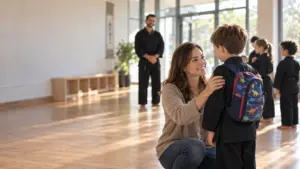
Key Takeaways
- Separation anxiety is a child’s fear or distress about being away from a parent or caregiver, and it commonly appears in babies, toddlers, and young children during transitions like starting preschool, changing schools, or beginning a new activity.
- The most effective approach combines a short, predictable goodbye routine with honest preparation beforehand: tell your child when you’ll return using an event they understand, say goodbye clearly, and leave without sneaking out.
- According to the CDC, fears and worries are typical in children, but persistent or extreme fear that interferes with school, home, or play may indicate an anxiety disorder and should be discussed with a pediatrician or mental health professional.
- Structured activities with predictable routines, such as age-grouped martial arts classes, may help some children practice independence and build confidence, but they are not a treatment for separation anxiety.
What Is Separation Anxiety in Children?
Separation anxiety is the distress a child feels when they’re away from a parent or primary caregiver. It shows up at school drop-off, at daycare, with a babysitter, at a grandparent’s house, or on the first day of a new activity. Some kids cry. Others go quiet, cling, complain of a stomachache, or refuse to get out of the car. The CDC notes that toddlers often become very distressed about being away from their parents even when they’re safe and well cared for, which is worth remembering on the mornings you feel like you’ve done something wrong. You usually haven’t.
Is Separation Anxiety Normal at Certain Ages?
Yes, distress at separation is common during early childhood. What matters isn’t whether your child feels afraid but how intense that fear is, how long it lasts, and whether it’s interfering with normal life.
Separation Anxiety in Toddlers and Preschoolers
Toddlers live in the moment, so a parent leaving the room can feel permanent. Preschool drop-offs often improve within a few weeks once the routine becomes familiar and the child learns that you always come back.
Kindergarten and School Drop-Off Anxiety
Older kids understand distance, and that’s precisely the problem. A child who happily attended a nearby preschool may struggle at a school across town. Setting up mornings well ahead of time helps, and these prepare for a calmer school day strategies give you a starting framework.
Anxiety When Starting a New Activity
New room, new adults, new expectations. Many children who do fine at school still fall apart at the door of a first sports practice or class, simply because nothing about it is familiar yet.
What Can Trigger Separation Anxiety?
Common triggers include starting preschool or kindergarten, switching schools, moving to a new house, a new sibling, a family illness or loss, a disrupted schedule, an unfamiliar caregiver, or beginning a new class. Sometimes there’s no identifiable trigger at all. A trigger explains a reaction; it doesn’t diagnose anything.
When Does Separation Anxiety Become a Concern?
The CDC draws a clear line here. When a child doesn’t outgrow typical fears, or when those fears become so many and so strong that they interfere with school, home, or play, it may point to an anxiety disorder rather than a phase. That’s a conversation for your child’s pediatrician or a qualified mental health professional, not something to sort out alone on a Tuesday morning.
School Refusal or Repeated Absences
Ongoing refusal to attend, or a pattern of missed days tied to anxiety, deserves professional input and coordination with the school.
Headaches, Stomachaches, Sleep Problems, or Panic
The CDC lists trouble sleeping, fatigue, headaches, and stomachaches among anxiety symptoms in children. Recurring or severe physical symptoms should be evaluated medically.
Fear That Disrupts Home, School, or Play
If worry is shrinking your child’s world, that’s the signal. A child who won’t sleep alone, won’t attend birthday parties, or can’t be in a different room from you is telling you something.
How Can Parents Ease Separation Anxiety?
Most families see real improvement through consistency rather than any single clever trick. The pattern below works because it’s repeatable, and repetition is what builds a child’s trust in the process. Expect progress to be uneven. A great week followed by a rough Monday is normal, not a failure. Here’s the sequence:
- Identify what changed or what your child is afraid of.
- Acknowledge the feeling before you try to fix it.
- Practice the separation in small, low-stakes doses.
- Use a short, predictable goodbye.
- Tell your child exactly when you’ll be back, then be there.
- Repeat it the same way, day after day.
1. Identify the Source of the Fear
Ask open questions away from the stressful moment. “What’s the hardest part of the morning?” works better than “Why are you crying?” Some children can name a specific worry, like a loud classroom or a friend who moved away. Others genuinely can’t, and pressing them only adds pressure.
2. Validate Feelings Without Reinforcing Avoidance
There’s a real difference between “You’re fine, stop crying” and “I can see this feels hard. We’re still going.” The first dismisses the feeling; the second accepts it while holding the plan steady. Naming emotions out loud helps kids settle enough to think clearly, and our guide on how to help kids handle big feelings breaks down the exact language to use.
3. Practice the Separation Beforehand
Rehearse it. Walk the route, visit the classroom, meet the instructor, or leave your child with a trusted relative for twenty minutes. Story-style previews help too: “I’ll hang up your coat, give you a hug, then Miss Jen will take you to the mat.” Familiarity does a lot of quiet work.
4. Create a Short, Predictable Goodbye Routine
Same words, same order, every time. Arrive, settle their things, one hug, one phrase, then go.
What Parents Should Say at Drop-Off
Keep it brief and warm. “I love you, I’ll be back after class, have fun.” Then leave. Long explanations invite negotiation.
Why Prolonged Goodbyes Can Make the Transition Harder
Every extra minute signals that leaving is negotiable. Children often settle within minutes of a parent’s exit, but not while the exit is still pending.
5. Explain Exactly When You Will Return
Young children don’t track clock time. “After snack” or “right when class finishes” means something to them; “at 4:15” doesn’t. Then follow through precisely, even early if you can.
6. Coordinate With Teachers, Caregivers, and Instructors
Tell the adults what’s happening. Ask how they’d like to handle the handoff, and use the same phrases they use. Good teachers and coaches have seen this hundreds of times and usually have a system.
7. Reinforce Brave Behavior and Small Progress
Praise the specific thing: “You walked in by yourself today.” Skip the big rewards for distress, which can accidentally teach the wrong lesson. Steady wins compound, and there are plenty of small daily ways to build your child’s confidence outside of drop-off moments.
What Should Parents Avoid During Difficult Goodbyes?
Some instincts backfire. Sneaking out while your child is distracted feels merciful in the moment and costs you trust for weeks afterward. Shaming, bargaining, promising things you can’t deliver, or coming back in “just once more” all extend the hard part. Minimizing the fear doesn’t remove it either. Here’s the short version:
- Avoid sneaking away. Instead, say a clear goodbye every time.
- Avoid “big kids don’t cry.” Instead, name the feeling and keep going.
- Avoid bargaining at the door. Instead, settle terms at home.
- Avoid returning after you’ve left. Instead, trust the handoff.
Should You Let a Child Stay Home Because of Separation Anxiety?
Repeated avoidance tends to keep fear alive rather than settle it. That said, don’t make this call in isolation. Talk to the school, and get professional guidance when distress is severe or persistent, or when something else may be going on such as bullying, illness, or a learning difficulty.
Should You Force a Crying Child Into an Activity?
Calm consistency is not the same as physically or emotionally forcing a child. Stay steady, keep the routine, and let the trained adult take over. If the reaction is extreme or escalating, stop and reassess with your pediatrician rather than pushing through.
How Can Structured Activities Build Confidence and Independence?
Kids get braver by doing slightly hard things repeatedly in a safe place. A well-run class offers exactly that: a known routine, a familiar adult, a peer group, and challenges sized to the child. None of that treats an anxiety disorder, and it shouldn’t be sold as though it does. What it can do is give a child regular, manageable practice at being capable without a parent in arm’s reach.
Why Routine and Repetition Can Help Children Feel Secure
Same bow-in, same warm-up, same closing. Predictability lowers the guesswork, and a child who knows what happens next has less to brace against. That repeated practice is also how kids build healthy coping skills they carry into school and friendships.
How Physical Activity May Support Emotional Well-Being
The CDC includes regular physical activity, including aerobic and vigorous exercise, among the healthy behaviors that may help children manage mental health symptoms alongside proper care. It’s listed as support, not treatment. For a diagnosed anxiety disorder, the agency points to behavior therapy and cognitive behavioral therapy as the evidence-based approaches.
Why Every Child Adjusts at a Different Pace
Temperament, age, and past experience all shape how fast a child settles in. One kid is fine by week two; another takes a season. That’s ordinary, and it’s why every child progresses differently through a program.
How Inspire Martial Arts Supports Young Students in North Royalton
Our classes run on a consistent structure, with instructors who spend their days working with young kids and know what a nervous first-timer looks like. We don’t treat anxiety, and we won’t pretend otherwise. What we offer is a familiar room, a clear routine, and adults who’ll take the handoff at the door so you’re not standing there for fifteen minutes.
Age-Appropriate Children’s Programs and Predictable Class Routines
We group students by age, with Inspired Kids classes for ages 4–6 and 7–12, so your child trains alongside peers at a similar stage. Ask us about class format, how we handle first-day nerves, and where parents can watch from.
Support From Master Chris and the Instructor Team
Families here often mention that the instructors take time to learn each child individually. One local parent, Joanne Asmis Sitaras, wrote that “Master Chris and the entire team are wonderful to work with. They really took the time to get to know our little guy. His concentration and focus have really improved over the last few months and his behavior at school has improved as well.” Every child’s experience differs, but that individual attention is what we aim for.
Helping Children Find a Place Where They Feel Comfortable
Finding the right fit matters more than finding the nearest option. Sarah Lenny, whose son started with us at five, described it this way: “It’s always hard finding the right place that your child fits in to. We have had nothing but amazing experiences here, and my son (5 yrs) loves it! We started in the fall, and he looks forward to every class.”
Confidence and Self-Discipline Outcomes Reported by Parents
Parents notice changes at home before they notice them on the mat. Tony Virovec put it plainly: “The staff does an excellent job of working with my son. My sons confidence and self discipline have sky rocketed through the roof.” That’s one family’s experience, not a guaranteed outcome.
What Parents Should Ask Before Choosing a Class
- How much experience do instructors have with this age group?
- Can parents watch, and from where?
- What’s the class size and student-to-instructor ratio?
- Is there a trial class?
- How is the drop-off handoff handled?
- What happens if my child becomes upset mid-class?
- How will you communicate with me about progress?
Want to see whether the room feels right for your child? Come watch a class at our North Royalton location before you commit to anything.
When Should Parents Seek Professional Help?
This article is general education, not medical advice, and martial arts classes are not a substitute for evaluation or treatment by a pediatrician or licensed mental health professional. The CDC is direct about the threshold: when fears and worries persist, become extreme, or interfere with school, home, or play, it’s time for an evaluation. Early help makes a real difference in how children function at home, in school, and in friendships.
Which Warning Signs Require an Evaluation?
Persistent school refusal, severe or repeated physical symptoms, ongoing sleep disruption, panic-like reactions, extreme fear of being alone, or anxiety that’s shrinking your child’s daily life.
Who Can Parents Contact First?
Start with your child’s pediatrician or primary care provider. School counselors and psychologists can help too, and your provider can refer you to a licensed child mental health specialist if an evaluation is warranted.
Take the Next Step With an Age-Appropriate Class in North Royalton
Separation anxiety usually loosens its grip through repetition, not persuasion. Prepare your child ahead of time, keep goodbyes short and honest, come back exactly when you said you would, and do it the same way tomorrow. Watch for the signs that call for a professional, and don’t wait on those. Everything else is practice, and practice is something kids are good at.
If you’d like your child to get that practice in a structured, age-grouped class, call Inspire Martial Arts at 440-877-9112 or stop by 10139 Royalton Rd Suite B, North Royalton, OH 44133 to see the current trial and class schedule. Tell us about your child’s drop-off worries when you book, and we’ll plan the first class around them.
FAQ Section
How long does separation anxiety last in children?
There’s no fixed timeline. Duration depends on your child’s age, temperament, what triggered the anxiety, and how consistently the new routine is maintained. Many children settle into a new school or activity within a few weeks, while others need a full season. Persistent or worsening distress warrants a conversation with your pediatrician.
What is the best goodbye routine for separation anxiety?
Keep it short, warm, and identical every time. Settle your child’s belongings, give one hug, say a brief phrase that includes when you’ll return, and leave. Use an event marker like “after snack” instead of a clock time for younger children, and be back exactly when you promised.
Is it better to sneak away or say goodbye?
Always say goodbye. Sneaking out while your child is distracted may avoid tears in the moment, but it teaches them you might vanish at any second, which usually makes future separations worse. A clear, quick goodbye protects your child’s trust in you.
Can separation anxiety cause stomachaches or headaches?
Yes. The CDC lists headaches, stomachaches, fatigue, and trouble sleeping among the physical symptoms children with anxiety may experience. If the symptoms are severe, recurring, or unexplained, have your child evaluated by a healthcare provider to rule out other causes.
Can martial arts help a child with separation anxiety?
A structured, supportive class may help some children practice independence, routine, and confidence away from a parent. It is not a diagnosis, treatment, or replacement for professional care. If your child has a diagnosed anxiety disorder, the CDC points to behavior therapy and cognitive behavioral therapy as evidence-based approaches.
What age can my child start martial arts in North Royalton?
Inspire Martial Arts offers Inspired Kids classes for ages 4–6 and 7–12, plus teen and adult programs. Age grouping matters for anxious children because the pace, language, and expectations are matched to their developmental stage. Call 440-877-9112 to ask which class fits your child.
Should I tell my child’s instructor about their anxiety?
Absolutely, and before the first class if possible. Instructors who know what to expect can plan the handoff, assign a buddy, or adjust how they approach your child in the first few minutes. Consistent language between you and the instructor makes drop-off noticeably smoother.