


This article was last updated on October 21, 2026
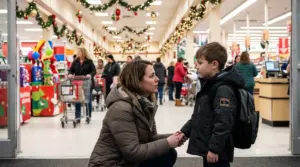
Table of Contents
- Why a holiday family safety plan matters in busy stores
- Practical strategies for avoiding crowd separation
- How martial arts builds focus and awareness in distracting environments
- Replacing “stranger danger” with smart alternatives
- Next steps: Equipping your child with lifelong safety skills
- Holiday shopping safety FAQs
Your seven-year-old was at the cart a second ago. Now there is a tower of snowman displays, a line of people at the register, and an empty spot where he was standing. Every parent in North Royalton knows that jolt, and a little preparation takes most of the sting out of it.
Key Takeaways
- Safe holiday shopping starts at home. Pick a few family rules, rehearse them for two minutes, and repeat them in the parking lot before you walk in.
- The check-first rule means a child asks a parent before leaving their side or approaching an unfamiliar adult.
- A child who gets separated should stop, find a store employee or cashier, and give their parent’s name and phone number. Searching the aisles alone makes a reunion harder.
- Martial arts training builds listening and focus that parents can reinforce at home, but close supervision is still the main protection in a crowded store.
To keep kids safe while holiday shopping, plan before you leave the house, keep young children within arm’s reach, teach a check-first rule, show them which adults to ask for help, and practice what to do if you lose each other. Families here run the same errands every November and December, from North Royalton to Strongsville and Parma, so the plan only has to be built once.
Why a holiday family safety plan matters in busy stores
A holiday store is designed to grab a child’s attention. Lights blink, music plays over the speakers, and the toy display sits exactly at kid height. Young children follow whatever looks most interesting, and that is rarely the adult pushing the cart. If you decide the rules at home, nobody has to improvise at the loudest moment of the trip. Keep the instructions short and match them to your child’s age: a four-year-old needs a hand to hold, while a ten-year-old can handle a meeting spot.
Here is a five-point checklist you can screenshot:
- Go over the family rules before you leave home.
- Repeat them in the parking lot, before you walk in.
- Keep young children within arm’s reach and older children in sight.
- Agree on who to ask for help: a cashier, the customer-service desk, or security.
- Review what to do if you lose each other.
Navigating the sensory overload of crowded malls
Noise, bright decorations, long lines, and a pile of unfamiliar faces wear kids down fast. A child who is overwhelmed does not listen well, and a child who does not listen is the one who drifts toward the next display. Give one or two simple instructions at the door (“stay next to the cart, ask me before you go anywhere”), then build in a short break if your child starts to melt down. Reassure a struggling child instead of scolding, because a scolded child hides the problem next time. Our guide on how to help kids handle big feelings goes deeper on calming down in the moment.
Some children need more than the standard plan. If your child has sensory sensitivities, a developmental difference, or a habit of bolting, plan for closer supervision, and have them carry identification such as a wristband or a card with your phone number.
Practical strategies for avoiding crowd separation
Most separations happen in seconds, usually at a moment when a parent is looking at a shelf, a screen, or a price tag. The American Academy of Pediatrics tells parents to keep their eyes on young children at all times in a crowd, and to keep physical contact with any child who tends to wander. Everything else in this section builds on that. A good plan covers the whole trip, from the driveway to the checkout lane.
- Before leaving home: explain the family rules.
- Before entering: agree to stay together and check first.
- During shopping: keep close supervision and regular eye contact.
- At checkout: keep children beside the adult who is responsible for them.
- If separated: follow the plan you practiced.
Age changes how this looks. Toddlers and preschoolers need a hand, a stroller, or a cart seat. Kids in early grade school can walk beside you but should never be out of your line of sight. Older children can earn more freedom in small steps, like walking to the next shelf in the same aisle. If you want a calm way to talk about all of this, we wrote about how to teach your child safety without fear.
Setting a “check first” rule before you leave the car
The check-first rule is a family agreement that a child asks a parent or guardian before leaving their side, approaching an unfamiliar adult, following anyone, or walking to another part of the store. Younger children still need an adult within reach, however well they know the rule.
To practice, stand in your kitchen and let your child point at something across the room. They say, “Can I go look at that?” and you answer yes or no. Three or four rounds takes about two minutes. Repeat the phrase in the parking lot so it is fresh when the doors slide open.
What should children do if they get lost in a store?
A child who is lost should stop, stay put, and ask a store employee for help. Searching a big building alone is how a short separation becomes a long one. Teach this routine:
- Stop moving instead of wandering to look for you.
- Find an employee near a register or service desk, someone in a uniform or name tag.
- Say, “I’m lost. I can’t find my mom (or dad).”
- Give your name and your phone number, or hand over an emergency contact card.
- Stay with that employee until you are reunited.
Parents have their own steps. Tell store staff right away, give them a description of your child and what they are wearing, and ask them to alert security and watch the doors. The AAP recommends keeping a recent photo and your child’s height and weight on a card or in a file, and a photo on your phone makes this step faster. If your child is not found quickly, call the police. Do not wait for someone else to make that call.
How martial arts builds focus and awareness in distracting environments
A martial arts class asks a child to do things that also help in a loud store: wait for an instruction, listen to all of it, and act when it is time. Researchers led by Anna Harwood-Gross published a study on martial arts training in at-risk youths in Frontiers in Pediatrics in 2021. Adolescent boys in specialized schools trained twice a week for six months and showed significant gains in inhibition, cognitive shifting, and processing speed. Those are the mental skills behind paying attention and stopping on cue. The study did not test shopping trips and did not involve young children, so the useful takeaway for a parent is the habit, not a promise. Class gives your child a weekly place to practice listening and self-control, and you can keep the habit going by asking them to repeat the plan before you walk into any store.
Developing real-world situational awareness
Situational awareness for a child means knowing where they are and who can help. It does not mean suspecting everyone. Build it with small games. At the entrance, ask a six-year-old to point out the customer-service desk and the nearest exit. Ask a ten-year-old what the store employees are wearing. At the checkout line, have your child tell you where the meeting spot is.
Parents at Inspire describe changes that follow their kids out of the dojo. One parent wrote, “Master Chris and the entire team are wonderful to work with. They really took the time to get to know our little guy. His concentration and focus have really improved over the last few months and his behavior at school has improved as well. Definetly worth the investment.” That is one family’s experience, and concentration is exactly what a child needs when the checkout line gets long.
Boosting confidence to speak up if separated
A child who freezes in front of an adult in a uniform will not ask for help. Speaking up is a skill, and it improves with repetition. Practice a short script: first name, parent’s name, phone number, and the sentence “I can’t find my mom, can you help me?” Say it at normal volume while looking at the adult.
One parent of a 15-year-old described the effect after a month of classes: “My 15-year-old daughter has been attending martial arts classes for approximately 1 month at Inspire, and we couldn’t be more satisfied. I am already noticing a boost in her confidence. She genuinely looks forward to going to class 2 times/week… We feel satisfied that this program will make our daughter more confident and give her the skills to defend herself if necessary.”
The confidence we mean here is the voice to say “I need help” to the right person. It has nothing to do with confronting anyone. If you want to see how Inspire teaches kids to handle it with confidence, the Bullyproof program is a good place to start.
If your child could use a weekly place to practice listening, focus, and speaking up, Inspire Martial Arts in North Royalton runs kids martial arts classes you can look at before the holiday rush.
Replacing “stranger danger” with smart alternatives
Telling kids to fear every stranger sets them up badly. Most adults in a store are harmless, and a child taught otherwise may hide from the very cashier who could help. A better rule is to teach who to go to: employees in uniform or name tags, the customer-service desk, security. If no staff member is in sight, a parent with children is a backup, though never a guarantee. The AAP also advises teaching kids never to go along with someone they do not know, even if the person asks for help finding a lost puppy, and to tell you about any approach, even if someone said they would hurt them for telling. Behavior that feels wrong is a warning whether the adult is a stranger or someone familiar. And no child should follow anyone to another location, even to look for you.
Creating a family emergency password
A family password gives your child one more way to check whether a message or a pickup really came from you. Here is how to set one up:
- Choose a short phrase your child will remember, like a silly pair of words.
- Tell your child when it applies: if someone says you sent them, they must know the password.
- Keep it private. Do not say it in public or write it on a backpack.
- Treat it as a backup. A child never leaves with an unfamiliar person because they know the password, and any change in pickup plans goes through you.
Letting kids own part of the plan makes them more likely to follow it. Our post on how to raise self-driven and self-motivated kids explains how to hand over responsibility one small step at a time.
Practicing your family safety plan before holiday shopping
Two minutes of role-play in the living room works better than a long lecture in the car. Keep it calm and brief, and skip any scary scenarios. Run through these three:
- Your child wants to look at a display in another aisle. They stop and ask first.
- Your child cannot see you. They stop, look for an employee, and say what they practiced.
- Your child needs help from an adult. They walk up, make eye contact, and ask.
Swap roles so your child plays the parent, which helps them remember the steps.
Next steps: Equipping your child with lifelong safety skills
The CDC’s adverse childhood experiences prevention strategy calls safe, stable, nurturing relationships essential to children’s health and wellbeing. A holiday safety plan is one small way to build that kind of predictability in your own family: the child knows what the rules are, and knows a trusted adult will help. The habits of listening, pausing, asking, and speaking up carry past December into school, sports, and the walk home.
Ready to see how Inspire Martial Arts in North Royalton builds those habits in kids? Contact us about a trial class and bring your child to meet Master Chris and the team.
Holiday shopping safety FAQs
What should my child carry in case we get separated?
A small card with your name and cell number, tucked in a pocket or inside a jacket, is enough. Keep it out of sight rather than on the outside of clothing, because a visible name lets strangers address your child as if they know them. A recent photo of your child on your phone helps store staff and police act faster.
How do I keep a toddler from running off in a crowded store?
Use a stroller, cart seat, or harness whenever possible, and hold their hand the rest of the time. Toddlers cannot follow a check-first rule reliably, so your supervision does the work. Choose the cart over a free-roaming trip.
How do I shop with several kids of different ages?
Give each older child a younger buddy to stay beside. Count heads every time you pass through a doorway, turn a corner, or reach the checkout. One adult watches the youngest and another watches the group when you shop with a partner.
How can I help a child who gets anxious in crowded stores?
Go when it is quiet: weekday mornings and early evenings are usually calmer than weekend afternoons. Keep trips short, and bring headphones or a comfort item if noise is the problem. Tell your child in advance how long you will be and what the plan is.
What should my child do if they get lost in the parking lot?
Teach them to stay where they are and call for you. Moving cars make a parking lot more dangerous than the store aisles. A child who cannot find you should ask an adult in a uniform or a parent with children, and to avoid getting into any vehicle. Hold hands from the car to the door to keep it from happening at all.
Should a safety plan change for teenagers?
Yes. Teens can split off for a store but should agree on a meeting spot, a time, and a check-in text. Sharing locations between family phones is a reasonable agreement, as long as your teen knows who can see it and keeps it off public apps