


This article was last updated on September 07, 2026
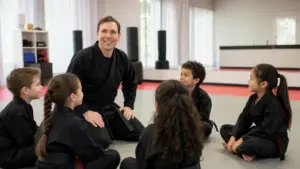
You asked once. Then twice. By the fourth round of that high, stretched-out voice coming from the back seat, your patience is gone and you hear yourself snapping the exact thing you swore you’d never say. Every parent in North Royalton has had that drive home.
Key Takeaways
- When your child whines, pause before you correct, check whether something basic is off (hunger, tiredness, overwhelm), then calmly model the words you want to hear and hold your original boundary.
- Whining is usually a communication gap, not manipulation most young children reach for a whiny tone when they don’t yet have the words or the regulation skills to express disappointment.
- Telling a child to “stop whining” rarely works because it names what to stop without teaching what to do instead; giving them a specific replacement phrase works better.
- Structured activities like kids martial arts give children repeated practice at listening, waiting, and controlling their bodies, though no class replaces the coaching that happens at home.
What Should You Do When Your Child Starts Whining?
The short version: pause, check for an unmet need, stay calm, model the words you want, and keep the boundary you already set. That order matters. Most of us skip straight to correcting, which pours fuel on a moment that was already burning. Picture a Tuesday evening your daughter wants a snack twenty minutes before dinner and her voice climbs into that register. You take one breath, notice she’s been at daycare since seven, and say evenly, “Try that again in your regular voice.” She does. You still say no to the snack, but you thank her for asking well. Some nights this lands beautifully. Some nights it doesn’t, and that’s normal too.
Pause Before Correcting the Behavior
Your tone sets the ceiling for the whole exchange. Kids read volume and body language faster than words, so a sharp “stop whining” tends to escalate rather than settle. One dad described catching himself mid-loop: he’d said “stop whining” three times in five minutes, each one louder, and his son had only gotten shriller. He stopped talking, waited four seconds, then dropped his voice. That pause is the actual technique.
Check for Hunger, Fatigue, Overwhelm, or Discomfort
Before you treat whining as a behavior problem, run a quick check. Is it late afternoon? Did lunch happen? Is the room loud, bright, or crowded? Whining spikes when a child’s tank is empty, and naming the real cause often shortens the episode. This isn’t an excuse for rudeness or unsafe behavior you can address the need and still expect a respectful voice. Assuming every whine is deliberate manipulation, though, usually leads parents down the wrong path.
Model the Words You Want Your Child to Use
Show, don’t lecture. Say the sentence the way you want to hear it: “Mom, can I please have the tablet?” Then invite the retry. Keep it warm and matter-of-fact. Mimicking your child’s whiny voice back at them may feel satisfying, but it teaches shame instead of skill, and shame doesn’t build language. Modeling gives them a script they can actually reuse tomorrow.
Reinforce the Appropriate Communication
When the calm version arrives, acknowledge it right away “That was a great way to ask.” Notice what that sentence does not say. It doesn’t promise the tablet. Acknowledging good communication while keeping your original answer teaches a child that respectful asking is worth doing even when the answer is no. Cave once and you’ve taught the opposite lesson.
Why Do Children Whine and Have Temper Tantrums?
Whining, frustration, overwhelm, and full tantrums aren’t the same thing, though they often show up in sequence. Whining is a communication strategy. Frustration is the feeling underneath it. Overwhelm is what happens when a child’s system takes on more than it can process. A tantrum is what spills out when regulation collapses entirely. Young children rely on a calm adult to help them settle first the borrowed steadiness that makes their own settling possible. Learning to spot which one you’re dealing with changes how you respond, and these practical ways to help kids handle frustration give you a starting point for the harder end of that spectrum.
The Connection Between Big Feelings and Whining
A whiny tone is often the sound of a feeling with nowhere to go. Disappointment, tiredness, fear, jealousy of a sibling kids feel all of it at full volume long before they can name any of it. The tone is the placeholder for vocabulary they don’t have yet. Building that vocabulary takes ordinary repetition, and it helps to talk about big feelings with kids during calm moments rather than mid-storm.
When Whining Becomes a Tantrum
A repeated request is a negotiation. A tantrum is a nervous system that has run out of road. The signs differ: whining keeps eye contact and adjusts to your responses, while a tantrum often loses both. Once you’re in tantrum territory, safety and calm presence matter more than teaching. Move dangerous objects, lower the stimulation, stay close, and wait. Save the conversation for later, and skip the urge to diagnose your child in the moment.
Why “Just Stop Whining” Often Fails
The phrase names the exit but not the door. A four-year-old hearing “stop whining” knows something is wrong and has no idea what to do differently. Replace it with a specific instruction: “Ask me in your regular voice,” or “Take a breath and try again,” or “Wait until I finish this, then ask.” Concrete beats corrective every time.
How Can Parents Build Child Self-Control at Home?
Self-control grows out of small, boring repetitions routines that don’t change, expectations stated once and held, and praise aimed at effort rather than outcomes. Kids learn it the way they learn free throws. Lectures don’t move the needle much; practice does. The goal isn’t a child who never whines but one who recovers faster and reaches for better words sooner. Parents who shift from managing behavior to teaching skills usually encourage better behavior naturally over a few months.
Teach One Replacement Behavior at a Time
Pick a single swap and work it until it sticks. “I want it now” becomes “Can I please have it?” That’s the whole project for two weeks. Your child will forget constantly, and you’ll prompt constantly, and that’s what learning looks like. Stacking five new expectations at once guarantees none of them land.
Practice Calm-Down Tools Before a Meltdown
A tool your child has never used calmly is useless mid-meltdown. Practice belly breathing on the couch after dinner. Try counting, stretching, drawing, or a designated calm corner while everyone is regulated and cheerful. Then, when the hard moment arrives, you’re reminding rather than teaching. If you want a deeper menu of options, these effective calm-down strategies cover far more ground than any single technique.
Use Clear and Consistent Boundaries
Validate the feeling, hold the line. “You’re really disappointed we’re leaving the park. We’re still leaving.” Both halves matter. Threats, sarcasm, and public shaming get compliance today and cost you trust tomorrow. Bribes work until the price goes up. Consistency does the slow work that neither shortcut can.
Can Structured Martial Arts Support Focus and Self-Control?
A weekly class isn’t a fix for whining, and any program that promises one deserves suspicion. What structured martial arts offers is reps dozens of small chances per class to listen, wait a turn, control a body that wants to move, try again after a correction, and respond respectfully to an instructor. Those are the same muscles a child uses at your kitchen table. Repetition in a setting kids enjoy tends to stick better than repetition in a setting they resent.
What Executive Function Means for Children
Executive function is the bundle of mental skills that lets a child hold instructions in mind, pay attention, plan a few steps ahead, switch tasks without falling apart, and put the brakes on an impulse. In practice, it’s the difference between a kid who hears “shoes, coat, backpack” and does all three, and a kid who is still holding one sock. These skills develop slowly through childhood and respond to practice.
What the Research Does and Does Not Show
Researchers Giulia Giordano, Manuel Gómez-López, and Marianna Alesi, working through the University of Palermo and the University of Murcia, compared 102 Italian children across three groups: martial arts practitioners, team sport athletes, and sedentary kids. Their 2021 paper found the martial arts group performed better on executive function measures and earned higher school marks than the comparison groups in that sample. Read that carefully. It’s an association within one group of children, not proof that martial arts causes the difference, and it says nothing at all about whining or tantrums.
A separate line of research looks at how an activity is structured rather than what it’s called. A 2026 review in Frontiers in Psychiatry pooled 21 randomized trials covering 915 children with ADHD and found that “open” activities the unpredictable, react-to-what’s-happening kind produced the strongest gains in inhibitory control, the skill behind pausing before you act. Programs running at least six weeks at moderate-to-vigorous intensity did best. Two honest caveats: those children all had an ADHD diagnosis, and the review didn’t test martial arts as its own category. What it does suggest is that the reactive quality of an activity may matter more than the label on the door.
Neither study tells you your child will stop whining. Together they point at something narrower and more useful: kids who get regular practice at reacting, waiting, and stopping tend to test better on the skills that make those things easier.
How Class Structure May Give Children Practice
The mechanism parents care about is mundane: predictable openings, clear commands, waiting in line, bowing, resetting after a mistake. (Copywriter note: confirm a specific Inspire class routine with Master Chris before publishing; the example below is illustrative until verified.) A child who struggles to sit still through homework may discover they can hold focus for a full class, and that discovery tends to travel home with them.
What Do North Royalton Parents Report About Inspire Martial Arts?
The most useful signal for a local family isn’t a research abstract it’s what other parents in the neighborhood actually noticed. These are individual experiences, not guaranteed outcomes, and they describe focus and behavior rather than an end to whining. Read them as one data point among several when you’re weighing a program.
Reported Improvements in Focus and School Behavior
Some parents point to changes teachers noticed first. In a Facebook recommendation displayed on Inspire’s website, local parent Joanne Asmis Sitaras wrote: “Master Chris and the entire team are wonderful to work with. They really took the time to get to know our little guy. His concentration and focus have really improved over the last few months and his behavior at school has improved as well.” That’s one family’s report on concentration and classroom behavior nothing more, and it’s worth exactly that.
Reported Improvements in Listening and Daily Tasks
Other families describe changes closer to home. In a Google review shown on the site, Yana Sichkar wrote: “Since my daughter started attending martial arts, she became more focused and determined in performing her daily tasks and assignments. Her listening skills, overall behavior and character has improved.” Again, that’s a parent’s own observation about listening and daily tasks, not a measured academic result.
What Parents Should Evaluate Before Choosing a Program
Before you sign anything, look at:
- Age grouping and how narrow the bands are
- How instructors communicate with parents after class
- Class structure, size, and supervision ratios
- Safety practices and how corrections are delivered
- Accommodations for shy, anxious, or neurodivergent kids
- The program’s stated teaching philosophy
- Schedule fit with your week and total cost, including gear and testing fees
Next Steps for North Royalton Parents
Whining isn’t a character flaw, and it isn’t a sign you’ve failed. It’s a skill gap that closes through calm modeling, consistent boundaries, and a lot of unglamorous practice. Structure helps at home first, and in the right activity second. Give your own approach two weeks of real consistency before you judge whether it’s working, and remember that no class does the parenting part for you.
Try the At-Home Strategy First
Next time it starts, run the sequence: pause, check the basics, model the phrase, invite the retry, hold your answer. Track what you notice over a week the time of day it hits hardest, how long recovery takes, which replacement phrase your child actually uses. That log will tell you more than any parenting book.
Explore Kids Martial Arts in North Royalton
If your child would benefit from a structured place to practice listening, waiting, and controlling their body alongside other kids, Inspire Martial Arts runs age-grouped programs for ages 4–6 and 7–12 in North Royalton. It’s one option among several local activities, not a treatment.
Request Current Class Information
Take a look at the kids’ martial arts program at Inspire Martial Arts, 10139 Royalton Rd Suite B, North Royalton, OH 44133, or call 440-877-9112 to ask about age placement, current schedule, trial terms, accommodations, and full pricing before you enroll.
FAQ Section
Should I ignore my child’s whining?
Ignoring a drawn-out negotiation is different from ignoring your child. You can decline to re-litigate a decision while still staying present and acknowledging the feeling. Never ignore signs of real distress, pain, fear, or an unmet need those aren’t behavior problems.
At what age do kids usually stop whining?
Whining tends to peak between ages two and five and eases as language and self-regulation develop, though many older kids still fall back on it when tired or stressed. There’s no fixed cutoff. If it’s intensifying rather than fading as your child grows, that’s worth mentioning to your pediatrician.
What if my child is too upset to speak calmly?
Stop teaching and start settling. Lower your voice, reduce demands and noise, stay physically close if your child accepts it, and wait for their system to come down. Problem-solving only works once they can actually participate in it.
Can martial arts help a child who has trouble listening?
Structured classes give children repeated practice at following directions, waiting a turn, and responding to instruction which can strengthen listening as a habit. Results vary by child and by program quality. Consider your child’s temperament and specific needs rather than assuming any class will work.
Is martial arts appropriate for a shy or easily overwhelmed child?
It can be, but the program matters more than the activity. Look for patient instructors, small classes, a manageable noise level, permission to participate gradually, and open communication with caregivers. Watch a class before enrolling.
Will martial arts make my child more aggressive at home?
A reputable children’s program emphasizes restraint, respect, safety, and controlled practice the opposite of aggression. That said, teaching culture varies between schools. Observe how instructors handle roughhousing and corrections before deciding.
When should I seek professional help for frequent tantrums?
Talk to your pediatrician if outbursts are severe, unsafe, unusually frequent for your child’s age, lasting well beyond the typical preschool years, or interfering with school, friendships, and family life. A qualified child-development or mental health professional can assess what’s driving them.