


This article was last updated on May 26, 2026
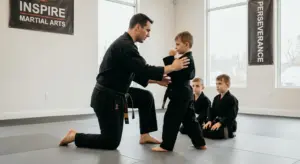
Table of Contents
Every parent has watched their child hit a wall a hard math problem, a missed goal, a skill that just won’t click. What happens next defines far more than that moment. Children who learn to push through failure build a foundation that carries them through school, relationships, and every challenge life throws their way. This article explains why perseverance is the most underrated life skill you can give your child and how martial arts is one of the most proven environments to develop it.
Key Takeaways
- Perseverance not talent is the strongest predictor of long-term success in school and life.
- Martial arts uses a mastery-based belt system that teaches kids to earn rewards through real effort.
- Failing a belt test is a learning tool, not a setback students discover how to try smarter, not just harder.
- Children who develop grit in structured activities like martial arts show better emotional resilience, academic performance, and social skills.
Why Perseverance Matters More Than Ever for Kids Today
We live in an age of instant gratification. Streaming services, same-day delivery, and social media rewards have quietly reshaped what children expect including how fast they should succeed. When things get hard, the natural response has become to switch, quit, or scroll past.
This isn’t a character flaw. It’s a conditioned response and it’s one that parents and educators in Ohio and across the country are actively working to counter.
The “Participation Trophy” Problem
Well-meaning as it is, the cultural shift toward rewarding participation over achievement has had an unintended side effect. Research from the American Psychological Association suggests that when children receive rewards regardless of effort or outcome, it can reduce intrinsic motivation over time. Kids learn that showing up is enough and they miss a deeper, more critical lesson: real growth lives outside the comfort zone.
This doesn’t mean we stop encouraging our kids. It means we need to give them structured experiences where effort actually matters where trying harder, learning from mistakes, and mastering something difficult yields a genuine, earned reward.
What the Real World Actually Rewards
Ask any employer, coach, or teacher in North Royalton what separates the kids who thrive from those who struggle and “perseverance” comes up every time. The ability to face a setback, course-correct, and try again is foundational to career success, healthy relationships, and mental well-being. You can’t shortcut your way to it. But you can practice it.
How Martial Arts Builds True Perseverance in Children
At Inspire Martial Arts in North Royalton, Ohio, perseverance isn’t a lesson plan on a whiteboard. It’s lived on the mat every class, every stripe test, every time a student falls down and gets back up.
Mastery-Based Progression Earning Every Belt
One of the most powerful aspects of martial arts is its belt and stripe system. Unlike school grades or team sports where advancement is often based on age or time, martial arts requires demonstrable mastery. You don’t earn your next belt because it’s been six months. You earn it because you can perform technically, physically, and mentally.
This honest feedback loop is something many children rarely experience elsewhere. Research published in the Journal of Youth Development confirms that skill-based achievement systems build stronger motivation and self-efficacy than time-based ones. When children know exactly what they need to do to advance, they learn to set goals, work deliberately, and measure real progress.
If you’re building this kind of goal-oriented mindset at home alongside their training, Helping Children Set Age-Appropriate Goals and Goal Setting for Kids: How to Unlock Your Child’s Full Potential offer practical frameworks worth exploring.
Learning to “Fail Well” and Try Again
What happens when a student doesn’t pass their belt test? At Inspire, it’s treated as information not a verdict. Instructors help students understand specifically what needs improvement and map out a clear path forward.
This is “failing well” a concept backed by decades of psychology. Carol Dweck’s landmark research at Stanford on growth mindset shows that children who learn to view setbacks as feedback (rather than proof of inadequacy) develop higher resilience, stronger problem-solving skills, and greater academic achievement. Source: Carol Dweck, Mindset: The New Psychology of Success
When kids learn that a stumble is just a step in the process, they stop fearing failure. And a child who isn’t afraid to fail is a child who isn’t afraid to try.
The Intrinsic Reward of Earned Success
There is nothing quite like the moment a child ties on a new belt they worked months to earn. Parents at Inspire describe it as transformative a visible shift in posture, eye contact, and confidence. That’s not an accident.
According to research in Frontiers in Psychology, intrinsic motivation the internal drive fueled by personal accomplishment is far more durable and powerful than external rewards alone. When children discover that their own effort produces real results, that belief becomes a core part of how they see themselves.
The Lifelong Benefits of Perseverance Built on the Mat
The mindset children develop in martial arts doesn’t stay in the dojo. Here’s how it shows up in the rest of their lives:
Academic Performance and Grit
Angela Duckworth’s research on grit the combination of passion and perseverance found it to be a stronger predictor of academic success than IQ. Students who’ve developed stick-to-it-ness in martial arts apply that same tenacity to tough assignments, frustrating subjects, and long-term school projects.
If your child struggles to stay consistent in martial arts or schoolwork Strategies to Motivate Your Child for Consistent Attendance offers approaches that work in both settings.
Emotional Resilience and Mental Health
A child who has practiced bouncing back from a missed belt, a hard sparring session, a technique that took weeks to click is a child who knows they can handle hard things.
The American Psychological Association on Resilience notes that resilience isn’t a trait you either have or don’t it’s built through experience and practice. Martial arts provides that practice in a safe, structured environment with trusted coaches.
For kids who struggle with big emotions when things get hard, Easy Ways to Help Kids Handle Anger and Frustration and 75 Awesome Calm Down Strategies for Kids pair well with martial arts training to give children a full emotional toolkit.
Skill Development Beyond the Dojo
A child who learns to persist through the frustration of mastering a new form doesn’t just get better at martial arts. They get better at learning. That persistence carries into music lessons, new sports, navigating friendships, and any skill that requires patience and repetition.
For a deeper look at developing this kind of whole-child resilience, 9 Ways to Build Perseverance in Kids (That Pays Off in School & Life) and How to Persist and Persevere When All You Want to Do Is Quit are excellent reads alongside this one.
Confidence That Comes From the Inside
When a child earns their achievements, confidence becomes real not a performance. It’s the kind of self-belief that doesn’t crumble when someone says something unkind or a new challenge appears. For a practical guide to building that foundation at home, 25 Things You Can Do Right Now To Build a Child’s Confidence is a great next step.
What North Royalton Parents Are Saying
The best evidence for what perseverance-focused martial arts training does for children comes from the parents watching it happen firsthand.
“My son’s confidence and self-discipline have skyrocketed through the roof. I could not have asked for a better experience for my child.” — Tony Virovec, Inspire Martial Arts Parent
“Most don’t realize that besides the physical part, there are so many mental aspects and life lessons that she has learned. The leadership abilities and confidence she has gained is something she could have never learned at this age. I am beyond thankful.” — Kelly Buzinski, Inspire Martial Arts Parent
“They do a great job teaching respect, perseverance, and confidence. If you’re looking for a great place for you or your children, this is it!” — Becky Slomka Mattes, Inspire Martial Arts Parent
“Master Chris and the entire team are wonderful to work with. His concentration, focus, and behavior at school have really improved over the last few months. Definitely worth the investment.” — Joanne Asmis Sitaras, Inspire Martial Arts Parent
“My son (5 yrs) loves it! We started in the fall, and he looks forward to every class. They learn a lot of life lessons, respect, discipline, as well as self defense. We are so glad we came here!” — Sarah Lenny, Inspire Martial Arts Parent
These aren’t isolated stories. They’re what happens when children are placed in a structured environment that demands real effort and then celebrates real results.
How Inspire Martial Arts Supports Every Child’s Journey
At Inspire Martial Arts in North Royalton, Ohio, every class is built around one core belief: children grow when they’re challenged with the right support. Master Chris and the team don’t just teach kicks and blocks. They teach children how to face something hard, stay with it, and come out the other side stronger.
Whether your child is 4 or 14, naturally confident or still finding their footing, there’s a clearly structured path here for them. Programs are designed by age and ability so children are always challenged at the right level not overwhelmed, and never bored.
If you want a broader look at what makes martial arts such a uniquely powerful environment for child development, Martial Arts for Kids: Building Confidence, Character, and Resilience and 6 Amazing Benefits of Martial Arts for Children are worth your time. For families just getting started, What to Expect From Your New Ninja: A Parent’s Guide to Martial Arts Progress is a reassuring read before day one.
The mat is where perseverance becomes a habit. And habits become character.
Conclusion
“If at first you don’t succeed, try, try again” isn’t just a saying. It’s a skill one that has to be practiced, coached, and reinforced. In a world that often rewards showing up over stepping up, martial arts stands apart: a structured, honest, and deeply supportive environment where children discover what they’re truly capable of.
At Inspire Martial Arts, your child won’t just learn to kick and punch. They’ll learn to get back up. And that lesson? It lasts a lifetime.
Ready to help your child build the perseverance that changes everything? Contact Inspire Martial Arts in North Royalton, Ohio today to schedule your first class and let them discover what they’re made of.
Frequently Asked Questions
1. What age is best to start teaching perseverance through martial arts? Martial arts programs at Inspire start as young as age 4. Early childhood is an ideal time to introduce structured challenge young children are highly receptive to learning persistence when it’s framed as fun, achievable, and celebrated by encouraging adults. That said, it’s never too late; older kids and teens benefit enormously from the goal-setting structure martial arts provides.
2. What if my child wants to quit when things get hard? This is one of the most common concerns parents bring to Inspire and one of the things martial arts is specifically designed to address. Instructors are trained to recognize when a child is frustrated versus genuinely overwhelmed. Rather than pushing through blindly, they help students reframe the challenge, break it into smaller steps, and reconnect with why they started. Learning not to quit when things get hard is literally the curriculum.
3. How does the belt system specifically teach perseverance? The belt and stripe system makes progress visible and ties advancement to demonstrated skill not time served. When a child earns a belt, they know exactly what effort got them there. That honest relationship between hard work and real reward is what builds genuine perseverance and lasting self-trust.
4. Can martial arts help children who struggle with frustration and emotional regulation? Yes and there’s growing evidence to support it. The combination of physical movement, structured focus, and breathing techniques in martial arts has been shown to support emotional regulation. Children who struggle with big emotions often find that having a productive physical outlet, clear expectations, and supportive coaches makes a meaningful difference relatively quickly.
5. Does martial arts only build perseverance, or are there other benefits? Perseverance is one benefit among many. Students at Inspire also develop confidence, respect, focus, anti-bullying awareness, physical fitness, and social-emotional skills. Many parents report improvements in school behavior, attention, and peer relationships within the first few months of consistent training.
6. What happens if my child fails a belt test at Inspire Martial Arts? A belt test that isn’t passed is treated as feedback, not failure. Instructors sit down with students to explain exactly what needs more work and build a clear, actionable path to the next test. This approach teaches children one of life’s most valuable lessons: a setback is a setup for a comeback.
7. How do I get started at Inspire Martial Arts in North Royalton, Ohio? Getting started is simple. Visit northroyaltonmartialarts.com or call 440-877-9112 to schedule a trial class. The team will match your child with the right program for their age and experience level and you can watch what perseverance-focused training looks like from day one.