


This article was last updated on May 07, 2026
- The Comparison Trap Every Parent Falls Into
- How Inspire Martial Arts Sees Every Child Differently
- Age-Appropriate Classes: Why One Size Never Fits All
- Even Within the Same Class, Every Child Shines Differently
- Healthy Competition vs. Harmful Comparison
- How Our Instructors Nurture Every Individual Child
- Celebrating Your Child’s Unique Journey at Inspire Martial Arts
- FAQs: Not All Ninjas Are The Same
We get it. As moms and dads, you lie awake hoping you’re doing right by your kids. You want them to grow up confident, kind, and capable ready to find their place in the world. But somewhere between the report cards, the team tryouts, and the neighbor’s kid who seems to master everything overnight, that love gets tangled up in comparison. And comparison, as it turns out, is one of the quietest ways we accidentally hold our children back.
At Inspire Martial Arts in North Royalton, Ohio, we’ve spent years watching children grow on the mat and the single most powerful thing we’ve learned is this: not all ninjas are the same. And that’s exactly the point.
🥋 Key Takeaways
- Every child develops physically, mentally, and emotionally at their own pace and that’s completely normal.
- Inspire Martial Arts uses age-specific, individualized curriculum so every child is challenged at just the right level.
- Comparing your child to others can damage self-esteem; tracking their own progress builds lasting confidence.
- Healthy competition focused on self-improvement not beating others is a powerful tool for growth.
The Comparison Trap Every Parent Falls Into
Why Comparing Kids Does More Harm Than Good
It starts innocently. You’re watching class, and you notice another child nail a kick your child is still working on. A small knot forms in your stomach. Should they be further along by now?
Here’s the truth: that knot? It’s love. But acting on it pushing your child to match someone else’s timeline is like putting sand in the wheels of a young heart. It creates anxiety, chips away at self-belief, and worst of all, it distracts from what truly matters: your child’s own growth.
As parents in our community have shared, the transformation they see isn’t always the fastest or the flashiest it’s the most meaningful. Parent Becky Slomka Mattes put it perfectly in her review of Inspire Martial Arts:
“This is such a wonderful martial arts school. Everyone here is awesome! Both of my sons go here and really enjoy it and everything they learn. They do a great job teaching respect, perseverance and confidence.”
That’s the real win. Not who kicked highest on day one.
What Science Says About Child Development Stages
The CDC’s Child Development Milestones make it clear: children grow in stages, and those stages vary widely from child to child. A 7-year-old’s brain is wired completely differently from a 10-year-old’s in terms of coordination, impulse control, focus, and emotional regulation. Expecting the same output from both isn’t just unrealistic; it’s developmentally unfair.
This is why cookie-cutter martial arts programs that throw all ages and skill levels into one room often leave kids frustrated, disengaged, or worse convinced they’re “not good at it.” If you’re wondering how to help your child build the kind of resilience that lasts, our article on building perseverance in kids explores exactly that.
How Inspire Martial Arts Sees Every Child Differently
The Pre-Class Assessment: Getting to Know Your Child First
Before any child steps onto the mat for their first real class at Inspire, we sit down with them and with you. It’s not a test. There are no grades. It’s a friendly conversation and a few simple movement activities designed to help us truly see this specific child.
Parent Sarah Lenny described her experience this way:
“It’s always hard finding the right place that your child fits in to. We have had nothing but amazing experiences here, and my son (5 yrs) loves it! The staff is amazing, and knows how to work well with children which is hard to find sometimes.”
That’s not an accident. It’s intentional design.
What We’re Really Looking For (It’s Not What You Think)
During that initial assessment, our instructors observe:
- Physical coordination Can they hop, balance, and throw? How do they move through space?
- Natural focus style Are they curious about details? Do they absorb by watching or by doing?
- Emotional readiness Are they excited, hesitant, or watchful about trying something new?
- Social comfort How do they interact in a group setting?
None of these observations are about labeling a child. They’re about understanding them so we can place them in the right environment from day one. The National Association for the Education of Young Children (NAEYC) calls this “Developmentally Appropriate Practice” meeting children where they actually are, not where we wish they were.
Age-Appropriate Classes: Why One Size Never Fits All
Little Ninjas (Ages 4–6): Building Foundations Through Play
For our youngest students, martial arts is about discovery. Classes are built around movement games, balance challenges, and simple coordination drills that feel like play because at this age, play is learning. The goal isn’t perfect technique; it’s building body awareness, listening skills, and the joy of showing up.
If you’re curious about what to expect when your youngest first joins, our article What to Expect From Your New Ninja walks you through the whole journey.
Junior Warriors (Ages 7–9): Coordination, Focus & Confidence
By ages 7–9, children are ready for more structured challenges. Their brains can handle sequences, their bodies are developing real coordination, and they’re beginning to understand the connection between effort and outcome. Classes at this level introduce more complex techniques, partner drills, and goal-setting all within a supportive, encouraging environment.
Parent Tony Virovec shared what this looked like for his son:
“The staff does an excellent job of working with my son. My son’s confidence and self-discipline have skyrocketed through the roof. I could not have asked for a better experience for my child.”
For more on how martial arts builds these skills, check out our piece on 6 Amazing Benefits of Martial Arts for Children.
Teen Leaders (Ages 10+): Discipline, Leadership & Self-Mastery
Teens face a different set of challenges peer pressure, identity, academic stress, and the constant pull of distraction. Our Teen Leaders program meets them there. Classes emphasize self-discipline, leadership, and mental toughness alongside advanced technique. Many of our teen students become near-peer mentors for younger students a dynamic that builds confidence on both sides. Our article on How Near-Peer Mentoring Creates Tomorrow’s Leaders dives deep into why this works so well.
Even Within the Same Class, Every Child Shines Differently
Aiden vs. Maya: A Real Story From the Mat
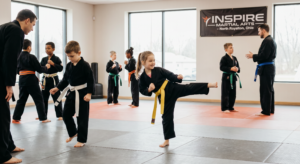
Here’s a picture from a recent Tuesday class two seven-year-olds, same age, same class, completely different strengths:
- Aiden practically flew through the agility ladder drill. His coordination was natural, his feet a blur. Physical movement? That’s his superpower.
- Maya moved more deliberately through the ladder. But when it came time for the quiet concentration drill holding a stance perfectly still while the instructor counted Maya transformed. She was a statue. Laser-focused. Calm strength where others fidgeted.
Aiden’s mom might have felt a flicker of worry watching Maya’s stillness. Maya’s dad might have wondered why the ladder seemed harder for her. Here’s the shift we encourage every parent to make:
Don’t watch sideways. Watch forward.
The real question is never “Why isn’t my child doing it like that child?” It’s “Look how much my child has grown since last month.”
The Right Way to Measure Your Child’s Progress
- Did Aiden show more patience today than when he started? That’s a win.
- Did Maya attempt the ladder with more confidence, even if her feet didn’t fly? Huge progress.
They’re on paths next to each other not on the same road. As educator Robert John Meehan said: “Every child has a different learning style and pace. Each child is unique not just able to learn, but able to win.”
Our article on Age-Specific Curriculum: What It Really Means for Your Child’s Success in Martial Arts goes deeper into how we structure this progression.
Healthy Competition vs. Harmful Comparison
When Competition Builds Kids Up
Competition isn’t the enemy misdirected competition is. A well-framed challenge “Can you beat your own best time?” or “Team up with your buddy to master this move!” pushes kids just outside their comfort zone in the best possible way. The American Psychological Association notes that healthy competition focused on self-improvement, rather than defeating others, actively builds resilience in children.
This is also why martial arts is uniquely powerful: the belt system gives every child a personal ladder to climb one that belongs entirely to them.
When Comparison Tears Kids Down
But when “fairness” always means measuring against another child especially during the critical early years of development it quietly erodes self-esteem and kills intrinsic motivation. The child stops asking “What can I do?” and starts asking “Why can’t I do what they do?” That’s a dangerous mental shift.
If you want to understand how to build your child’s inner confidence from the ground up, our article 25 Things You Can Do Right Now To Build a Child’s Confidence is a great place to start.
How Our Instructors Nurture Every Individual Child
Strength-Based Coaching in Action
Our instructors are trained to be expert observers and encouragers. They don’t just teach technique they see children. They notice Maya’s natural calm and give her leadership roles in focus exercises. They channel Aiden’s physical energy into agility challenges that also incorporate small moments of stillness. They celebrate Maya’s ladder attempt with the same genuine enthusiasm as Aiden’s speed.
Parent Joanne Asmis Sitaras noticed this firsthand:
“Master Chris and the entire team are wonderful to work with. They really took the time to get to know our little guy. His concentration and focus have really improved over the last few months and his behavior at school has improved as well.”
That’s strength-based coaching in action and it works. For a deeper look at how this translates into school performance, read our article on The Positive Effects of Martial Arts for a Child in School.
The Power of Specific Praise
Generic praise (“Good job!”) fades fast. Specific praise sticks. When an instructor says, “Wow, Maya your focus during that stance was incredible,” or “Aiden, you must feel so proud mastering that tricky kick,” it builds something deeper than a compliment. It builds identity. Understood.org highlights how recognizing individual learning differences and strengths is one of the most powerful tools adults have for building children’s confidence.
This combination celebrating effort and achievement while nurturing internal pride is infinitely more powerful than any comparison. And it’s the foundation of everything we do at Inspire.
Celebrating Your Child’s Unique Journey at Inspire Martial Arts
That proud grin when they finally nail a move they’ve been working on for weeks. The focus they bring to homework (yes, parents tell us this happens a lot). The quiet confidence of standing a little taller. These are the victories that build unshakeable self-worth and they look different for every single child.
As the saying goes: “Don’t compare your child to others. There’s no comparison between the sun and the moon. They shine when it’s their time.”
At Inspire Martial Arts in North Royalton, Ohio, we don’t train identical ninjas. We nurture individual humans helping each child find their strength, their focus, their courage, and their own brilliant way to shine. On their schedule. Because when a child believes in their own unique potential, that’s the most powerful move of all.
Ready to find out where your child’s journey begins? Contact Inspire Martial Arts today and let’s discover what makes your ninja one of a kind.
FAQs: Not All Ninjas Are The Same
Q1: At what age should my child start martial arts? Children as young as 4 can begin martial arts at Inspire through our Little Ninjas program. Classes at this age focus on coordination, listening, and fun movement all developmentally appropriate for young learners. Every child is assessed individually before placement to ensure the best fit.
Q2: What if my child progresses slower than others in their class? Slower progress in one area often means deeper strength in another. Our instructors track each child’s individual growth not their rank compared to classmates. Belt progression at Inspire is based on personal readiness, not a fixed timeline, so every child advances when they are truly ready.
Q3: How does Inspire Martial Arts handle different learning styles? Before classes begin, we conduct a friendly assessment to understand how each child moves, focuses, and engages. Our instructors are trained in strength-based coaching and adapt their approach to meet visual, kinesthetic, and auditory learners where they are.
Q4: Is martial arts good for kids who struggle with focus or confidence? Absolutely. Martial arts is one of the most effective tools for building focus, self-discipline, and confidence in children including those with ADHD, anxiety, or social challenges. The structured, encouraging environment at Inspire is specifically designed to help every child succeed. See our article on Martial Arts for ADHD Children for more.
Q5: How is Inspire Martial Arts different from other martial arts schools in North Royalton, Ohio? Inspire uses age-specific curriculum, individualized assessments, and strength-based coaching rather than a one-size-fits-all approach. Our instructors genuinely invest in knowing each child, and our programs are built around child development science, not just technique. Our article 7 Must Ask Questions: Choose the Best Karate Classes in North Royalton Ohio can help you compare your options.
Q6: Will my child be compared to other students during class? Never. At Inspire, the only comparison we encourage is your child vs. their past self. Instructors celebrate individual milestones and use specific, personal praise to build each child’s internal confidence and motivation.
Q7: How do I know if Inspire Martial Arts is the right fit for my child? The best way is to come in and experience it. We offer a friendly introductory session where your child can meet the instructors, try some activities, and see how they feel on the mat no pressure, no commitment. You can also read what other North Royalton parents have shared about their experience, or explore our article Why Martial Arts Is Great For Your Kids to learn more about the benefits.