


This article was last updated on April 16, 2026
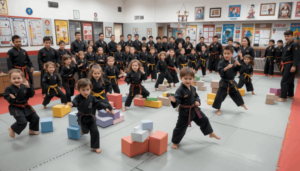
If you’ve ever watched a five-year-old and a ten-year-old try to learn the same martial arts technique the same way, you already know something is off. Children grow, think, and move differently at every stage and a curriculum that ignores that doesn’t just underperform, it can actually push kids away from a sport they’d otherwise love. This article breaks down what a genuine age-specific martial arts curriculum looks like, why the science behind it matters, and how it creates lasting results for children at every developmental stage.
Article at a Glance
- “Age-specific” means more than sorting kids by age it requires adapting teaching methods, expectations, and curriculum design to match cognitive, physical, and emotional development.
- Children ages 4–6 and 7–12 are in fundamentally different developmental phases and need distinct approaches to thrive in martial arts.
- The American Academy of Pediatrics confirms that structured, developmentally appropriate physical activity improves both motor skills and cognitive performance in children.
- At Inspire Martial Arts in North Royalton, instructors are trained specifically in child development milestones not just martial arts technique.
WHAT MOST SCHOOLS GET WRONG ABOUT AGE-SPECIFIC CURRICULUM
Walk into many martial arts schools and you’ll find classes divided by age: a group for 4–6-year-olds here, a group for 7–12-year-olds there. That’s a start. But age grouping alone is not an age-specific curriculum. It’s a scheduling decision.
A truly age-specific curriculum goes three layers deeper:
- Cognitive alignment Is the instruction paced to match how children this age actually process information?
- Physical readiness Are the techniques appropriate for the motor development stage of this age group?
- Emotional fit Does the class structure account for how children this age regulate frustration, manage peer interaction, and respond to correction?
Teaching the same kick sequence to a five-year-old and a ten-year-old using the same language, pacing, and expectations is the instructional equivalent of handing a first-grader a middle-school algebra textbook. You won’t get learning you’ll get frustration and dropout. That gap is exactly what Inspire Martial Arts, led by Master Chris Gehring (7th Degree Black Belt, 30+ years of experience), set out to close.
THE DEVELOPMENTAL SCIENCE THAT DRIVES THE CURRICULUM
The foundation of a legitimate age-specific program isn’t opinion it’s research. According to a clinical report published in Pediatrics by the American Academy of Pediatrics, structured physical activity in children ages 5 to 13 improves cognition, including memory, processing speed, and attention (Source: American Academy). That’s not just good news for fitness it means martial arts classes designed around how children’s brains actually work can amplify learning outcomes far beyond kicks and forms.
The AAP recommends that children ages 3 to 5 get at least three hours of physical activity per day, while children 6 and older need 60 minutes of moderate to vigorous activity most days (Source: Healthychildren). The question isn’t just how much activity it’s what kind, and whether it’s structured to match where a child is developmentally.
At Inspire Martial Arts, years of research into child development, neuroscience, and educational psychology shaped the program from the ground up. The result is a martial arts framework designed not just to teach self-defense, but to serve as a child development vehicle using the dojo as the classroom.
This philosophy connects closely to why helping children build focus and self-regulation through movement is treated as central to every class session, not a bonus.
HOW INSPIRE MARTIAL ARTS STRUCTURES ITS AGE-SPECIFIC PROGRAM
Ages 4–6: Building Foundations Through Play
Children in this age range are in a critical gross motor development window. Their attention spans are short (typically 5–10 minutes on a single task), and they learn most naturally through imitation, repetition, and play. Abstract instructions and lengthy demonstrations simply don’t land.
At Inspire Martial Arts, the 4–6 curriculum is built around this reality:
- Techniques become games. “Balance beam kicks” build coordination through movement challenges children find fun and achievable.
- Listening skills are taught explicitly, not assumed. A child who doesn’t yet know how to follow multi-step verbal instructions needs to be taught that first.
- Short wins build confidence. Every class ends with achievable milestones so children leave feeling successful, which drives them to return.
- Social skills are embedded. Taking turns, encouraging classmates, and learning to interact with peers in a structured environment mirrors what children will need in school.
This approach also directly addresses separation anxiety in younger children, which can be one of the biggest early barriers to consistent class attendance.
Ages 7–12: Advancing Through Challenge and Leadership
By age seven, children are entering a markedly different developmental phase. Working memory is expanding, abstract thinking is emerging, and social comparison becomes a motivating factor. A good curriculum for this group leans into those changes rather than ignoring them.
The 7–12 curriculum at Inspire Martial Arts introduces:
- Progressive skill sequences that build on each other over weeks and months, rewarding persistence and memory.
- Structured sparring with tactical problem-solving students aren’t just reacting physically, they’re making decisions under pressure.
- Leadership roles within the class, such as leading warm-ups or demonstrating techniques, which develop confidence and accountability.
- Goal-setting frameworks tied to belt progression, teaching children how to track effort over time.
This mirrors the broader research on building perseverance in kids, which consistently shows that children need age-appropriate challenge not tasks too easy to engage them, and not tasks so hard they shut down.
WHY INSTRUCTOR TRAINING IS THE HIDDEN VARIABLE
The curriculum design is only half of the equation. The other half is the person delivering it.
Instructors at Inspire Martial Arts undergo training that goes well beyond learning martial arts techniques. They study developmental milestones so they know, for example, that a four-year-old simply cannot be expected to memorize a ten-step form and that asking them to try doesn’t build discipline, it builds discouragement.
Two core teaching frameworks shape instruction:
- The RATE Method (Reflective, Adaptive, Targeted Engagement): Focuses on reading individual students and adjusting instruction in real time.
- The STEDEYE Method (Structured, Engaging, Dynamic Empowerment): Keeps sessions goal-oriented while keeping children genuinely invested in what’s happening.
The impact of well-trained instructors shows up clearly in what parents report. One parent wrote of her son: “The staff does an excellent job of working with my son. My son’s confidence and self-discipline have skyrocketed through the roof. I could not have asked for a better experience for my child.”
Another parent whose son has ASD and ADHD shared: “This place has been crucial to my son’s development. The staff is very supportive and very well trained to deal with kids that need the extra help. Here my son has learned the value of persistence. He never gives up.”
This kind of outcome doesn’t happen by accident. It happens when instructors understand how martial arts helps children with ADD and ADHD, and adapt their approach accordingly.
WHAT PARENTS ACTUALLY SEE AT HOME
One of the clearest signs of an age-appropriate curriculum is that the benefits transfer. Kids who are challenged at the right level don’t just improve in the dojo they change at school, at home, and in how they handle difficult moments.
Parents at Inspire Martial Arts consistently describe these shifts:
- Improved focus and ability to follow multi-step directions
- Better emotional regulation during frustrating situations
- Increased willingness to try new things and bounce back after failure
- A noticeable uptick in self-confidence in social situations
One parent described her 15-year-old daughter’s experience after just one month: “Since my daughter started attending martial arts, she became more focused and determined in performing her daily tasks and assignments. Her listening skills, overall behavior, and character have improved.”
Another parent summed up the environment simply: “Every time we have a sibling or family conflict, Master Chris is always a helpful resource. I feel like he is part of our family team.”
These results align with what researchers have documented about the positive effects of martial arts for children in school particularly around focus, self-regulation, and academic readiness.
HOW TO EVALUATE WHETHER A SCHOOL HAS A TRUE AGE-SPECIFIC CURRICULUM
If you’re choosing a martial arts school for your child, these questions cut through marketing language quickly:
- How do your instructors adapt instruction within an age group? (A real answer describes teaching methods, not just groupings.)
- What developmental milestones does your curriculum account for? (Look for specifics, not generalities.)
- How do you handle children who are ahead of or behind the average for their age group? (This reveals whether individualization is real or theoretical.)
- What training do instructors have in child development, beyond martial arts? (This is the differentiator.)
- Can I observe a class for the age group I’m considering? (Legitimate programs welcome this.)
Also worth reading: 7 Must-Ask Questions to Choose the Best Karate Classes in North Royalton Ohio walks through this evaluation process in detail and is worth reviewing before any school visit.
THE RESULT: MORE THAN KICKS AND PUNCHES
When a martial arts school truly commits to age-specific curriculum design, classes stop being extracurricular activities and start being developmental experiences. Students come away with:
- Confidence earned through genuinely appropriate challenges
- Discipline built through methods that match how their brains actually work
- Resilience developed through structured failure and recovery
- Life skills that show up in classrooms, friendships, and family dynamics long after the gi comes off
At Inspire Martial Arts in North Royalton, the curriculum isn’t a collection of techniques organized by age. It’s a research-backed child development framework that happens to be delivered through the vehicle of martial arts. Master Chris Gehring and his team have spent decades refining it and the results speak through the parents and children who’ve lived it.
Ready to see it for yourself? Book a trial class for your child today at northroyaltonmartialarts.com and experience what age-specific instruction actually looks and feels like.
FREQUENTLY ASKED QUESTIONS
What is an age-specific martial arts curriculum?
An age-specific curriculum adapts techniques, teaching methods, pacing, and expectations to the cognitive, physical, and emotional development stage of a particular age group. It goes beyond grouping children by age to actually changing how instruction is delivered based on what children at each stage are ready to learn and retain.
At what age can children start martial arts at Inspire Martial Arts?
Inspire Martial Arts accepts children as young as 4 years old into its developmentally designed program. The earliest classes focus on gross motor skills, listening, and social interaction rather than complex techniques, making the experience both appropriate and enjoyable for young children.
How is the 4–6-year-old curriculum different from the 7–12-year-old curriculum?
The 4–6 curriculum uses play-based instruction, simplified movement challenges, and heavy repetition to match short attention spans and early motor development. The 7–12 curriculum introduces progressive skill sequences, tactical thinking in sparring, and leadership roles, aligning with the more complex cognitive and social development of older children.
Does an age-specific curriculum help children with ADHD or special needs?
Yes. A curriculum calibrated to developmental stage rather than a one-size-fits-all format is particularly beneficial for children with ADHD, ASD, or other learning differences, because it reduces the mismatch between instruction and a child’s capacity to process it. Multiple parents at Inspire Martial Arts have reported significant improvements in focus and behavior for children with ADHD and ASD.
How do I know if an instructor is trained in child development, not just martial arts?
Ask the school directly: what formal training do instructors receive in child development, developmental milestones, and adaptive teaching methods? At Inspire Martial Arts, instructors are trained in specific frameworks including the RATE and STEDEYE methods designed around age-appropriate engagement.
Will my child fall behind if they start later than other kids in their age group?
No. Age-specific programs are designed to meet children where they are, not where the class average is. A new student entering at age 8 is assessed on their current skill level, not compared to peers who started earlier. The goal is individual growth within an age-appropriate framework.
How long does it typically take to see results from an age-specific martial arts program?
Many parents report visible changes in focus, confidence, and behavior within the first four to eight weeks. Measurable skill development builds progressively over months, with belt progression serving as a structured, visible marker of growth tied to real achievement.