


This article was last updated on January 01, 2026
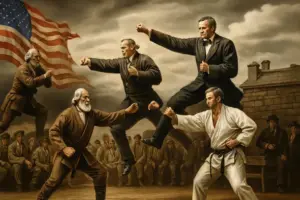
- The fast thought: what martial arts really entails
- Wrestling (grappling) and it formed early America
- The reason why this topic is significant today
- Leadership advantages martial arts can develop
- Collar and elbow wrestling and George Washington
- Abraham Lincoln, the frontier wrestler
- Ulysses S. Grant: complete lack of formality and patience
- Theodore Roosevelt: judo/jiu-jitsu to the White House
- Barack Obama: taekwondo schooling and an honorary black belt
- The similarities of all the five presidents
- The way you can use these lessons in your own life
- Conclusion: What these presidential warriors are demonstrating
- FAQs about Presidential Warriors
Martial arts do not exist as a single entity. They are a massive family of combat systems comprising of grappling, striking, and weaponry training of a great number from cultures. And, when you carefully study U.S. history, you discover this: a number of commanders-in-chief who have studied these arts not as a gimmick, but as a method of developing discipline, toughness and self-control.
Article Summary
- Some U.S. presidents were trained in wrestling and martial arts as a form of fitness, self-defense and character building.
- The collar-and-elbow wrestling appears at an early age in American life and is associated with Washington and Lincoln in wrestling history. National Wrestling Hall of Fame+2National Wrestling Hall of Fame
- The White House training of Roosevelt is based on his Strenuous Life strategy and the taekwondo experience of Obama demonstrates a well-organized discipline and appreciation of the art. WHHA (en-US)+2Theodore Roosevelt Center
- Some are written down, some are folklore that has been accreted over the years, and thus the most reliable one is one which disentangles legend and record. WIN Magazine+1
The fast thought: what martial arts really entails
When a majority of the folks think of martial arts, they imagine Asian striking martial arts such as karate or taekwondo. However, in a broader and more historically correct sense, wrestling is also a martial art and during the early times, wrestling was one of the most widespread combat sports in America. National Wrestling Hall of Fame
Wrestling (grappling) and it formed early America
During the 18th and 19th centuries, wrestling was ubiquitous: champions of wrestling were found in every town, soldiers wrestled as a form of entertainment, and young men wrestled to demonstrate their manliness. According to the National Wrestling Hall of Fame, collar-and-elbow was a well-known style of the time, which was associated with such great people as Washington and Lincoln. National Wrestling Hall of Fame
The reason why this topic is significant today
Fighting is not the only thing that combat training entails. Instructor will teach you how to control yourself, your body, your feelings and your decisions when the pressure is on. That is why the stories resonate with the readers of nowadays who are concerned with confidence, discipline, and leadership.
Leadership advantages martial arts can develop (not just muscles)
The martial training is nothing more than the practice of stress. You experience pain, struggle and loss in a non-hysterical manner, and learn to get better without panicking.
Discipline and routines
There is a simple routine: come, work out, get a little better, created by belts, rounds, drills, and repeated fundamentals. Such rhythm may be transferred to the workplace, health, and decision-making.
Calm under pressure
Calm is particularly forced by grappling. If you tense, you gas out. You live as long as you think and breath. The same ability that helps leaders to remain functional in times when things are tight.
Confidence without ego
The most fitness centers reward humility. You lose, you learn, you reset. Such confidence is not obnoxious.
These same principles of discipline, emotional control, and confidence are also visible in the real-life benefits of martial arts training, especially when practiced consistently over time
Collar and elbow wrestling and George Washington
The sports image of Washington is not a new-fangled hype. According to wrestling historians, he was a collar-and-elbow champion at the age of 18, and later accounts tell how he was still strong enough to accept fights when commanding armies. National Wrestling Hall of Fame
What is collar-and-elbow (and why it has diffused in the U.S.)
Collar-and-elbow is a Irish common type of jacket-wrestling, that was brought with the Irish people and was popular in the United States. It focuses on grips, trips and throws with fast legs. Wikipedia
The delicate manner of expressing it is that reputable sources of wrestling-history attribute to Washington considerable talent in the art, and even a championship during his teens. National Wrestling Hall of Fame
What sources say about Washington’s skill
That is not to say that all schoolyard drama is flawlessly documented but it does point to the bigger argument: Washington never underestimated physical prowess and the spirit of competition.
Leadership teaching: aggression under control
Wrestling gives you the lesson of using force but not to lose control. The common perception of Washington as a disciplined, consistent, and difficult to intimidate a person well suits the mindset.
Abraham Lincoln, the frontier wrestler (and the myth-making problem)
The wrestling fame of Lincoln is actual, yet is a kind of temptation to exaggeration. A few of the proclamations on the internet (such as hundreds of matches, only one loss) have been refuted as the folklore, not the confirmed record. WIN Magazine
What’s believable and the Jack Armstrong story
One of the most famous stories is one that pits Lincoln against Jack Armstrong in New Salem, Illinois. Historical documents on wrestling give an account of the match as a pivotal point in local reputation building by Lincoln.
The essential notion remains the same in all versions: Lincoln was a tough guy, difficult to shake and he never gave up.
Dividing folklore and records
When you would like your article to seem credible, admit that:
- Probably factual: Lincoln is a wrestler who was admired as a tough guy and used that as a political tool. HISTORY
- Usually blown out of proportion: precise number of matches, champion of the entire state, and other exaggerated statements that go viral because the tale is entertaining.
Leadership lesson: power and moderation
Power was not the only effective quality that Lincoln portrayed as a fighter. It was restraint. That would appear in the form of remaining principled during provocation rather than responding emotionally in a leadership context.
Ulysses S. Grant: complete lack of formality In wrestling, and a reputation of patient fighter
Grant is frequently also mentioned as one of the presidents associated with wrestling culture despite the fact that his competitive career is not recorded in the same manner the stories about Lincoln are. The National Wrestling Hall of Fame puts him in the larger context of the wrestling presidents of that time.
Why Grant seldom misses a list of wrestling presidents
During the 1800s wrestling was popular recreation and roughhousing. This inclusion by Grant is indicative of the norms of his time, and of the fact that various presidents had been raised in an environment where grappling was a regular ordeal of masculinity.
How informal wrestling must have appeared at that time
Consider not so much organized tournaments, but:
- friendly challenges
- military-camp sport
- family roughhousing
- demonstrating that you could take pressure and still maintain your temper.
Descriptions of Grant by those who knew him tell of him wrestling with his children, which is appropriate to such an informal form of grappling-as-bonding. Martial History Team
Life lesson: substantial pressure is better than theatrics
Persistence is what Grant based his military reputation on. In grappling, that is the who does not panic, maintains position and gradually turns the situation to his advantage until the win is certain.
Theodore Roosevelt: judo/jiu-jitsu to the White House
Making combat training a part of his image, it was Theodore Roosevelt who did it. Several historical accounts tell how Roosevelt was taught jiu-jitsu/judo by a Japanese instructor Yamashita (Yoshiaki) and demonstrated the art at the White House.
The lessons by Yamashita and the demonstrations at the White House
White House History records a scene of Roosevelt playing jiu-jitsu with Yamashita in the White House, which is as primary-entity as it can be in a publicly-facing source.
Theodore Roosevelt Center also contains letters related to those lessons, such as payment and gratitude for training. Theodore Roosevelt Center
Belt rank information and information to say
Numerous contemporary articles report that Roosevelt attained the brown belt level. The most correct and safe way to say this is:
Roosevelt also trained intensely and did not just train without interest as many of his instructors were elites.
Explicit claims with respect to belt colors must be approached with some caution since over time, belt systems evolved and became standardized and what is later retold are simplified versions of the ranking story.
Lesson on leadership: the Strenuous Life way of thinking
Consistency was the actual martial art of Roosevelt. He also trained with health setbacks and physical preparation was not his vanity project but a moral obligation.
Barack Obama: taekwondo schooling and an honorary black belt
One of the best-documented contemporary presidential martial arts stories is the relationship that Obama had with taekwondo.
Obama was trained and ranked intermediate in Chicago
Obama is reported to have trained in taekwondo in Chicago and attained an intermediate level (which is usually referred to as green belt in retellings). MMA Underground
The main thing, to be precise, is that even the Korean officials called him intermediate instead of the master level. The Korea Times
The honorary belt gift of 2009 and its meaning
In November 2009, Obama was given taekwondo gifts such as an honorary black belt in a visit to South Korea, which was covered in the contemporary press.
Some of the artifacts related to this are also listed in the Obama Presidential Archives, such as the black belt and an honorary certificate. Obama Library Collection
Lesson in leadership: do not be perfect, be progressive
The story of Obama is practical since it is not about being the greatest fighter. It is about appearing, training, perfecting, and valuing the system to the extent of accepting an honor without posing that it has been years of competitive mastery.
The similarities of all the five presidents
Different eras. Different styles. Similar benefits
Grappling and governance (making decisions in narrow corridors)
Wrestling teaches you to make choices when somebody is literally trying to manipulate you. That is a good fit for leadership: conflicting priorities, constant opposition, time constraints, and the necessity to remain composed.
Why do combat sports so frequently make leaders who are relaxed?
As they provide you with a repeating cycle:
- pressure arrives
- you breathe and stabilize
- you choose a response
- you review and improve
And this is the core of discipline. Beyond physical strength, these stories highlight the core lessons learned through martial arts, including resilience, patience, and calm decision-making under pressure
The way you can use these lessons in your own life (without being hurt)
The benefits do not have to be borrowed by someone who is a president.
Selecting an appropriate coach
Look for a coach that is focused on safety, fundamentals, and respect.
- a novice curriculum that has a defined progress.
- controlled fighting and defensive regulations.
- a learning culture as opposed to ego.
- An easy-going discipline and fitness program.
Ease-of-use test This is a short 6-week test:
- Two sessions in a week (consistency first)
- focus: basic position, balance, breathing, basic escapes.
- write a small training journal: what was better, what was difficult, what to do again.
- 10 minutes of exercise a day to recover and be mentally clear.
Safety and expectations
Martial arts are not supposed to break you but to make you healthier. Get out there early, don’t hurry, and plan to play a long game.
Conclusion: What these presidential warriors are actually demonstrating
The lesson of Washington, Lincoln, Grant, Roosevelt and Obama, which goes to the bottom, is not that leaders should fight. This is: leaders ought to train. Training builds discipline. It builds calm. It develops the power to react rather than respond.
Next step: Decide on a skill you choose one of these stories (discipline, confidence, composure) and you select a training custom to aid you in that skill. Two sessions per week can do the trick, even three months of them, and transform the way in which you wear stress and present yourself in the world.
This is why many leaders and everyday people discover why people of all ages choose martial arts as a long-term personal practice.
FAQs about Presidential Warriors
1) Who were the presidents of the U.S who practiced martial arts?
Historically, wrestling culture has been associated with such presidents as Washington, Lincoln, Grant, Roosevelt was a jiu-jitsu/judo student, and Obama was a taekwondo student.
2) Is wrestling a martial art?
Yes. Martial arts involve organized fighting systems and wrestling is an ancient combat sport with self-defense as well as competition background.
3) What is collar-and-elbow wrestling?
It is a traditional Irish wrestling (also used in the diaspora communities) that is based on predetermined grips and rapid leg trips and throws.
4) Does not Theodore Roosevelt train martial arts at the White House?
Yes, there are valid historical accounts of Roosevelt being taught by Japanese teacher Yamashita and organizing protests at the white house.
5) Did Obama have taekwondo black belt skills?
In 2009, he was awarded an honorary black belt as a diplomatic gift; he was also reported to be at the intermediate, but not the master level.
6) Does Lincoln wrestle in his claims of hundreds of matches?
Most of these numbers are common tropes but also doubted as myth or folklore. The less dangerous solution is to state that he struggled and was reputed to struggle, but precise figures are unclear.
7) What are the most developed leadership qualities of martial arts?
Discipline, emotional control, resilience, and comfort under pressure are the largest carryovers since during the training you are constantly in tough situations that you learn to handle.