


This article was last updated on June 03, 2026
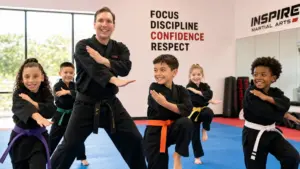
Table of Contents
- What Is Bilateral Coordination (and Why It Matters for Your Child)
- The Brain Connection: Crossing the Midline and the Corpus Callosum
- Why Midline Crossing Is the Secret to Reading, Writing, and Focus
- Warning Signs: When Bilateral Coordination Is Behind (The “Ambidextrous” Myth)
- How Martial Arts Supercharges Bilateral Coordination and Brain Development
- What the Science Actually Says
- What Parents Can Do at Home (Simple, Proven Activities)
- Where Movement Meets Neuroscience: The Inspire Difference
- Conclusion
- Frequently Asked Questions (FAQs)
Watching your child grow from a wobbly toddler into a confident, capable kid is one of parenting’s greatest joys. But if your little one seems clumsy, switches hands constantly, or struggles to sit still and read, the root cause may surprise you. This article explains a hidden skill called bilateral coordination why it shapes everything from handwriting to focus, and exactly how you can help your child build it.
📌 Key Takeaways
- Bilateral coordination is your child’s ability to use both sides of the body together and it’s tightly linked to brain development.
- Crossing the midline strengthens the connection between the brain’s two hemispheres, which supports reading, writing, and emotional regulation.
- Difficulty crossing the midline after age 4–5 (not “being ambidextrous”) can signal a coordination delay worth addressing early.
- Cross-body movement activities including martial arts are proven, fun ways to build coordination, attention, and executive function.
What Is Bilateral Coordination (and Why It Matters for Your Child)
Bilateral coordination simply means using both sides of the body together in a controlled, organized way. Think of jumping jacks (both sides doing the same thing) or cutting paper while the other hand holds it steady (each side doing a different job).
It sounds small, but it’s foundational. According to pediatric occupational therapists at Children’s Therapy Place, most self-care, fine-motor, and play tasks getting dressed, tying shoes, writing, catching a ball require age-appropriate bilateral coordination. When it’s weak, everyday life gets frustrating fast.
The Three Stages of Bilateral Coordination
Bilateral skills develop in a predictable order:
- Symmetrical — both hands do the same thing (clapping, pulling up pants, catching a ball with two hands).
- Alternating (reciprocal) — sides take turns (crawling, climbing, swimming, riding a bike).
- Dominant + supporting hand — one hand leads, the other assists (cutting with scissors, writing, buttoning).
A child generally must master each stage before the next clicks into place.
The Brain Connection: Crossing the Midline and the Corpus Callosum
At the heart of bilateral coordination is the corpus callosum a thick band of nerve fibers connecting the brain’s left and right hemispheres. Every time your child reaches across their body (called crossing the midline), they strengthen the neural “bridge” between those two halves.
This is a big deal. As the team at Mount Pleasant Pediatric Therapy explains, spontaneously crossing midline promotes communication between the left and right brain and supports the development of a dominant hand which is essential for skilled fine-motor work.
Developmental Milestones by Age
Research summarized by The OT Butterfly outlines a typical progression:
- 0–2 years: Uses both hands fairly equally; around 20 weeks babies begin reaching across the body for a toy.
- 2–3 years: Spontaneous midline crossing starts to appear during play.
- 3–4 years: Bilateral coordination, trunk rotation, and midline crossing become more natural and refined.
- Ages 4–9: Midline crossing steadily strengthens and becomes automatic.
This is the same window when structured movement programs pay off most something we explore in our guide to childhood brain training through martial arts.
Why Midline Crossing Is the Secret to Reading, Writing, and Focus
Here’s where physical skill quietly becomes academic skill.
Reading requires your child’s eyes to track smoothly from left to right across the midline line after line. Writing requires controlled cross-body hand movements. When midline crossing is weak, you often see:
- Choppy reading and trouble tracking words across a page
- Messy handwriting and poor spacing on the page
- Difficulty with sports, catching, and following moving objects
As The OT Toolbox notes, occupational therapists check for midline crossing in nearly every evaluation because when a child can’t cross midline fluidly, challenges show up in “practically every functional task,” from schoolwork to self-care. Building these foundations early connects directly to the effort and focus kids need in school.
Warning Signs: When Bilateral Coordination Is Behind (The “Ambidextrous” Myth)
Many parents proudly assume a child who uses both hands equally is “ambidextrous.” But after age 4–5, this is often a red flag, not a gift. It can signal weak interhemispheric communication rather than advanced skill.
Common signs a child may be avoiding the midline include:
- Switching hands mid-task when coloring, cutting, or throwing (after age 3)
- Turning the paper sideways instead of reaching across it
- Rotating the whole body to grab something instead of reaching across
- An immature throwing pattern (no trunk rotation, no opposite-foot step)
- Trouble visually tracking a slow-moving object
If several of these sound familiar, it’s worth a conversation with your pediatrician or an occupational therapist. Early support makes a real difference and the same principles apply to the realistic behavioral and developmental expectations for 7-to-9-year-olds.
How Martial Arts Supercharges Bilateral Coordination and Brain Development
Few activities train cross-body movement as naturally as martial arts. Blocks, kicks, forms, and partner drills constantly require both sides of the body to work together and to cross the midline while the brain plans, sequences, and adapts in real time.
The Inspire Martial Arts program, designed by founder Chris Gehring, intentionally builds these neural connections through purposeful, age-appropriate play. (For the bigger picture, see our overview of why martial arts is great for your kids.)
Age-Specific Drills at Inspire Martial Arts
- Preschoolers (3–5 years): Animal walks (crab and bear crawls), simple obstacle courses, and jumping to music to wake up cross-body coordination.
- Early school age (5–7 years): “Knee-tag” games (touch the opposite knee), figure-8 patterns, and stance work that demand midline crossing.
- Older kids: Combination drills, forms, and controlled partner work that build balance, timing, and reaction speed.
This is exactly why our age-specific curriculum matters the right drills at the right stage. These benefits also explain the 7 things kids learn from martial arts that go far beyond kicks and blocks.
What the Science Actually Says
This isn’t just dojo wisdom the research backs it up.
- A study of 102 children (average age ~12) published on PubMed found that kids practicing martial arts showed better executive functioning and higher school marks than children in team sports or no sport at all.
- A 2023 functional near-infrared spectroscopy (fNIRS) study in the Journal of Experimental Child Psychology, available on ScienceDirect, found martial arts training enhanced working memory and attention in school-aged children more than free play or rest.
- Research in Frontiers in Pediatrics showed martial arts training improved inhibition, mental flexibility, and processing speed in at-risk youths.
A key mechanism, as occupational therapy experts at The OT Butterfly note, is that cross-lateral movement strengthens the neural connection between the hemispheres helping the “whole brain function better as a team.” These cognitive gains are also why martial arts is so often recommended for children with ADD and ADHD and as a confidence-builder for children on the autism spectrum.
What Parents Can Do at Home (Simple, Proven Activities)
You don’t need fancy equipment. Try these therapist-recommended, cross-body activities:
- Play “Simon Says” with a twist: “Touch your left ear with your right hand.”
- Cross crawls: Right hand to left knee, left hand to right knee great as a morning warm-up.
- Draw big figure-8s in the air, in sand, or on a whiteboard.
- Wash the car or windows with big, sweeping circular arm motions.
- Play Twister or hand-clapping games for fun midline practice.
- Animal walks, climbing, and swimming to build alternating coordination.
Want to keep the whole family involved? Our 8 ways to start and keep the family exercising together is a great place to begin. If you suspect a delay, loop in your child’s teacher or an OT for extra support.
Where Movement Meets Neuroscience: The Inspire Difference
At Inspire Martial Arts in North Royalton, Ohio, every drill is rooted in developmental science. Parents see a fun, energetic class but behind the scenes, each movement is building both body and brain.
The honest words of local parents say it best:
“Master Chris and the entire team are wonderful to work with. They really took the time to get to know our little guy. His concentration and focus have really improved over the last few months and his behavior at school has improved as well.” — Joanne
“My son’s confidence and self-discipline have skyrocketed through the roof. I could not have asked for a better experience for my child.” — Tony
“Most don’t realize that besides the physical part there are so many mental aspects and life lessons that she has learned. The leadership abilities and confidence she has gained is something she could never have learned at this age.” — Kelly
These outcomes focus, confidence, and school readiness are exactly what strong bilateral coordination supports, and they echo the positive effects of martial arts for a child in school.
“Our drills aren’t random they’re neural workouts. We’re building brains as much as bodies.”
— Chris Gehring, Inspire Program Founder
Conclusion
Bilateral coordination is one of the most important and most overlooked building blocks of your child’s physical and cognitive growth. By understanding the science and weaving cross-body movement into everyday play, you give your child a real head start in reading, writing, focus, and confidence.
👉 Next Step: Want to see science-based training in action? Visit Inspire Martial Arts in North Royalton for a trial class, and discover the 6 amazing benefits of martial arts for children firsthand.
Frequently Asked Questions (FAQs)
- What is bilateral coordination in simple terms?
It’s the ability to use both sides of the body together in a smooth, controlled way like cutting with scissors while holding the paper. It’s essential for daily tasks, sports, and handwriting. - At what age should a child cross the midline?
Spontaneous midline crossing typically appears around age 2 and becomes well-established by ages 3–4, strengthening through age 9. Consistent hand-switching after age 4–5 may be worth checking. - Is being ambidextrous a sign of poor bilateral coordination?
Often, yes after age 4–5. True hand dominance should emerge by then. Constant hand-switching can signal weak communication between the brain’s hemispheres rather than special ability. - How does bilateral coordination affect reading and writing?
Reading requires the eyes to track left-to-right across the midline, and writing requires controlled cross-body movements. Weak coordination can lead to choppy reading and messy handwriting. - Can martial arts really improve coordination and brain function?
Yes. Peer-reviewed studies link martial arts training to better executive function, working memory, and attention in children, thanks to its cross-body, mentally engaging movements. - What home activities build bilateral coordination?
Cross crawls, “Simon Says” with cross-body moves, figure-8 drawing, Twister, animal walks, climbing, and swimming are all simple, effective options. - When should I talk to a professional about my child’s coordination?
If your child frequently switches hands, avoids reaching across their body, struggles with dressing or handwriting, or shows clumsiness beyond their age, consult your pediatrician or an occupational therapist.