


This article was last updated on May 14, 2026
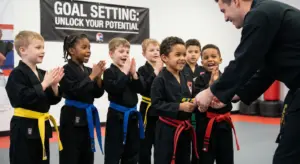
Table of Contents
- Why Goal Setting is One of the Most Important Skills You Can Teach a Child
- The 3-Tier Goal Mastery System: How We Build Goal Setters at Inspire Martial Arts
- Why Martial Arts is One of the Best Environments for Teaching Kids to Set Goals
- What North Royalton Parents are Seeing at Home
- A Parent’s Toolkit: How to Reinforce Goal Setting Outside the Dojo
- The Long-Term Payoff: What Goal-Setting Children Become as Adults
- Conclusion: The Goal is Bigger than the Belt
- Frequently Asked Questions About Goal Setting for Kids
Your child has more potential than you can imagine. But without a system for setting and chasing goals, much of it stays locked away. Goal setting isn’t something children simply pick up on their own. It has to be taught, practiced, and reinforced in an environment that makes achievement feel real and worth fighting for. This article will show you exactly how that works and what you can do starting today.
📋 Article at a Glance
- Children who practice structured goal setting show measurably higher self-regulation and academic persistence than their peers.
- Short-term wins build the momentum kids need to tackle bigger, long-term challenges.
- Martial arts provides a uniquely visible goal progression stripe to stripe, belt to belt that makes abstract achievement tangible for kids.
- Parents play a critical role: simple home routines can double the impact of any goal-setting program.
WHY GOAL SETTING IS ONE OF THE MOST IMPORTANT SKILLS YOU CAN TEACH A CHILD
Most parents focus on what their child is learning reading, math, sports technique. Far fewer focus on how their child approaches learning. That “how” is exactly what goal setting addresses.
Research from the American Psychological Association confirms that children who practice structured goal setting demonstrate measurably higher self-regulation and greater persistence in the face of academic difficulty compared to their peers. In plain terms: they don’t give up as easily, and they believe their effort actually matters.
This matters far beyond school. The habits formed in childhood how a child responds to difficulty, how they measure progress, whether they see failure as a wall or a stepping stone shape the adult they become. That’s why at Inspire Martial Arts in North Royalton, Ohio, we treat goal setting as a core curriculum item, not a bonus topic.
As Master Chris Gehring reminds every student: “A black belt is just a white belt who never quit.” That’s not just a motivational phrase it’s a framework for how we approach every class, every stripe, and every belt test.
What Happens in a Child’s Brain When They Set Goals
When a child sets a goal and achieves it, the brain releases dopamine the same chemical associated with motivation and reward. According to the Harvard Center on the Developing Child, repeatedly planning and executing steps toward a goal also strengthens the prefrontal cortex the area responsible for decision-making, impulse control, and emotional regulation.
Teaching children to set goals isn’t just building good habits. It’s literally developing brain architecture that will serve them for life. Children who learn to build perseverance early carry that neurological advantage into their teens and adulthood.
THE 3-TIER GOAL MASTERY SYSTEM: HOW WE BUILD GOAL SETTERS AT INSPIRE MARTIAL ARTS
At our studio in North Royalton, Ohio, goal setting is built directly into the structure of every class. It isn’t a lecture or a worksheet it’s lived, repeated, and celebrated in a way that children from age four onward can genuinely feel.
Tier 1 – Micro-Wins: The Stripes System (Short-Term Goals)
Every class focuses on one clearly defined, achievable skill. A precise kick. A new blocking technique. A focus drill. After guided practice, students who demonstrate mastery earn a colored stripe on their belt.
It sounds simple and that’s exactly the point. Psychologists confirm that immediate, tangible rewards significantly increase a child’s task persistence. The stripe system makes progress visible. A child doesn’t have to wait months to know they’re improving. They see it on their belt. They feel it when they tie it on the next morning.
This is how we build the effort-to-reward habits that carry over directly into how children approach schoolwork and challenges at home. If you want to reinforce this at home, our guide on 11 easy tips that will help your kids be successful walks through simple, daily habits that complement this approach perfectly.
Tier 2 – Milestone Mastery: Belt Advancement (Medium-Term Goals)
Collecting eight stripes unlocks belt testing a meaningful milestone that takes roughly two months of consistent work. During the test, students perform sequenced skill demonstrations in front of their peers and instructors. They have to stay composed under pressure and show they’ve truly earned it.
This process trains delayed gratification the ability to work toward something you can’t have today. Research from the Journal of Sport Health Science (PMC/NIH) confirms that structured martial arts progressions build perseverance competencies that transfer directly into academic settings.
The student who earns a new belt learns, viscerally, that sustained effort leads somewhere real. That lesson has no ceiling.
Tier 3 – Cognitive Conditioning: The Life Skills Curriculum (Long-Term Goals)
Once a year, we run a dedicated four-week Life Skills intensive that teaches children the framework behind goal achievement not just the experience of it. Students learn:
- S.M.A.R.T. Goal Frameworks: Goals that are Specific, Measurable, Achievable, Relevant, and Time-bound
- Progress Mapping: Using journals and visual tools to track where they started and how far they’ve come
- Setback Reframing: Learning to treat a failed attempt as information, not evidence that they can’t succeed
Students leave this curriculum with personal goal blueprints they apply to academics, friendships, hobbies, and their martial arts journey. This connects naturally with the broader work of helping children develop a growth mindset in a competitive world the belief that ability is built, not fixed.
WHY MARTIAL ARTS IS ONE OF THE BEST ENVIRONMENTS FOR TEACHING KIDS TO SET GOALS
Goal setting works best when it’s embedded in an environment that makes progress impossible to ignore. Martial arts does exactly that.
Unlike a classroom where a child might wait weeks to see the result of their work, martial arts gives instant, physical feedback. The kick either lands correctly or it doesn’t. The form flows or it doesn’t. Children learn to read their own performance in real time which builds the self-awareness that strong goal setting depends on.
There’s also the community dimension. In a dojo, students see their peers achieving goals every class. They celebrate each other’s stripes. They cheer at belt tests. This shared experience creates what developmental researchers call a mastery climate an environment where effort, improvement, and helping others are more valued than simply being the best.
The positive effects of martial arts in school go far beyond the dojo: children who train in martial arts consistently show improved focus, emotional regulation, and academic persistence. That’s the goal-setting operating system working in real time.
WHAT NORTH ROYALTON PARENTS ARE SEEING AT HOME
The goal-setting habits children build in the dojo don’t stay there. Here’s what parents in our community are sharing:
“My son’s confidence and self-discipline have skyrocketed through the roof. I could not have asked for a better experience for my child.” Tony Virovec, North Royalton Martial Arts parent ⭐⭐⭐⭐⭐
“Master Chris and the entire team really took the time to get to know our little guy. His concentration and focus have really improved over the last few months and his behavior at school has improved as well. Definitely worth the investment.” Joanne Asmis Sitaras, North Royalton Martial Arts parent ⭐⭐⭐⭐⭐
“The leadership abilities and confidence she has learned is something she could have never learned at this age. I am beyond thankful to Master Chris.” Kelly Buzinski, North Royalton Martial Arts parent ⭐⭐⭐⭐⭐
“Since my daughter started attending martial arts, she became more focused and determined in performing her daily tasks and assignments. Her listening skills, overall behavior and character have improved.” — Yana Sichkar, Google Review ⭐⭐⭐⭐⭐
“This program is helping my child gain self-confidence and self-control while teaching him important life lessons in a nurturing and encouraging environment.” Deborah Janiak, Google Review ⭐⭐⭐⭐⭐
These results aren’t accidental. They’re the product of a structured system that takes goal setting seriously and treats children as capable of more than they sometimes believe.
A PARENT’S TOOLKIT: HOW TO REINFORCE GOAL SETTING OUTSIDE THE DOJO
The most powerful thing you can do is bridge what children learn in class with what they experience at home. Here are three evidence-backed strategies that work.
1. The “Win Jar” Technique
Keep a jar on the kitchen counter. Whenever your child accomplishes something passes a test, sticks with a hard task, earns a new stripe have them write it on a slip of paper and drop it in. Empty the jar together every few months and read through the wins out loud.
This builds accomplishment awareness the habit of noticing and internalizing progress, rather than moving on without acknowledging it. Pair this with a few ideas from our list of 25 things you can do right now to build a child’s confidence and you’ll see a meaningful shift in how your child talks about themselves.
2. The Two-Minute Rule for Overwhelming Tasks
When a goal feels too big, children freeze. The Two-Minute Rule breaks that pattern: ask your child to work on the overwhelming task for just two minutes. Almost always, starting is the hardest part and once they begin, momentum builds.
This technique combats task paralysis and teaches children that the only bad attempt is the one never made. It’s the same principle behind our stripe system: begin, show up, and the rest follows. Our article on 5 simple ways you can help your child become a leader today has more practical tools for building this kind of initiative at home.
3. Weekly Reflection Questions That Build Metacognition
Once a week, replace “How was your day?” with questions that prompt real reflection. Try:
- “What’s something you worked hard at this week?”
- “What’s one thing that didn’t go how you planned and what would you do differently?”
- “What are you trying to get better at right now?”
Developmental psychologists confirm that this kind of metacognitive questioning is one of the highest-leverage habits a parent can cultivate. It teaches children to self-assess honestly which is the foundation of all effective goal setting. These conversations also strengthen your family bond in a way that surface-level check-ins simply can’t.
THE LONG-TERM PAYOFF: WHAT GOAL-SETTING CHILDREN BECOME AS ADULTS
Stanford researchers have identified what they call “Effort Optimism” in children who practice consistent goal setting the deeply held belief that challenges are solvable through sustained, strategic effort. This isn’t naïve optimism. It’s a calibrated confidence built from repeated experience of setting something hard, working for it, and achieving it.
Studies confirm that children who develop this framework early are significantly more likely to report career satisfaction, demonstrate lower stress levels in adulthood, and build stronger social relationships because they know how to commit to something and follow through.
According to Association for Psychological Science research on growth mindsets, this belief system correlates more strongly with lifetime achievement than IQ or initial talent alone.
We are not just teaching children to kick and punch. We are building the operating system through which they will approach every challenge for the rest of their lives. And it starts with a stripe.
If your family is ready to experience this together, family martial arts classes at Inspire are a powerful way to practice these values side by side and to model for your child exactly the kind of persistence and growth you want them to embody.
CONCLUSION: THE GOAL IS BIGGER THAN THE BELT
Goal setting for kids isn’t a worksheet activity or a one-time conversation. It’s a skill system built over months and years through consistent practice, visible progress, and the right kind of challenge.
At Inspire Martial Arts in North Royalton, Ohio, we’ve built that system into every class, every stripe, and every belt test. Children don’t just learn about goal setting here they live it.
Your next step: Contact Inspire Martial Arts today to schedule a free introductory class. Let your child feel what it’s like to set a goal, work for it, and earn it starting this week.
FREQUENTLY ASKED QUESTIONS ABOUT GOAL SETTING FOR KIDS
What is the best way to teach goal setting to young children? Start with very small, visible goals things a child can achieve in a single session or a single week. Physical progress markers, like a sticker chart or earned stripes, make abstract goal achievement concrete and motivating. The key is pairing the goal with immediate, specific feedback so children connect effort to outcome right away.
At what age should kids start learning how to set goals? Children as young as 4–5 can begin learning goal-setting basics through structured activities with simple milestones. Formal goal frameworks like S.M.A.R.T. goals are typically introduced around ages 7–9, when children develop stronger executive function. The earlier a child experiences the effort-to-reward cycle, the more natural goal pursuit becomes.
How does martial arts help kids with goal setting? Martial arts provides a built-in, visible goal framework through belt and stripe systems. Every class focuses on one clearly defined skill. Every belt represents weeks of consistent effort. This structure teaches children through lived experience rather than lectures what it feels like to set something, work for it, and achieve it. The positive effects of this approach carry directly into school, relationships, and everyday challenges.
What should I do when my child gives up on a goal? Normalize it first quitting impulses are human. Then help your child separate the goal (which may still be worth pursuing) from the strategy (which might need to change). Ask: “Is the goal still important to you?” If yes, problem-solve the barrier together. If no, help them consciously redirect to something more meaningful. Giving up on the wrong goal isn’t failure it’s discernment.
How can I track my child’s progress toward goals? Use visual progress trackers charts, jars, goal boards that your child can see and update themselves. Regular short check-ins (weekly works well) help children stay connected to their goals without making the process feel like parental pressure. Our guide on developing a growth mindset explores how to frame progress conversations in a way that builds motivation rather than anxiety.
Can goal setting help kids with anxiety or low confidence? Absolutely and it’s one of the most effective tools available. When children have a clear, achievable goal and a system for pursuing it, they spend less mental energy on uncertainty and self-doubt. Each small win reinforces the belief that they are capable. Over time, this rewires the internal narrative from “I can’t” to “I haven’t yet.” For children who need an extra confidence foundation, start with these 25 research-backed strategies.
What’s the difference between a short-term and a long-term goal for kids? Short-term goals are achievable within days or a few weeks earning a stripe, finishing a book, trying a new food. Long-term goals span weeks or months earning a new belt, completing a school project, building a new habit. Both matter: short-term goals build momentum and confidence, while long-term goals build the delayed gratification and persistence that define lasting success.
Inspire Martial Arts is located at 10139 Royalton Rd Suite B, North Royalton, OH 44133. Call us at 440-877-9112 to schedule your child’s first class.