


By Master Chris Gehring | 7th Degree Black Belt, Taekwondo | Founder, Inspire Martial Arts, North Royalton, OH | Updated February 22, 2026
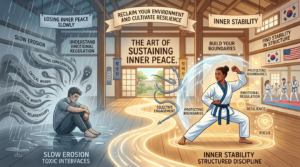
Table of Contents
- What Inner Peace Actually Means (And What It Does Not)
- How Toxic Relationships Quietly Destroy Your Mental Equilibrium
- The Art of Setting Boundaries Without Burning Everything Down
- Choosing Your Battles: The Discipline of Selective Engagement
- Building the Relationships That Actually Restore You
- Why Emotional Resilience Is the Foundation Not the Result of Inner Peace
- Practical Daily Habits That Protect Your Inner Peace
- Conclusion: Peace Is Something You Build, Then Protect
- Frequently Asked Questions
Most people do not lose their peace all at once. They lose it slowly one draining conversation at a time, one relationship they stayed in too long, one argument they never should have entered. By the time they realize what has happened, exhaustion has become their baseline and stress feels normal.
I have spent more than 30 years teaching martial arts to children, teens, and adults. And one of the most consistent things I have observed on the mat and off it is that the people who struggle most with confidence, focus, and emotional regulation are almost always the people surrounded by the wrong relationships. The physical training matters. But the emotional environment a person lives in every single day matters just as much, if not more.
This article is about reclaiming that environment deliberately recognizing what is draining you, making hard decisions about who gets access to your time and energy, and building the kind of inner stability that does not collapse under pressure.
📌 Key Takeaways
- Inner peace is not a passive state it is something you actively build and protect through daily choices about relationships, boundaries, and self-regulation.
- Toxic relationships are not always dramatic or obvious; many are quietly exhausting, leaving you feeling worse about yourself after every interaction.
- Setting boundaries is not selfish it is a prerequisite for sustained emotional health, and it is a skill that can be learned at any age.
- Structured disciplines like martial arts build the emotional resilience, self-awareness, and boundary-setting confidence that make inner peace sustainable long-term.
WHAT INNER PEACE ACTUALLY MEANS (AND WHAT IT DOES NOT)
Inner peace gets talked about in vague, almost mystical terms as though it is a permanent state of serenity that certain enlightened people carry around with them. That framing is not just inaccurate; it is discouraging, because it makes peace feel like something you either have or you do not.
A more useful definition: inner peace is the ability to remain grounded and clear-headed when life around you is difficult. It does not mean you never feel anger, grief, or frustration. It means those feelings move through you without hijacking your decisions or destroying your relationships.
Psychologists sometimes call this emotional regulation the capacity to experience difficult emotions without being controlled by them. And the research is consistent: emotional regulation is not a personality trait you are born with. It is a skill that develops through practice, the right environment, and critically the absence of chronic relational stress.
That last point is the one most people underestimate. You can practice breathing exercises, journaling, and mindfulness every morning. But if you spend the rest of the day in relationships that are manipulative, critical, or emotionally chaotic, those practices will only ever be damage control. Real inner peace requires addressing the source, not just managing the symptoms.
HOW TOXIC RELATIONSHIPS QUIETLY DESTROY YOUR MENTAL EQUILIBRIUM
The word “toxic” gets overused, which has made some people skeptical of it. So let me be specific about what I mean and what I do not mean.
A toxic relationship is not simply one where you disagree, argue occasionally, or go through difficult seasons together. Healthy relationships include conflict. What makes a relationship toxic is a consistent pattern where one person’s behavior systematically undermines the other’s sense of self-worth, safety, or stability and where attempts to address it are met with denial, blame-shifting, or escalation.
The Signs That Are Easy to Miss
The most damaging toxic relationships are rarely the dramatic ones. The obvious ones where someone is visibly cruel or abusive are painful, but they are also easier to identify and name. The subtle ones are harder:
- You consistently feel worse about yourself after spending time with a particular person
- You find yourself editing what you say or how you feel around them to avoid their reaction
- They frequently make you feel responsible for their emotions or problems
- Conversations with them leave you feeling drained rather than energized even when nothing overtly negative was said
- They undermine your decisions, achievements, or relationships with others in small, deniable ways
If several of those feel familiar in connection with a specific person in your life, that is worth paying attention to.
What Chronic Relational Stress Does to Your Brain
This is not just emotional it is neurological. Research published in Psychoneuroendocrinology has consistently shown that chronic interpersonal stress elevates cortisol levels over time. Sustained high cortisol does measurable damage to the hippocampus (memory and learning) and the prefrontal cortex (decision-making, impulse control, emotional regulation) the exact areas of the brain you need functioning well to maintain focus, make good decisions, and regulate your emotions.
In plain terms: staying in chronically stressful relationships does not just make you feel bad. Over time, it impairs your capacity to think clearly and respond to difficulty calmly. This is why removing toxic relationships is not a luxury or a personality preference it is a health decision.
THE ART OF SETTING BOUNDARIES WITHOUT BURNING EVERYTHING DOWN
Boundaries are one of the most misunderstood concepts in personal development. Some people treat them as weapons a way to cut people off and justify it. Others are so uncomfortable with the discomfort of setting them that they never do, and they erode slowly instead.
Neither extreme serves you. Here is what actually works.
What a Boundary Is and What It Is Not
A boundary is not a demand that another person change their behavior. You cannot control what other people do. A boundary is a clear statement of what you will and will not accept, and what you will do if your limit is not respected.
The distinction matters enormously. “You need to stop being so critical” is a demand and it hands all the power to the other person. “I’m not going to continue this conversation when it becomes personal” is a boundary and it puts the power back with you, because it only requires your own action.
How to Set Them Clearly (Without Guilt)
The guilt that comes with setting boundaries is almost universal, and it is almost always misplaced. It usually comes from one of two places: a belief that your needs matter less than other people’s comfort, or a fear that the relationship cannot survive honest limits. Neither of those beliefs is serving you.
Practically, here is how to set a boundary in a way that is firm without being hostile:
1. State it simply and directly. Long explanations invite negotiation. “I need us to talk about this calmly or I’m going to step away” is complete. You do not need to justify it for three paragraphs.
2. Follow through immediately and consistently. A boundary you do not enforce is not a boundary it is a suggestion. The first time you set one and hold it, regardless of how the other person reacts, is the moment it becomes real.
3. Detach from their reaction. Some people will respect your boundary immediately. Others will push back, escalate, or accuse you of being unreasonable. Their reaction is information about them, not evidence that you were wrong.
At Inspire Martial Arts, one of the most powerful things we teach children especially in our anti-bullying curriculum is exactly this skill: how to hold a verbal boundary calmly, confidently, and without aggression. It is remarkable how many adults need to learn it too. If you want to explore how we teach this to children specifically, our article on how to talk to kids about saying no walks through the practical approach we use on the mat.
CHOOSING YOUR BATTLES: THE DISCIPLINE OF SELECTIVE ENGAGEMENT
One of the hardest things to learn and one of the things martial arts training teaches directly is that not every provocation deserves a response.
In martial arts, we teach students that physical defense is always the last resort. The goal is never to fight; the goal is to resolve. Walking away from a situation that does not require your engagement is not weakness it is the most disciplined response available.
The same principle applies to interpersonal conflict. Before engaging in any argument or confrontation, three questions are worth asking honestly:
- Does the outcome of this matter to my life in any meaningful way?
- Is there a realistic chance this conversation leads anywhere constructive?
- Am I engaging because it will help the situation or because I am emotionally reactive right now?
If the answer to all three is “no,” disengagement is not avoidance. It is strategic preservation of your energy for things that actually matter.
This does not mean becoming a pushover or tolerating genuine mistreatment. It means being deliberate about where you invest your emotional energy because that energy is finite, and what you spend on unnecessary conflict is unavailable for the things you actually care about.
BUILDING THE RELATIONSHIPS THAT ACTUALLY RESTORE YOU
Once you begin creating distance from relationships that drain you, something important needs to fill that space not a vacuum, but genuinely nourishing connection.
Research on social wellbeing is consistent on this point: the quality of close relationships is one of the strongest predictors of long-term mental and physical health. The famous Harvard Study of Adult Development, one of the longest-running studies on human happiness ever conducted, found that the single biggest predictor of wellbeing in later life was not wealth, achievement, or even physical health it was the warmth and quality of personal relationships.
This means actively investing in relationships where:
- You feel comfortable being honest without fear of disproportionate reaction
- The support is genuinely mutual not a one-way drain
- You leave interactions feeling energized or settled, not depleted
- Disagreement is possible without the relationship becoming destabilized
These relationships do not usually just happen. They are built through consistent, genuine investment over time showing up, following through, being honest, and extending the same generosity you want to receive.
One reason so many families at Inspire Martial Arts tell us the community matters as much as the training itself is that the martial arts environment naturally creates this kind of relationship. When you are training alongside people who share a commitment to discipline, respect, and personal growth, you are surrounded by people who model the relational qualities that support inner peace rather than undermine it.
WHY EMOTIONAL RESILIENCE IS THE FOUNDATION NOT THE RESULT OF INNER PEACE
Most people think of inner peace as the reward you get after you fix your relationships, manage your stress, and get your life in order. I would argue it works in the opposite direction.
Emotional resilience the capacity to absorb difficulty without being destabilized is what makes peace possible, not what follows from it. And resilience is built through practice, not through waiting for circumstances to improve.
This is the core insight behind everything we do at Inspire Martial Arts. The mat is a controlled environment where students face difficulty, make mistakes, feel frustrated, and have to choose how to respond repeatedly, safely, with guidance. Every belt earned represents not just a physical milestone but a psychological one: evidence to the student that they can face something hard and come through it.
That experience accumulates. A child who has practiced responding to difficulty with composure on the mat, in role-play scenarios, in belt tests carries a different internal foundation into every other challenge they face. And so does an adult.
For parents thinking about how to build this resilience intentionally in their children alongside any external activities, resilience: helping children and teens build coping skills and 100 everyday ways to strengthen your child’s mental health are two of our most practical resources.
PRACTICAL DAILY HABITS THAT PROTECT YOUR INNER PEACE
Beyond the bigger decisions about relationships and boundaries, there are daily practices that make a measurable difference in maintaining emotional equilibrium. These are not revolutionary but consistency with simple things tends to outperform occasional effort with complex ones.
Start mornings with intention, not your phone. The first 20 minutes of your day set the neurological tone for everything that follows. Scrolling through social media or news first thing floods your brain with other people’s urgency before you have established your own footing. Even 10 minutes of quiet whether that is breathing, stretching, or simply sitting with coffee before the noise starts changes the baseline.
Build a physical outlet into your week non-negotiably. The link between physical activity and emotional regulation is one of the most robust findings in behavioral neuroscience. Exercise reduces cortisol, increases BDNF, and releases endorphins all of which directly support the calm, clear-headed state that inner peace requires. This does not need to be intense. Consistent matters more than impressive.
Audit your inputs regularly. The accounts you follow, the news sources you consume, and the group chats you participate in are all relational environments of a kind. Chronic exposure to negativity, outrage, or comparison-driven content has measurable effects on mood and self-perception. Curating your digital environment is boundary-setting too.
Practice the pause before responding. In any emotionally charged situation a difficult email, a provocative comment, a conversation that is starting to escalate the pause between stimulus and response is where your agency lives. Building the habit of taking one breath before reacting is deceptively simple and genuinely powerful. It is also one of the first things we teach students in conflict de-escalation on the mat.
For a comprehensive toolkit of regulation strategies that work particularly well for families, 75 awesome calm-down strategies for kids translates directly to adults too the neuroscience is the same.
CONCLUSION: PEACE IS SOMETHING YOU BUILD, THEN PROTECT
Inner peace is not found. It is constructed through deliberate choices about who you spend your time with, what you allow into your mental space, how you respond to difficulty, and how consistently you invest in your own emotional foundation.
The relationships you maintain are not neutral. They are either contributing to your stability or quietly undermining it. Recognizing that distinction and acting on it is one of the most important decisions you will ever make for your own wellbeing.
At Inspire Martial Arts, everything we teach from boundary-setting and conflict resolution to emotional regulation and resilience is built on this foundation. The physical training is real and it matters. But the deeper goal has always been to develop people who can walk through difficulty without losing themselves.
That is what inner peace looks like in practice. Not the absence of hard things but the presence of the tools to handle them.
Ready to build that foundation for yourself or your child? 👉 Claim your free 2-week trial at Inspire Martial Arts and experience what a supportive, structured environment actually feels like.
FREQUENTLY ASKED QUESTIONS
What is the difference between inner peace and just avoiding problems?
Inner peace is not about avoidance it is about having the emotional capacity to face problems without being destabilized by them. Someone with genuine inner peace can engage with conflict, difficulty, and uncertainty while remaining grounded. Avoidance, by contrast, is reactive it reduces immediate discomfort but tends to make underlying problems worse over time.
How do I know if a relationship is truly toxic or just going through a difficult phase?
The key distinction is pattern versus episode. Every relationship goes through difficult periods that is normal and does not make it toxic. A toxic relationship is characterized by a consistent, repeating pattern of behavior that leaves you feeling worse about yourself, more anxious, or less capable over time. If the dynamic returns to the same harmful place regardless of attempts to address it, that is a pattern worth taking seriously.
Is it selfish to cut people out of my life for my own peace?
Removing yourself from relationships that are genuinely harmful to your wellbeing is not selfish it is a necessary act of self-preservation. Selfishness implies taking something at someone else’s expense. Declining to participate in a relationship that is damaging you does not harm the other person it simply stops harming you. That is a meaningful distinction.
Can children learn to set boundaries and protect their peace?
Absolutely and the earlier they learn, the better equipped they are for life. Children can be taught to identify their emotional responses, use clear verbal boundaries, and disengage from situations that are harmful. These are exactly the skills we build into our curriculum at Inspire Martial Arts, beginning as young as age 5. Our article on how to talk to kids about conflict, dignity, and bullying is a practical starting point for parents.
How does martial arts specifically help with inner peace and emotional regulation?
Martial arts training builds emotional regulation through structured, repeated exposure to challenge in a safe environment. Students learn to manage frustration, practice composure under pressure, hold verbal and physical boundaries, and respond to difficulty with discipline rather than reactivity. These skills transfer directly to everyday emotional life. The structured progression system also builds the kind of genuine confidence that makes a person less reactive to social stress in general.
How long does it take to rebuild inner peace after a toxic relationship?
There is no fixed timeline it depends on the duration and intensity of the relationship, the individual’s existing resilience, and the support available during recovery. What research consistently shows is that the most important factors in recovery are removing the source of chronic stress, rebuilding positive social connection, and reestablishing a sense of personal agency. All three can begin immediately, even if the full restoration of equilibrium takes longer.
What is the single most effective daily habit for maintaining inner peace?
If I had to choose one, based on both the research and what I have observed in 30 years of working with people: the consistent physical outlet. Exercise regulates cortisol, releases endorphins, and provides a daily reset for the nervous system that no other single habit matches. It does not need to be intense it needs to be consistent. Twenty minutes of physical activity most days will do more for your baseline emotional state than almost any other single change.
Master Chris Gehring is the founder and head instructor of Inspire Martial Arts in North Royalton, Ohio. A 7th Degree Black Belt in Taekwondo and Black Belt in Kali with over 30 years of teaching experience, Master Chris specializes in character development, emotional resilience, anti-bullying curriculum, and confidence training for children, teens, and adults.