


This article was last updated on October 01, 2026
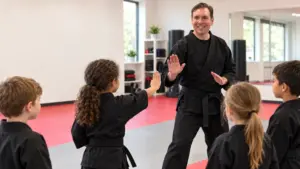
Table of Contents
- Why the Traditional “Stranger Danger” Talk is Outdated
- How Martial Arts Builds Boundary-Setting and Confidence
- Practical Child Safety Tips for North Royalton Parents
- The Local Role of Inspire Martial Arts in Enhancing Child Safety
- Next Steps: Equipping Your Child for the Real World
- Frequently Asked Questions
For North Royalton parents, the goal isn’t a child who fears every unfamiliar face at the park or in the pickup line. It’s a child who can pause, check with a trusted adult and follow a clear plan. The sections below build that plan step by step.
Why the Traditional “Stranger Danger” Talk is Outdated
The old message splits adults into two bins: strangers are dangerous, familiar faces are safe. Real life refuses to cooperate. RAINN reports that child sexual abuse often involves someone the child already knows or trusts, so appearance and familiarity make poor safety tests. A friendly stranger who helps a lost child find a parent poses no threat, while a familiar adult who brushes off a child’s “no” deserves attention. These lessons apply at school pickup, in parks, at youth sports and at community events around North Royalton, and none of it requires treating your town as anything but a normal place to raise kids. Your child will absorb the rules faster when they sit on top of the foundations of respect and boundaries you already teach at home.
What should parents teach instead of stranger danger?
- Check with a parent or guardian first.
- Recognize behavior that feels uncomfortable.
- Use a strong “no.”
- Leave and tell a trusted adult.
Shifting the Focus to “Tricky People” and Safe Adults
A tricky person is any adult, known or unknown, whose behavior makes a child feel unsafe, confused or uncomfortable. The label comes from actions, never appearance: requests for secrecy, offers that skip a parent’s permission, and disregard for personal space.
Teach your child to watch for adults who:
- ask them to keep an uncomfortable secret
- ask them to go somewhere without checking first
- ask for help that another adult should normally give
- ignore personal space or a child’s “no”
- try to get them alone
Trusted adults matter just as much. NCMEC describes a trusted adult through behavior: someone who listens, helps a child feel safe and respects their body and personal space. Sit down with your child and name three to five of them, such as a grandparent, a teacher, a coach or a neighbor. Then say plainly that they will never be in trouble for reporting something that felt strange.
Researchers studying a 10-week martial-arts-based program for secondary-school students found gains in resilience and self-efficacy, the belief that you can handle what comes your way. That study didn’t test stranger safety, so it can’t tell us how children respond to a threat. It does suggest that structured training can build the steadiness that makes speaking up easier. Knowing the rules is half the work. The other half is rehearsal: saying the words out loud, in a calm voice, before a real moment demands them.
How Martial Arts Builds Boundary-Setting and Confidence
Knowing a rule and using it with a pounding heart are two different skills. Practice closes the gap. A structured martial arts class gives children a place to rehearse standing tall, speaking firmly, listening closely and keeping a safe distance from another person. Inspire’s kids program centers on self-protection, respect and discipline, and it teaches children to avoid violence whenever they can. Martial arts remains one tool among several, and no class can guarantee a child will never face danger. Families who want to see how age-appropriate kids martial arts classes approach these skills can start with the program overview.
In a well-run class, children practice:
- posture and eye contact
- projecting their voice
- staying aware of the space around them
- listening and following safety instructions
- staying controlled under pressure
- asking an instructor for help
- physical self-defense, only when it’s truly appropriate
Parent experience isn’t scientific proof, but it shows what families notice at home. One Inspire parent described it this way: “[INSERT QUOTE C VERBATIM]”
Developing Voice Control and Situational Awareness
Give your child one sequence to remember: Stop → Step back → Use a strong voice → Move toward safety → Tell a trusted adult. Five steps are few enough to recall when nerves hit.
A confident voice is firm and loud, not aggressive. Children can practice it at home with simple role-play, such as “Pretend I’m someone at the park asking you to help find my puppy.” Build these habits alongside it:
- Keep an arm’s length of distance from anyone who makes you uneasy.
- Notice exits and nearby adults whenever you enter a new place.
- Never walk toward a vehicle when someone calls from it. Check first.
- Ask loudly for help from other adults.
The American Academy of Pediatrics supports teaching children to say no, move away and seek help. The same skills apply when a child faces bullying, which the guide on empowering kids to speak up covers in depth.
Parents who want their child to practice these communication and awareness skills in a structured setting can explore Inspire’s age-appropriate kids program.
Practical Child Safety Tips for North Royalton Parents
Safety sticks when it becomes routine instead of one frightening talk. Short, calm conversations in the car or at the dinner table beat a single big lecture. The AAP stresses naming trusted adults, practicing a forceful “no” and reassuring children they won’t be in trouble for reporting an uncomfortable approach. Pick two or three items from the checklist below and add more as each becomes habit. Your child should finish every conversation feeling capable, not worried.
- Name three to five trusted adults together.
- Set a “check first” rule. NCMEC teaches children to check with a parent before going anywhere, helping someone, accepting something or getting into a vehicle, even when they know the person.
- Teach that they may say no to any adult who makes them uncomfortable.
- Practice leaving an uncomfortable situation and finding another adult.
- Pick a meeting point at crowded events.
- Explain what to do if you get separated.
- Practice calling 911, and explain it’s for real emergencies only.
- Keep every conversation judgment-free so telling you feels safe.
Picture your family at a crowded school, community or sporting event when your child loses sight of you. They stay calm, walk to a safe adult such as event staff, a store employee or a parent with kids, and ask for help finding you. Nothing in that scenario requires fear, only a plan they’ve practiced.
Creating a “Family Password” for Emergencies
A family password lets your child confirm that an unexpected pickup really came from you. Set it up in six steps:
- Choose a memorable word that strangers couldn’t easily guess.
- Explain that it’s only for unexpected pickup situations.
- Tell your child never to share it casually.
- If an adult they don’t expect says a parent sent them, your child asks for the password.
- If the adult doesn’t know it, your child stays put and contacts a parent or trusted adult.
- Change the password if it ever gets disclosed.
The password supports your school’s authorized pickup list but doesn’t replace it. The AAP recommends that schools release children only to parents, guardians or people designated in advance, so confirm your school’s pickup rules too.
The Local Role of Inspire Martial Arts in Enhancing Child Safety
Inspire Martial Arts runs a dedicated location on Royalton Road in North Royalton, Ohio, with children’s programs organized by age group. That structure matters for safety training because a five-year-old and a ten-year-old need different lessons at different speeds. Instructors can revisit the same skills week after week, and repetition turns a rule into a reflex. Classmates practice alongside each other, which makes speaking up feel normal instead of awkward. If you’re comparing martial arts classes in North Royalton, look for that mix of structure, age-appropriate teaching and a clear emphasis on avoiding conflict. No program guarantees protection from abduction, assault or bullying, and anyone who promises otherwise deserves skepticism.
Parents often notice the first changes at school. One parent credited Master Chris with sharper focus, stronger concentration and better behavior in the classroom: “[INSERT QUOTE A VERBATIM]”
Translating Focus and Discipline to Real-World Safety
Every class asks children to listen, stop on command, respect personal space, manage frustration, answer out loud and make quick decisions in a controlled setting. Those habits carry over. A child who can stop and listen in class is better prepared to stop and think when something outside feels off. They also support the steadiness described in this guide to building resilience in children.
Confidence and self-discipline come up often when parents describe their kids: “[INSERT QUOTE B VERBATIM]”
See whether the class environment fits your child’s confidence, awareness and self-defense development: view the kids martial arts schedule, request information or try a class.
Next Steps: Equipping Your Child for the Real World
Safety is built through repetition, not one frightening conversation. Here is the action plan in order: Talk → Identify trusted adults → Establish boundaries → Practice scenarios → Check first → Build confidence → Repeat regularly. Revisit one step every few weeks, and let your child lead some of the role-play. Research on martial arts supports structure while staying modest about what it proves. A randomized school trial of karate across several countries reported significant gains in academic performance and conduct, yet its overall measure of psychosocial difficulties didn’t differ significantly between groups. Treat karate as support for behavior, focus and physical development, not as proof that it prevents coercion or victimization.
The lesson is simple. Children stay safer when they know what to do, not just what to fear. Teach behaviors and boundaries, name your trusted adults, rehearse out loud and repeat until it all feels ordinary. Martial arts can give that rehearsal a structured home, and parents remain the center of the plan.
Explore Kids Martial Arts Classes in North Royalton and request a trial class at Inspire Martial Arts. Classes serve ages 4–6 and 7–12 in a supportive, age-appropriate setting built around confidence, self-defense and discipline.
Frequently Asked Questions
What age should I start teaching my child about stranger safety?
Many parents begin around preschool age with simple rules, like checking with a grown-up before going anywhere or taking anything. Add detail as your child grows, such as handling online contact or walking to a friend’s house. Keep each talk short and calm.
What should my child do if an adult asks for help finding a lost puppy?
Your child should say no and stay where they are, then tell a parent or trusted adult. Adults rarely need a child’s help, since they can ask other adults. Role-play this exact scenario so the response feels automatic.
What if my child freezes when something feels wrong?
Freezing is a normal reaction, not a failure. Practice at home until the first step, stopping and stepping back, becomes automatic, and rehearse out loud so the words come easier. Praise effort, not perfection.
Should I teach my child to fight back?
Teach running, yelling and getting to a safe adult first. Physical self-defense is a last resort and works best when it’s age-appropriate and taught by qualified instructors. A good class emphasizes avoiding violence whenever possible.
What should I do if my child tells me about an adult who made them uncomfortable?
Stay calm, thank them for telling you and listen without interrupting or blaming. Never punish them for a secret they shared. Then take steps to keep them away from that adult and contact your pediatrician, school or local authorities as needed.
How often should we practice our safety plan?
Aim for a quick review every few weeks rather than one big annual talk. Rotate topics: the check-first rule, the family password, what to do if separated. Short, repeated practice builds the habit better than a long lecture.
What ages does Inspire Martial Arts in North Royalton teach?
Inspire offers children’s classes for ages 4–6 and 7–12. Grouping kids by age lets instructors match lessons on awareness, respect and self-protection to how each child learns.