


This article was last updated on November 17, 2026
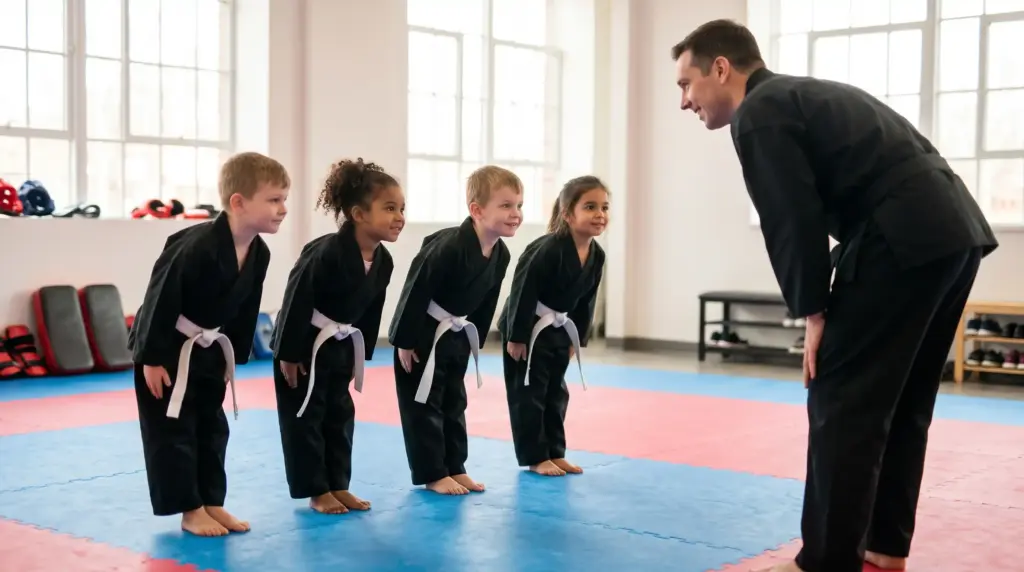
Table of Contents
- Is 3 too young for karate?
- What a preschool karate class looks like
- What 3 and 4 year olds learn in karate
- Karate for 4 year olds: what changes
- What about martial arts for 2 year olds?
- Preschool karate, taekwondo, or jiu-jitsu?
- How to tell if your preschooler is ready
- What to look for in preschool karate classes
- Is karate safe for 3 year olds?
- Starting karate in North Royalton
- Frequently asked questions
If your three-year-old already karate-chops the couch cushions and kicks at every bouncy ball, you’ve probably wondered about karate for 3 year olds. Can a child that young really take a class? Will they sit still? Will they get hurt? The short answer is yes, a three-year-old can start martial arts, as long as the class is designed around preschoolers. A big-kid class with easier moves won’t hold a three-year-old’s attention. Here is what preschool classes look like, what children learn at this age, and how to tell if your child is ready.
Key Takeaways
- Most children can start karate at 3, as long as the class is built for preschoolers, with short drills and lots of games.
- A typical preschool class runs about 30 minutes: bow in, a play warm-up, one new skill, pad practice, a game, a short lesson, and bow out.
- At this age the class format counts for more than the style, so watch a class before you sign up.
- Preschool karate is non-contact. Kicks and punches go into pads held by instructors.
- Inspire Martial Arts in North Royalton teaches children ages 4 to 6 in its Inspired Kids program.
Is 3 too young for karate?
For most children, no. Three is the youngest age most martial arts schools accept, and plenty of preschoolers do well in a class designed around how they think and move.
What makes the difference is the format. A three-year-old can pay attention for a few minutes at a time, then needs to move, laugh, or switch to something new. A good preschool karate class is built in short pieces: a minute of instruction, a few minutes of practice, then a game. Kids this age can’t manage long lines and lectures. The American Academy of Pediatrics gives similar advice for ages 2 to 5: keep instruction short, show rather than explain, include playtime, and skip competition. It also lists martial arts among the activities that work well at a basic level for young children (HealthyChildren.org).
There is also a health reason to start early. The U.S. Physical Activity Guidelines for Americans say preschool-aged children (ages 3 through 5) should be active throughout the day, and that adults should aim for at least three hours a day of active play at light, moderate, or vigorous intensity (Office of Disease Prevention and Health Promotion). A martial arts class twice a week won’t cover all of that, but it adds structured movement that most preschoolers don’t get anywhere else.
What a preschool karate class looks like
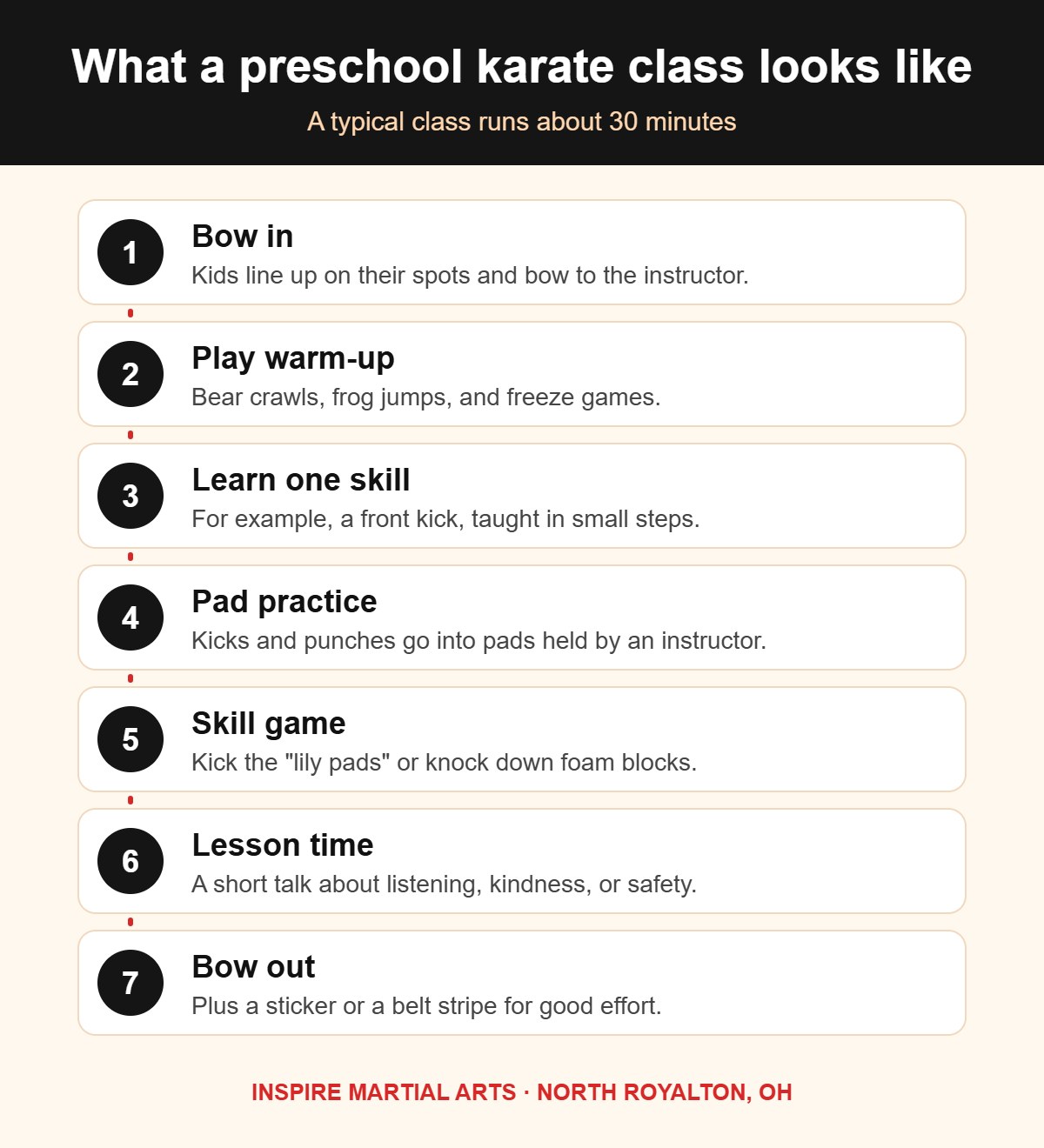
Classes for this age group usually run about 30 minutes. A typical class might go like this:
- The kids line up on their spots, bow to the instructor, and say hello.
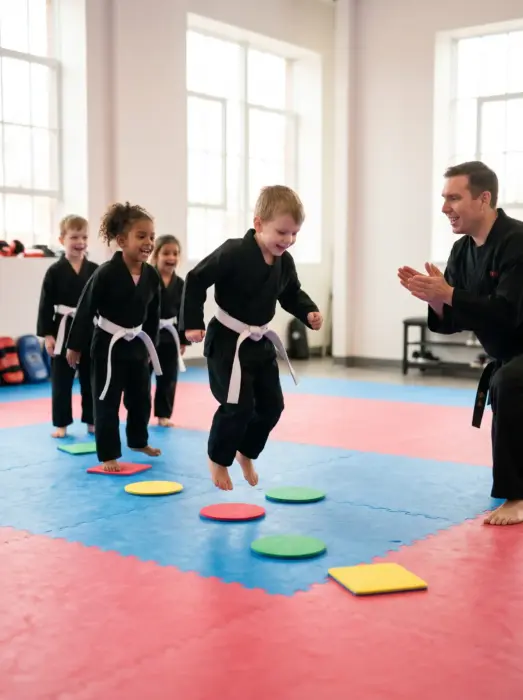
- A warm-up that feels like play: bear crawls, frog jumps, running in a circle, freezing when the instructor claps.
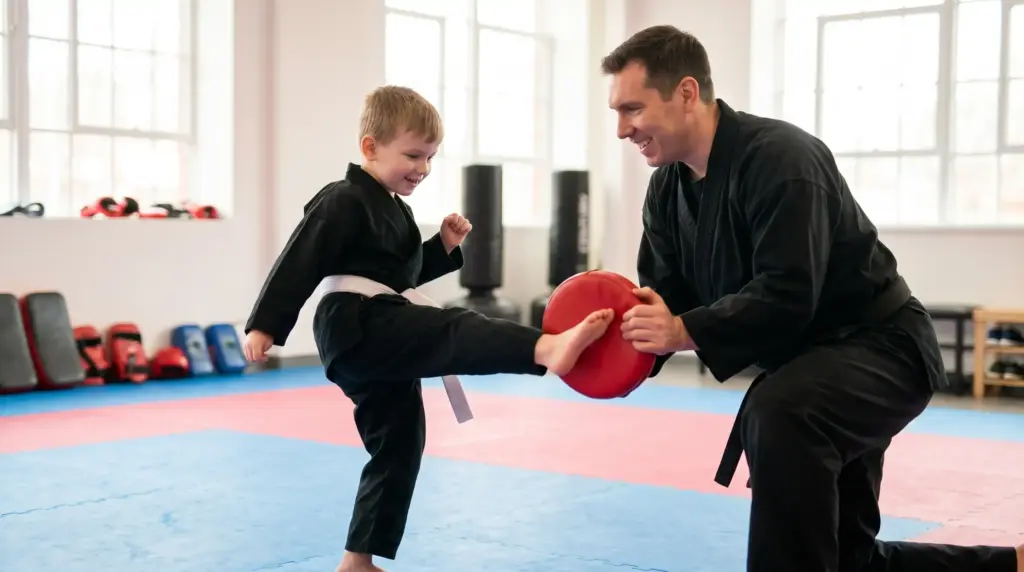
- One new skill, taught in small steps. For example, a front kick: lift the knee, kick, bring the foot back, put it down.
- Practice on a pad held by an instructor, with lots of high fives.
- A game that uses the new skill, such as kicking “lily pads” across the floor or knocking down foam blocks.
- Everyone sits in a line for a short lesson on listening, kindness, or safety.
- Bow out, plus a sticker or a stripe on the belt for good effort.
Notice how much of that is play. At three, children learn karate the same way they learn everything else: by doing it over and over in a way that feels fun.
What 3 and 4 year olds learn in karate
Body control and coordination
Balancing on one foot to chamber a kick, punching with one hand while the other pulls back, jumping and landing with both feet: these are all motor skills preschoolers are still working on. Karate gives them hundreds of repetitions in a single month. Parents often notice better balance and fewer tumbles at home within the first few weeks.
Listening and following directions
“Eyes on me.” “Feet together.” “Wait for your turn.” Preschool karate classes practice these all the time, and in class, listening earns a high five. Following a two-step instruction, like “step forward and punch,” is a real accomplishment at three.
Respect and manners
Bowing when you come onto the mat, saying “yes, sir” or “yes, ma’am,” and shaking hands with a partner are small rituals, but they give young kids a simple structure for politeness. Many parents say this is the part that shows up at home first. We’ve written more about what respect looks like and how to teach it if you want ideas for reinforcing it outside class.
Early safety skills
Three-year-olds aren’t learning to fight. What they learn are simple safety habits: using a loud voice to say “No!” or “Stop!”, staying close to a grown-up in public, and knowing their parents’ names. These lessons are kept short and calm so they never feel scary.
Confidence
Earning a stripe, standing up in front of the class to show a kick, or simply getting through a whole class without mom or dad on the mat are big moments for a preschooler. Small wins like these are how confidence starts, and they build on each other over time. If confidence is your main goal, our article on empowering kids with confidence, support, and strength goes into more depth.
Karate for 4 year olds: what changes
A year makes a big difference. Four-year-olds can usually focus a little longer, remember a short sequence of moves, and handle more structure. In karate classes for 4 year olds, you’ll often see:
- Simple combinations, like punch-punch-kick
- A first short form or pattern
- Partner drills with pads
- More formal belt testing
Many schools group 3 to 5 year olds together and let each child move at their own pace. If you’re looking at martial arts for 4 year olds and your child has never tried a structured class before, starting at four is just as good as starting at three. There’s no catching up to do.
What about martial arts for 2 year olds?
Most schools don’t run karate classes for 2 year olds. Two-year-olds are still learning to separate from their parents, follow group directions, and use the bathroom on their own, and a class that asks for those things tends to frustrate everyone.
If your two-year-old is full of energy, try parent-and-child movement classes, toddler gymnastics, or plenty of playground time. Then come back to karate around their third birthday.
Preschool karate, taekwondo, or jiu-jitsu?
Parents often ask which martial art is best for a preschooler. Honestly, at this age the class format counts for much more than the style. A preschool taekwondo class and a preschool karate class teach a three-year-old very similar things: kicks, punches, balance, listening, and manners. Preschool jiu-jitsu classes focus more on rolling, tumbling, and wrestling-style games, which some kids love and others find too close-contact.
So watch how the class is taught. Are the kids moving and smiling? Do the instructors get down to the children’s eye level? Is there a clear routine? Those answers tell you more about whether your child will enjoy it than the name on the sign.
How to tell if your preschooler is ready
There’s no test, but most children who do well in their first karate class can do most of these:
- Follow a simple one-step direction from an adult who isn’t their parent
- Stay in a group activity for about 30 minutes, with breaks
- Use the bathroom independently, or at least tell an adult they need to go
- Take turns some of the time (not perfectly, they’re three)
- Show interest in kicking, jumping, or “ninja” play
If your child hides behind your legs at first, that’s normal. Many shy preschoolers spend the first class watching and the third class showing off. A trial class is the easiest way to find out.
What to look for in preschool karate classes
Not every program that accepts three-year-olds is really built for them. When you visit a school, look for:
- A separate class for ages 3 to 5, so preschoolers aren’t mixed in with 10-year-olds
- A small group with more than one instructor on the floor, so every child gets attention
- Short drills and frequent games (if kids stand in line for more than a minute, the class is too slow for this age)
- No contact sparring, with kicks and punches aimed at pads only
- A place for parents to watch
- Instructors who praise effort as well as good technique
Ask if you can watch a class before signing up. A good school will say yes.
Is karate safe for 3 year olds?
Yes, when the class is designed for preschoolers. At this age, karate is non-contact: children strike pads and targets held by instructors, and games are chosen to keep kids moving without collisions. The bumps you’ll see are the same ones you’d see at a playground, usually from tripping over their own feet.
Most families find the opposite of what they expected. Kids who learn karate early tend to get better at controlling their bodies, which means fewer accidental kicks and fewer falls at home.
Starting karate in North Royalton
At Inspire Martial Arts in North Royalton, our youngest students train in the Inspired Kids program for ages 4 to 6, where they learn kicks, balance, focus, and respect in classes built around how young children learn. If your child is three, give us a call. We’re happy to talk through when they’ll be ready to start and what they can practice at home until then.
If you’re in North Royalton, Broadview Heights, Strongsville, Brecksville, or Parma, stop by the school at 10139 Royalton Rd, Suite B, North Royalton, OH 44133, or call us at 440-877-9112 to ask about a trial class.
If you want the whole family involved, read about the benefits of taking martial arts with a loved one. Once your child is a bit older, our guides on learning effective goal setting and how to develop mental resilience show how martial arts lessons carry into school and home.
Frequently asked questions
What is a good age to learn karate?
Most children can start karate at 3, as long as the class is designed for preschoolers. Ages 5 to 7 are also popular starting points, because kids at that age can follow longer instructions and remember sequences of moves. There’s no age that’s too late. Teens and adults start all the time.
Is jiu-jitsu good for 3 year olds?
It can be. Preschool jiu-jitsu classes are mostly rolling, tumbling, and simple grappling games, and many kids love them. Children who don’t like close physical contact may feel more comfortable in a karate or taekwondo class, where all the kicks and punches go into pads.
How long are karate classes for 3 year olds?
Usually about 30 minutes. That’s long enough to warm up, learn a skill, and play a game, and short enough to finish before attention runs out. Classes for older kids often run 45 minutes to an hour.
Do 3 year olds earn belts?
Yes. Most preschool programs use belts with stripes, so children get frequent recognition for progress. A three-year-old might earn a stripe every few weeks and test for a new belt every few months. Those regular rewards help keep young kids excited to come back.
What should my child wear to their first karate class?
Comfortable clothes they can move and kick in, like leggings, sweatpants, or athletic shorts and a T-shirt. Karate is done barefoot, so skip anything with zippers or buttons, and leave jewelry at home. Students usually get a uniform once they enroll.
Can parents watch preschool karate classes?
At most schools, yes. Some kids do better when a parent stays where they can see them for the first few classes. Others focus better once mom or dad is out of their line of sight. Your child’s instructor can help you figure out which works for your child.