


This article was last updated on October 14, 2026

Table of Contents
You ask about school and get a shrug. You ask about lunch and get “fine.” Ten minutes later you are giving the same instruction for the third time, and nobody seems to be listening.
Key Takeaways
- Kids give one-word answers after school because they are tired and the question is too broad. A specific, low-pressure question asked at the right moment gets a fuller answer.
- Behavior improves when children have predictable routines, clear expectations, and an adult who listens before correcting.
- Structured activities like martial arts classes give children repeated chances to practice listening, patience, and self-control. They are not a treatment for ADHD, autism, or any other condition.
- Ask one or two questions a night, and treat “I’ll tell you later” as an acceptable answer.
Improving child behavior in North Royalton, Ohio usually starts with how families talk to each other. Punishments come second. A child who clams up is rarely being defiant. More often, that child has spent seven hours following other people’s rules and has nothing left for a dinner-table interview. This article covers why the usual questions fall flat, what to ask instead, and how a local program like Inspire Martial Arts can reinforce the skills you build at home.
Why the standard dinner table questions lead to disconnection
Ask a child “How was school?” at 3:45 p.m. and you are asking them to summarize six hours while hungry and drained. A shrug is an honest answer to that question. Pressure makes it worse, and so do phones buzzing on the counter and evenings split between practice and homework. Some kids do not want to talk. Others want to but have no words yet for what happened, and from the kitchen the two look identical. Many parents meet that silence with a correction, which teaches kids that sharing leads to a lecture.
Try connection before correction. Listen to the whole story, keep your voice level, and save the lesson for later. Calm, consistent responses build the habit of telling you things, and the same logic applies when whining is the daily pushback. These strategies to stop whining at home rest on staying calm and modeling the tone you want your child to use back.
The psychology of open-ended questions for kids
An open-ended question cannot be answered with yes, no, or a single word. “Did you have fun?” is closed. “How was your day?” is technically open but so broad that a tired child has no place to start. The best questions sit in between: specific enough to answer, open enough to need a sentence.
| Common question | More engaging alternative |
|---|---|
| Was school good? | What was something interesting that happened today? |
| Did you behave? | What was one choice you felt proud of today? |
| Did you have fun? | What made you smile today? |
Timing counts as much as wording. Kids talk more in the car, on a walk, or while helping with dinner, because sitting side by side feels less like an interrogation than sitting across a table. Active listening means setting the phone down, repeating back a piece of what you heard, and resisting the urge to fix the problem. Tell your child they can say “I’ll tell you later.” Permission to pass lowers the pressure, and plenty of kids come back an hour later with the whole story.
How meaningful conversations build child focus and concentration
Every conversation is a small workout in attention. To tell you about their day, a child has to recall events in order, decide what is worth mentioning, wait for a turn, and put a feeling into words. A classroom asks for those same skills: listening, remembering instructions, organizing thoughts, and explaining what you need. Asking “What would you do differently?” starts a habit of thinking before acting. Talking at home does not raise grades by itself, and no single habit does. Focus grows from many small, repeated chances to practice it in more than one place.
One parent whose son trains at Inspire Martial Arts described what that repeated practice looked like for their family:
“Master Chris and the entire team are wonderful to work with. They really took the time to get to know our little guy. His concentration and focus have really improved over the last few months and his behavior at school has improved as well. Definetly worth the investment.”
The change took months. You can add to that kind of progress at home with the same ingredients: consistent conversations, and an evening that follows a familiar shape.
Bridging the gap between home routines and school success
A predictable after-school routine gives a child’s brain a place to land. The sequence below suits most elementary-age kids and asks for less than an hour of your attention.
- Arrive and decompress. Offer a snack and water, then give 15 to 20 minutes of quiet or free play before any questions.
- Connect for five minutes. Ask one specific question from the list in the next section and listen to the full answer.
- Set the evening’s expectations. Keep the order the same each night: homework, then play, then one small chore.
- Name the effort you see. “I watched you keep trying on that math sheet” teaches more than “good job.”
If your evenings are packed, a few minutes of reading can help you learn how to talk with your child in a way that fits your schedule.
How can I improve my child’s focus after school? Give a short break first, keep the order of the evening the same each day, and set homework in the same spot at the same time.
Supporting emotional regulation in children through local activities
Emotional regulation is the ability to notice a big feeling and handle it without a meltdown. Children learn it the way they learn anything else, through repetition in places where the rules are clear. Harvard Health Publishing describes executive function as a set of skills that includes working memory, impulse control, and cognitive flexibility. The article lists martial arts among the organized physical activities that may help children build them. Positive reinforcement plays a part too: kids repeat what gets noticed, so catching a child waiting patiently does more than scolding a child who interrupted.
Families in North Royalton looking for an activity outside school can run the same test on any program. Are the expectations clear, and do kids get to repeat a skill until it sticks?
The role of martial arts in reinforcing good behavior
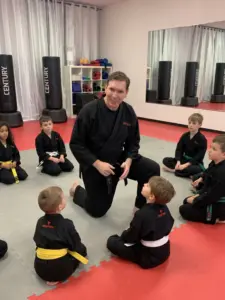
Picture a class learning a front kick. The instructor explains it in one sentence, demonstrates it once, and sends everyone to practice. A child who rushes gets a calm correction. A child who freezes gets encouragement. Everyone waits a turn at the pads. In a single class, a child may listen, wait, try, miss, and try again a dozen times, and that is the whole point of the format.
A martial arts class is not therapy, and no class replaces a pediatrician or a child’s therapist. What a good one offers is a place to practice listening, patience, cooperation, and respect for boundaries. Another parent, whose son has additional learning needs, described the instructors’ approach this way:
“We came to Inspire Martial Arts in search of an activity to help our son build esteem and focus. My son has asd/adhd and this place has been crucial to my son’s development. The staff is very supportive and very well trained to deal with kids that need the extra help.”
One family’s experience cannot predict another’s. It does show what to look for when you visit a school: staff who adjust their teaching to the child in front of them. If you want your child to practice focus, confidence, and respectful teamwork in a structured setting, you can Explore Kids Martial Arts Classes in North Royalton.
Developing cognitive function beyond the mat
A 2019 study hosted on PubMed Central, Effect of Taekwondo Practice on Cognitive Function in Adolescents with Attention Deficit Hyperactivity Disorder, looked at 40 adolescents with ADHD. One group joined an 18-month Taekwondo program and a control group did not. The Taekwondo group improved on measures of selective attention. The sample was small and mostly male, and the study covered one martial art in teenagers, so it cannot speak for every style or every age.
The finding is still easy to picture. Taekwondo means memorizing sequences, following spoken instructions, and tuning out distractions, which are all attention skills. You can borrow the same ideas at home:
- Give your child one small responsibility and let them finish it.
- Ask them to listen to the whole instruction before answering.
- Teach them to say “I’m frustrated” instead of slamming a door.
- Praise persistence when a task takes three tries.
- Help them spot what sets off a bad moment, then talk about it afterward.
Children develop at different rates, and what works for one may not work for a sibling. Helping children express their feelings is slow work, and some kids need more support than a class or a kitchen conversation can give. Martial arts can sit beside individual professional care. It does not take its place.
5 alternative parenting communication strategies to try tonight
These five questions give a child something specific to answer, and each one builds a different skill. Pick one or two per evening. Asking all five at once turns a conversation into a quiz, and kids can tell. Tone carries as much weight as wording, so ask them the way you would ask a friend, with a relaxed voice and no hurry. Your goal is to hear what your child says, and a particular answer is not the target.
- “What was one thing you felt proud of today?” This builds self-awareness and helps your child spot their own effort.
- “Was there a moment today that felt difficult? What happened?” This invites emotional expression without a verdict on behavior.
- “If you could try one part of today again, what would you do differently?” This encourages reflection and age-appropriate problem-solving.
- “Who made your day better, and what did they do?” This opens the door to kindness, friendship, and gratitude.
- “What’s one thing you’d like to try doing by yourself tomorrow?” This sets a small goal and builds responsibility.
Younger children often answer better through play, drawing, or a shared activity than through direct questions. Try asking while you build blocks together, or have your child draw the best part of the day and tell you about the picture. When a child says “I don’t know,” accept it and try again another night. For more ways to start these talks, see these effective ways to talk with your child.
Next steps for your child’s development in Ohio
Start small. Pick one question from the list, hold the same after-school order for a week, and notice what your child does well out loud. Those changes cost nothing and give you a baseline to watch. Behavior shifts slowly, and a few weeks of steady habits tell you more than any single evening.
When you want another setting where your child practices focus, patience, and listening, Inspire Martial Arts in North Royalton is a local option. Before you commit to any school, read these seven questions to ask before choosing a martial arts school. The better ones ask about your child as much as you ask about the program.
Children behave better when they feel heard, know what to expect, and get regular chances to practice self-control. Conversation builds the first, routine builds the second, and a structured activity can supply the third. Parents do not need a perfect system to begin, only one new habit tonight.
Call or visit Inspire Martial Arts in North Royalton and ask about an introductory class for your child: northroyaltonmartialarts.com.
Frequently asked questions
These answers cover situations that come up once you start changing the evening routine.
How can I improve my child’s behavior without constantly correcting them?
Set expectations before a situation starts, such as “We’re leaving the park in five minutes.” Then praise the moments your child gets it right. Corrections land better when most of your comments are positive.
Why does my child only give one-word answers after school?
Most kids are worn out after a full day of following instructions. Wait 20 minutes, offer a snack, and ask something specific instead of “How was your day?” Some children simply process feelings later, often at bedtime.
What activities help kids practice focus and self-control?
Board games teach turn-taking and patience. Building projects, music lessons, and team sports ask kids to follow directions and manage frustration. Any activity with clear rules and regular repetition gives a child room to practice.
Can martial arts help children develop better listening skills?
Classes ask kids to follow short instructions, wait their turn, and respond to feedback, so listening gets practiced every session. Results vary from child to child, and a class works best alongside what you do at home. Visit a class and watch how the instructor handles a distracted student.
How long does it take to see better behavior in a child?
There is no set timeline. Some parents notice small shifts in a few weeks, while others see change over several months. Consistency matters more than speed, so keep the routine steady and track one behavior at a time.
When should parents seek additional support for behavioral concerns?
Talk to your child’s pediatrician if behavior is escalating, lasts for months, or disrupts school, friendships, or family life. A teacher’s repeated concerns are also worth taking seriously. A pediatrician can suggest an evaluation or refer you to a child psychologist.