


This article was last updated on June 29, 2026
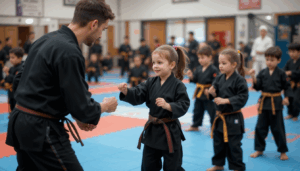
Table of Contents
- What is the Difference Between Empowering and Enabling a Child?
- Why Children Need Structured Environments for Self-Discipline
- Practical Ways to Empower Your Child in Daily Life
- North Royalton Parents Trust Inspire Martial Arts
- Take the Leap at Inspire Martial Arts
- Frequently Asked Questions: Building Kids’ Confidence in North Royalton, OH
There’s a moment most parents know well. You’ve asked your child to start their homework three times, the backpack is still unpacked, and somewhere between stepping in and stepping back, you start to wonder whether all that helping is holding them back. That line between healthy support and over-involvement is harder to walk than it looks and crossing it too often carries real consequences for how your child learns to face the world.
Key Takeaways
- Empowering a child means guiding them through challenges while letting them do the hard work; enabling means removing the challenge entirely, which stunts the development of self-discipline and lasting confidence.
- Research from Harvard University’s Center on the Developing Child shows that executive function and self-regulation are actively built through structured environments not through situations where adults consistently remove obstacles.
- The American Academy of Pediatrics confirms that structured physical programs, including martial arts, significantly improve emotional regulation, reduce childhood anxiety, and build long-term resilience in school-aged children.
- Children who experience productive struggle and learn to push through it develop the independence and confidence that follow them into adolescence and beyond.
What is the Difference Between Empowering and Enabling a Child?
Most parents don’t intend to enable their children. The instinct to help comes from a genuine place love, care, and the natural desire to reduce a child’s pain. The problem is that empowering and enabling produce entirely different outcomes, even when the motivation behind both looks exactly the same on the surface.
When you empower a child, you acknowledge the difficulty they’re facing. You offer guidance, point to a resource, or ask a question that helps them think then you step back and let them work through it. When you enable, you remove the discomfort entirely. You write the first sentence. You remind them five times to bring their lunch. You call the friend who hurt their feelings to sort it out on their behalf. Over time, a child learns one of two things: either that they can handle challenges, or that challenges require an adult to step in and resolve them.
One of the most effective things parents can do is help them learn personal responsibility through small, deliberate choices resisting the urge to intervene the second frustration appears, allowing productive struggle to run its course, and celebrating what the child accomplished rather than what you did for them.
The Hidden Costs of Helicopter Parenting and Over-Enabling
It feels protective in the moment. Stepping in when your child is crying over a math problem, doing their chores because they had a hard day, handling a sibling conflict before it escalates all of these feel like reasonable responses to real stress. The issue is what accumulates quietly beneath the surface over time.
Researchers at Harvard University’s Center on the Developing Child have established that executive function and self-regulation the mental architecture a child needs to plan tasks, sustain focus, and control impulses are not hardwired at birth. These capacities are actively built through consistent, structured environments and routines that allow children to practice managing their attention and behavior without constant parental intervention. When adults consistently remove obstacles, children lose exactly the repetitions they need to develop those internal skills.
The long-term cost goes well beyond unfinished chores and forgotten assignments. Children raised in environments where problems are routinely solved for them often struggle to maintain healthy boundaries in social settings, develop heightened anxiety when support is not immediately available, and carry a quiet ceiling on how much challenge they believe they can handle. None of that is what any parent sets out to create.
Why Children Need Structured Environments for Self-Discipline
Structure is not the same as rigidity. A structured environment gives a child clear expectations, predictable sequences, and a defined space to practice making decisions and managing themselves independently. That predictability is precisely what reduces anxiety in children who feel overwhelmed by shifting rules and unstructured time.
When children know what is expected of them and trust the routine they’re part of they spend far less mental energy managing uncertainty. More of that energy goes toward the actual task in front of them. A home environment where expectations shift depending on how tired the parent is, or where rules bend under enough pressure, keeps a child in a low-level state of stress that makes genuine focus and self-control much harder to access. Learning the tools to handle anger and frustration works best when it’s embedded within a consistent routine a child can rely on not applied as a reactive fix when things have already boiled over.
Building that structure doesn’t have to be dramatic. It starts with small, consistent expectations repeated daily until they become second nature.
How Martial Arts Builds Focus and Better Habits at Home
A martial arts class is, at its core, a highly structured environment with non-negotiable expectations. Students bow in at the start of class, follow a set sequence of activity, listen without interrupting, attempt techniques they may not execute correctly on the first try, and earn advancement through demonstrated behavior not simply through showing up.
That structure doesn’t stay inside the dojo. Parents in North Royalton consistently report that the discipline their children practice on the mat begins appearing at home within the first few weeks of training. One local mother described exactly this shift: “We really struggled with getting our daughter to focus and take responsibility for her chores without us hovering. Since she joined, the change in her attitude is incredible, and Master Chris teaches so much more than just kicks he teaches true focus, so she now does her homework independently without being asked.”
That outcome isn’t a coincidence. When a child practices sustained attention under instruction every week in a structured class, the capacity generalizes beyond the mat. It becomes part of how they operate at the kitchen table, in the classroom, and anywhere else that demands their focus.
Practical Ways to Empower Your Child in Daily Life
Practical change at home starts with parents making deliberate choices about where to step back. Those moments are uncomfortable. Watching a child struggle when you could fix things in thirty seconds works against every parenting instinct but it is exactly where development happens. The goal is not to withhold support entirely; it’s to provide the right kind of support at the right moment, which often means asking a question rather than supplying an answer.
Here are specific steps that shift a parent from enabling to genuinely helping a child grow:
- Let natural consequences land. If your child forgets their water bottle, they’ll be thirsty. That discomfort teaches more than a reminder ever will.
- Ask instead of solving. “What do you think you should try first?” positions you as a thinking partner, not a problem-resolver.
- Build non-negotiable routines. Homework at the same time, in the same place. Backpack packed the night before. When expectations are consistent, children stop testing them and start meeting them.
- Separate your anxiety from their challenge. Many parents intervene not because the child truly needs help but because watching the struggle is uncomfortable. Recognizing that distinction is its own kind of work.
- Praise the process, not just the result. “I noticed you kept going even when it got hard” matters more to a child’s long-term confidence than “You got an A.”
There are proven ways to build a child’s confidence that go well beyond praise and most of them involve allowing a child to experience the full arc of trying, struggling, and succeeding entirely on their own terms.
Allowing Safe Failures to Build Resilience and Independence
Safe failure is an intentional concept it doesn’t mean leaving a child to struggle through situations with serious consequences. Rather, it means designing situations where the results of falling short are proportionate, instructive, and survivable, places where the child can genuinely get back up and try again.
The American Academy of Pediatrics has documented in clinical research that participation in structured, organized physical activities including martial arts significantly improves a school-aged child’s ability to regulate their emotions, reduces symptoms of anxiety, and builds long-term resilience when children are supported to safely face and overcome progressive challenges. The key word there is safely. A well-run program doesn’t throw children into the deep end it raises the bar incrementally, always matched to what each child has demonstrated they can handle. That progressive challenge is the actual engine through which lasting confidence gets built.
Parents who apply this same model at home increasing responsibility gradually as a child earns it, celebrating the attempt rather than only the result, and resisting the pull to intervene before the child has truly tried tend to see the same behavioral outcomes outside the dojo that they first notice inside it.
North Royalton Parents Trust Inspire Martial Arts
North Royalton families face the same day-to-day pressures as parents anywhere academic performance expectations, social conflict, screen time battles, and bedtime meltdowns that leave everyone exhausted by 9 PM. What Inspire Martial Arts offers is a local, consistent structure where those pressures are addressed directly through physical training, clear behavioral expectations, and long-term mentorship from an instructor who takes child development seriously.
Master Chris Gehring, a 7th Degree Black Belt with more than 30 years of experience working with children in the North Royalton area, has built a program specifically designed to reach children where they genuinely struggle not just physically, but emotionally and behaviorally. The results parents describe are specific, measurable, and lasting. One North Royalton family put it this way: “Before starting at Inspire Martial Arts, my son was incredibly anxious and would shut down completely during homework time. Master Chris has been absolutely amazing with him; we’ve seen such a huge shift where he now has the confidence to tackle hard assignments without crying, and his self-control at home is like night and day.”
Changes like that don’t come from a single class or a single conversation. They build over weeks and months of consistent structure, honest feedback, and an instructor who holds children to real standards with genuine care behind every expectation.
Moving from Self-Doubt to Lasting Perseverance
Self-doubt in children rarely announces itself clearly. It looks like giving up early, refusing to attempt things where failure is possible, or shutting down completely when a task is harder than expected. What presents as a bad attitude is frequently a child who simply hasn’t yet discovered that difficulty is survivable and that pushing through it is where real confidence actually lives.
The belt progression in martial arts is a long game by design. Children who stay in the program discover, through accumulated experience rather than a single motivational moment, that consistent effort produces results that feel completely different from easy wins. That lesson doesn’t remain in the dojo it carries directly into schoolwork, friendships, and every area of life where persistence matters. This is precisely how you build lasting perseverance in kids not through inspiration alone, but through the repeated, lived experience of pushing past the point where quitting feels like the easier option.
Take the Leap at Inspire Martial Arts
Reading about confidence is useful. Building it requires doing something about it.
Parents across North Royalton have seen what consistent structure and skilled mentorship do for children who arrive anxious, unfocused, or quick to walk away from anything difficult. One family captured the shift with clarity: “The emotional difference in our boy is unbelievable because before Inspire, he was dealing with a lot of self-doubt and would give up on things easily. Master Chris helped him build real confidence and self-discipline, and he no longer needs me to enable or hover over him to get tasks done.”
That shift from learned helplessness to self-direction is exactly what Inspire Martial Arts is built to create. The work is gradual, intentional, and rooted in a teaching philosophy developed over three decades of understanding how children actually change.
Building kids’ confidence in North Royalton, OH doesn’t happen through motivational posters or one good conversation. It comes from showing up consistently to something that genuinely asks more of a child and from parents who hold the line at home while a trusted instructor holds it in the dojo. The two reinforce each other in ways that accelerate everything.
If your child struggles with focus, self-confidence, or resilience, visit Inspire Martial Arts at 10139 Royalton Rd Suite B, North Royalton, OH 44133, or call 440-877-9112 to schedule a trial class. Master Chris has been doing this for over 30 years. The first step is simply showing up.
Frequently Asked Questions: Building Kids’ Confidence in North Royalton, OH
What age should children start martial arts to build self-confidence?
Most structured martial arts programs accept children as young as 3–4 years old for introductory classes, though the most measurable gains in focus and self-discipline tend to emerge around ages 5–7, when children can fully engage with the instructional environment. At Inspire Martial Arts in North Royalton, curriculum is tailored to different developmental stages, meaning children of varying ages benefit from age-appropriate training. Starting before age 10 is generally ideal because foundational habits around effort, listening, and follow-through are established before competing behavioral patterns become entrenched.
How long does it take to see changes in a child’s behavior after starting martial arts?
Many North Royalton parents report noticing early shifts such as a child completing tasks without prompting or managing frustration without a full meltdown within the first four to eight weeks of consistent attendance. These initial changes tend to be small but compound meaningfully over time. More significant behavioral outcomes, including genuine self-discipline, reduced anxiety, and improved resilience under pressure, are typically well-established after three to six months of regular training.
Is martial arts a good fit for children who deal with anxiety?
Structured martial arts training is particularly well-suited to anxious children because it provides a predictable environment with clear, consistent expectations precisely the conditions that reduce the uncertainty driving anxiety in many kids. As children progress through a structured program and experience success after facing controlled challenges, they gradually reframe their relationship with difficulty itself. Instructors like Master Chris Gehring at Inspire Martial Arts are experienced in meeting anxious children where they are before systematically expanding their comfort zone in a way that feels safe rather than overwhelming.
What is the difference between discipline and punishment in raising a confident child?
Discipline is a long-term teaching process it builds a child’s internal understanding of what behavior is expected, why it matters, and how to meet that standard on their own. Punishment is reactive and focused primarily on consequence rather than learning. Child development research consistently demonstrates that discipline-based approaches, which rely on structure, clear expectations, and natural consequences, produce lasting behavioral change in ways that punishment-focused responses simply cannot replicate. Confident children are typically raised in environments where discipline not punishment is the consistent default.
How can I tell if I’m enabling my child rather than genuinely helping them?
Common signs include regularly completing tasks your child is capable of doing themselves, stepping in before they have genuinely had a chance to attempt something, consistently accepting excuses in place of completed responsibilities, and feeling anxious when your child experiences discomfort even in low-stakes situations. If your child routinely expects you to step in without trying first or becomes dysregulated when you don’t it is worth examining whether the pattern of intervention has become their default expectation rather than a genuine need for support.
Can martial arts help a child who has trouble focusing in school?
Yes, and this is one of the most consistently reported benefits among North Royalton families enrolled at Inspire Martial Arts. A martial arts class structurally requires sustained attention, listening without interruption, following multi-step instructions, and attempting skills that require patient repetition to master all of which directly train the executive function skills that transfer to academic environments. Parents frequently note improved ability to sit with difficult assignments, follow directions without multiple reminders, and manage classroom distractions after their child has trained consistently for several months.
Does Inspire Martial Arts in North Royalton offer a trial class for new students?
Yes. Inspire Martial Arts, located at 10139 Royalton Rd Suite B in North Royalton, OH, welcomes families to schedule a trial class before making any long-term commitment. You can reach the school directly by calling 440-877-9112. Master Chris Gehring and his team work with children across a wide range of ages, ability levels, and behavioral profiles, and welcome students who have never trained before just as readily as those with prior experience.