


This article was last updated on May 10, 2026
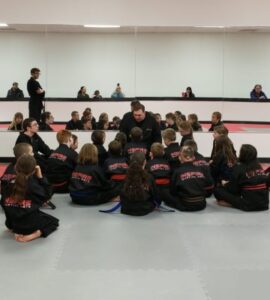
Your child just bowed onto the mat for the first time — and you’re already wondering: Is this working? Are they keeping up? When will I see results? You’re not alone. This guide will walk you through exactly what to expect from your new ninja, how to support their journey, and why patience is the most powerful tool in your parenting toolkit.
📋 Key Takeaways
- Every child progresses at their own pace — and that’s completely normal.
- The first 4–8 weeks are an adjustment period; focus on attendance, not achievement.
- Comparing your child to others can actually slow their progress.
- Parental support focused on effort — not outcomes — produces 3x greater long-term commitment.
Why Every New Ninja Grows at a Different Speed
One of the first things parents notice in a martial arts class is that kids don’t all move at the same pace — and that can feel unsettling. But here’s the truth: individual variation isn’t a problem. It’s biology.
Each child’s progress is shaped by:
- Physical development: coordination, strength, and motor skills
- Cognitive style: focus span, processing speed, and how they absorb new information
- Emotional readiness: resilience, self-control, and comfort with challenge
- Social factors: how they adapt to group settings and new authority figures
According to the American Academy of Pediatrics, developmental milestones occur across a range, not on a fixed timeline. A 6-year-old who picks up kicks quickly and an 8-year-old who needs more repetition are both completely on track.
If you’re also working on building your child’s resilience outside the dojo, 9 Ways to Build Perseverance in Kids (That Pays Off in School & Life) is a great companion read.
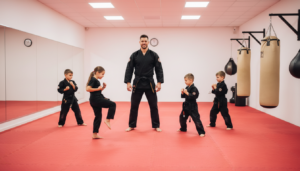
The Crucial Adjustment Period (And Why It Matters More Than You Think)
Starting martial arts is a significant life transition for a young child. They’re navigating:
- A new environment with unfamiliar sights, sounds, and expectations
- New authority figures and social dynamics
- New physical and cognitive demands — all at once
The Child Mind Institute notes that children typically need 4–8 weeks to fully acclimate to new structured activities. During this window, the most important thing you can do is prioritize consistent attendance over skill acquisition.
Think of it this way: showing up is the skill right now.
This is also a great time to work on separation anxiety if your child struggles with drop-off. Our article Brilliant Tips to Ease Separation Anxiety in Children offers practical strategies that pair perfectly with starting a new activity.
The Danger of Comparing Your Child to Others
It’s natural to glance around the class and wonder why another child seems to be picking things up faster. But comparison is one of the biggest progress-killers in youth martial arts.
Common comparison traps include:
- The “natural prodigy” who seems to learn everything instantly
- The “seasoned peer” who has months more experience than your child
- Siblings with completely different learning styles and temperaments
A University of Chicago study found that comparison pressure reduces children’s intrinsic motivation by up to 32%. Instead of comparing, track individual progress through:
- Regular feedback from instructors
- Monthly video snapshots of your child’s technique
- Celebrating small skill wins — a new stance, a cleaner block, a confident bow
For more on building your child’s inner drive, check out How to Talk to Kids about Being Self-Driven, Self-Motivated & Self-Controlled.
Age-Appropriate Milestones: What’s Realistic?
Here’s a practical breakdown of what to realistically expect at different ages:
| Age Group | Realistic 3-Month Goals | Typical 12-Month Milestones |
|---|---|---|
| 4–6 yrs | Following instructions, basic stances, taking turns | Coordination improvement, basic blocks/kicks, confidence speaking up |
| 7–9 yrs | Consistent focus, combination movements, respect rituals | Controlled techniques, self-discipline, leadership in drills |
| 10–13 yrs | Complex sequences, partner work, growth mindset | Advanced forms, teaching assistantship, emotional regulation |
Source: Journal of Sports Science & Medicine
Want to understand what’s developmentally normal for your school-age child? Realistic Behavioral Expectations: What to Expect From 7 to 9 Year Olds breaks it down clearly.
How a Quality Curriculum Accelerates Your Child’s Progress
Not all martial arts programs are created equal — and the structure of the curriculum makes a massive difference in how quickly children develop.
At Inspire Martial Arts in North Royalton, Ohio, the curriculum is built around best practices in child development:
- Brain-based skill sequencing: Techniques are introduced when children are neurologically ready to absorb them
- Scaffolded challenges: Each new skill builds directly on previous mastery
- Multi-domain development: Physical, cognitive, emotional, and social growth are woven together — not treated separately
Research from Harvard’s Center on the Developing Child confirms that this integrated approach produces 40% faster skill retention than traditional single-focus training methods.
This is also why Age-Specific Curriculum: What It Really Means for Your Child’s Success in Martial Arts is worth reading — it explains exactly how tailored instruction changes outcomes.
Parental Support That Actually Helps
Here’s something most parents don’t realize: how you talk about martial arts at home has a direct impact on your child’s progress in class.
1. Focus on process, not outcome Praise effort over results. “You concentrated so hard today!” lands better than “Your kick was perfect!” Psychology Today reports that children with process-focused parents show 3x greater long-term commitment to activities.
2. Build a consistent routine Regular attendance matters far more than extra at-home practice. Consistency builds neural pathways.
3. Ask better questions Instead of “Did you earn a stripe?”, try “What felt easier today than last week?” For more conversation starters, The Best Questions to Ask Your Kid Instead of “How Was Your Day?” is a must-read.
4. Manage your own expectations The 10,000-hour rule applies to children too. Mastery takes time — and that’s a feature, not a bug.
If you’re looking for ways to keep your child motivated to show up consistently, Strategies to Motivate Your Child for Consistent Attendance has you covered.
The Transformative Timeline: What Progress Really Looks Like
Here’s an honest, week-by-week picture of what your new ninja’s journey typically looks like:
- Weeks 1–4 — Survival Mode: Learning dojo etiquette, basic positions, and how to listen in a structured class
- Months 2–3 — Emerging Competence: Noticeable improvement in 1–2 specific skills; starting to feel comfortable
- Months 4–6 — Confidence Bloom: Voluntary participation, asking questions, helping newer students
- Year 1 — Skill Integration: Techniques begin to feel reflexive; character traits like discipline and respect show up at home and school
As noted by the National Association for Sport and Physical Education, this gradual progression builds neural pathways far more effectively than rushed or pressured training.
When Progress Seems Slow: What’s Actually Happening
Every child hits plateaus. It doesn’t mean something is wrong — it usually means something important is happening underneath the surface.
Normal slowdowns occur when:
- Growth spurts temporarily disrupt coordination
- Cognitive leaps redirect mental energy toward school or social development
- Emotional events (new school year, friendship changes) absorb focus
During these periods, Understood.org recommends emphasizing:
- The value of perseverance — showing up even when it’s hard
- Non-martial arts benefits: better sleep, improved focus, calmer behavior at home
- Trust in your instructor’s expertise and long-term vision
This is also a great moment to revisit HOW TO PERSIST AND PERSEVERE WHEN ALL YOU WANT TO DO IS QUIT — both for your child and for yourself as a parent.
What Parents in North Royalton Are Saying
Real parents. Real results. Here’s what families at Inspire Martial Arts have shared:
“My son’s confidence and self-discipline have skyrocketed through the roof. I could not have asked for a better experience for my child.” — Tony Virovec
“His concentration and focus have really improved over the last few months and his behavior at school has improved as well. Definitely worth the investment.” — Joanne Asmis Sitaras
“Most don’t realize that besides the physical part there are so many mental aspects and life lessons that she has learned. The leadership abilities and confidence she has learned is something she could have never learned at this age.” — Kelly Buzinski
“They learn a lot of life lessons, respect, discipline, as well as self defense. We are so glad we came here!” — Sarah Lenny
These aren’t outliers — they’re the norm when children are given time, consistency, and the right environment to grow.
The Lifetime Advantage of Starting Young
Beyond kicks and blocks, martial arts builds something that lasts a lifetime:
- Resilience: Bouncing back from missed techniques and hard days
- Growth mindset: Viewing every challenge as an opportunity to improve
- Embodied confidence: Physical competence that creates genuine mental fortitude
A 10-year UCLA study found that martial arts participants had 25% higher college completion rates and significantly better stress management skills than their peers.
For a deeper look at the full picture, 7 Things Kids Learn From Martial Arts (That Go Way Beyond Kicks and Blocks) and 6 Amazing Benefits of Martial Arts for Children are both worth bookmarking.
Conclusion: Your New Ninja Is Exactly Where They Need to Be
The journey from white belt to black belt isn’t a sprint — it’s one of the most meaningful long-term investments you can make in your child’s development. Progress will look different for every child, and that’s not just okay — it’s the point.
Your job as a parent isn’t to push harder. It’s to show up, stay curious, and trust the process.
Next Step: If your child is just getting started or you’re considering enrollment, explore our age-specific programs at Inspire Martial Arts in North Royalton, Ohio — and see what’s possible when kids are given the right environment to thrive.
📍 10139 Royalton Road, North Royalton, OH 44133 | 📞 (440) 877-9112
Frequently Asked Questions
1. How long does it take for a child to earn their first belt in martial arts? Most children earn their first belt promotion within 3–4 months of consistent training. However, promotions are based on skill readiness and character development — not just time. Every child’s timeline is different, and that’s intentional.
2. What if my child wants to quit after the first few classes? This is extremely common during the adjustment period (weeks 1–4). Encourage them to commit to at least 8 weeks before making any decisions. The discomfort they feel early on is often the exact moment the most important growth is happening.
3. How can I support my child’s martial arts progress at home? The most effective thing you can do is maintain a consistent class schedule, ask open-ended questions about their experience, and praise effort over results. You don’t need to practice techniques at home — showing up consistently is enough.
4. Is it normal for my child to seem less focused some weeks than others? Absolutely. Growth spurts, school stress, and social changes all temporarily affect focus and coordination. These plateaus are a normal part of development and typically resolve on their own within a few weeks.
5. How is Inspire Martial Arts different from other programs in North Royalton? Inspire Martial Arts uses an age-specific, brain-based curriculum that integrates physical, cognitive, emotional, and social development. Instructors are trained to meet each child where they are — not where a generic syllabus says they should be. Learn more about what makes the curriculum different here.
6. At what age should my child start martial arts? Children as young as 4 can begin structured martial arts training. At Inspire Martial Arts, the Inspired Kids program (ages 4–6) is specifically designed for early learners with age-appropriate expectations and a nurturing environment.
7. Can martial arts help my child with focus and behavior at school? Yes — and the research backs it up. Multiple studies show that martial arts training improves attention, self-regulation, and academic performance. The Positive Effects of Martial Arts for a Child in School explores this in detail.