


This article was last updated on January 10, 2026
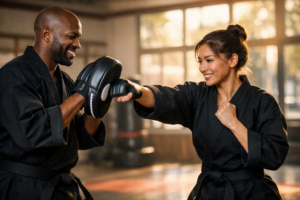
Fitness routines are very difficult to maintain by all because of their comfort zone. They tend to abandon it not due to the ineffectiveness of the training but because life is busy and the momentum is lost. Exercising with a friend, partner, or loved one makes the exercise a common routine that is easier to maintain, more regular, more efficient, and actually fun to do. Whether you practice karate or jiu-jitsu, the benefits are incredible. While we are focusing on couples today, these align with the Top 5 Reasons to Practice Martial Arts that apply to everyone
Major Insights (Overview of the Article)
- It is easier to exercise with a partner since you have a good partner to keep you on track.
- A training partner enhances drilling, timing, and skill enhancement- without which there is no actual progress in martial arts.
- Co-scheduling will decrease friction, which enhances adherence to a routine.
- Exercising together enhances everyday pleasure and encourages a positive attitude, which facilitates the sustainability in the long run.
The reason why training together is particularly effective in martial arts
Martial arts is not merely an exercise but an art that entails footwork, timing, balance, and distance management, coordination, and control during a stressful situation. These skills are developed through practice, and a practice partner can hasten the development.
Partner or couple-based training can be a game changing deal. You automatically acquire when you train with a person you like:
Accountability: you will be not as prone to miss sessions.
More practicing: drills you train when you are not in classes.
Confidence: you do not enter a new environment by yourself.
Some of the goals: belt tests, fitness and defensive preparedness.
This benefit is applicable to any form of martial art: karate, taekwondo, kickboxing, Muay Thai, Brazilian jiu-jitsu, judo, or an actual self-defense course.
Advantage 1: Keep yourself Motivated and Accountable
The most difficult thing about any fitness plan is consistency. A single unattended session may result in a one-week break and such habits tend to be broken. Exercising with a loved one will decrease such a risk since the commitment is shared. In other words, you will find it difficult to bail out when another person is willing to accompany you.
The benefit of getting partner supports
When you are training with a partner or spouse
Reminders without nagging.
Motivation, particularly at the beginning when things seem to be difficult.
Consensus, helping each other to shake off bad weeks.
You also do away with decision fatigue that typically kills consistency. You can reason yourself out of going alone; you can default yourself by going together.
Consistency is the most difficult part of any fitness plan. If you need more strategies beyond partner work, check out these 8 Ways to Start & Keep The Family Exercising Together to ensure no one loses momentum
The way to motivate without coercion
The most successful couples do not make motivation controlling but supportive. Try:
Lets go for the class today?
Certainly, we will do the warm-up and we will see.
We need not have any trouble to-day; we need not even turn up.
Avoid:
Guilt Tripping When one accuses one of being lazy, in an attempt to make it sound like that person is saying no. It is a means of coercing you to do what they desire through the shame.
Scorekeeping This occurs when one keeps count of his/her every favor such as a debt and comments such as I do more than you. It makes a relationship a competition and there is always someone who is losing.
The relationship test of training
- Always Support your partner which is helpful, Don’t
- Minor tasks that hold both parties in line.
- Working out with a loved one turns it into a hobby, rather than an obligation. There are 4 Benefits of Taking Martial Arts With A Loved One, strengthening your bond while you get fit.
Use simple, repeatable goals:
- Two sessions of two weeks.
- One 10 minutes warming up session at home per week.
- Work on one technique instead of training on everything like a clean job, a simple hip escape or guard recovery..
- Stasis wins over intensity. Two months of stability will always work better than two weeks of anarchy.
Advantage 2: Respect Your Free Training Partner
Martial arts do not get better without repetitions even with great coaching. Reps are simpler and more useful when there is a partner as it is an interactive element. On other side practicing alone can be difficult in maintaining Distance, timing, reaction, and control
The love one provides a stable partner to train with:
- Pad holding and Muay Thai kickboxing combinations.
- Train your slips and blocks till they become instinctive, in order that you will, without training, be able to block a blow, and to remain prepared toreact.
- Pay attention to sitting up straight and learning simple escapes to make sure that you are not fixed or trapped.
- Be conscious of the surroundings, engage in minimal motions that maintain distance and enable no one to approach you.
Technique enhancing partner exercises
These are the some beginner exercises that you can be perform safely and daily basis.
Practicing kickboxing, karate, taekwondo
- Jab-Cross: Have the mitts to concentrate on hitting with a perfect punch and light, instead of brute force.
- Low Kicks: The technique of low kicks is the same thing but you just have to practice flicking your pads to make sure that your balance and technique are correct before you begin to swing with full force.
- Flow: It is better to keep the contact light on initially to ensure your body becomes familiar with the correct movement so that you do not become sloppy when you are tired
- Distance exercise: one individual gets in the other gets out (footwork and range).
Grappling (BJJ, judo)
- Hip escape (shrimp) + guard recovery.
- Posture and framing drill.
- Follow your instructor to make sure stands up are controlled.
- Practice with Safety: drills versus sparring.
The difference:
- Drilling also allows you to learn moves without much risk as you can predict what you are going to do.
- Sparring is unpredictable and live hence making it a lot more intense and dangerous.
Novices must pay attention to drilling and instructor led partner activities.
When you fight, make it light-hearted and disciplined and make it an education and not a contest to win.
Quality training partners cushion one another.
Various levels of skills, the way to make it work.
It is still possible to train together successfully even in cases that one of the partners is more experienced, The experience partner is concerned with accuracy and precision. The new partner dwells on basics and trust.
Change positions: striker/holder, bottom/top, attacker/defender.
One more point not to forget: your partner is not your enemy. They will be your long term partner.
Benefit 3: It will be simpler and more reliable to schedule
Fitschedule friction is one of the greatest hurdles to fitness.
Whenever we can train, we tend to end up training, rarely.
It is easier to plan with a loved one or spouse because:
You are already aware of the working hours and the duties of each other.
You have the option of regular lesson. You are able to make changes as well as planning ahead without confusion.
Same-day, same-time advantage
Eliminating daily decisions is one of the secrets of building habits. Make the choice once, then follow the schedule.
Example schedule:
Monday and Wednesday at 6:30 PM.
Saturday morning class.
Optional: 15–20 minutes at home on Sunday.
Basic weekly plans (2 to 4 days a week).
Beginner plan (2 days per week).
Two classes per week (best place to start).
Progress plan (3 days per week).
Two classes and one short home session.
Accelerated plan (4 days per week).
One session of conditioning or technique and three classes.
What in case one of the individuals misses a class
Missing one session should not interrupt the habit.
In case one individual is not able to be in attendance, the other individual can be present.
Conduct a brief catch-up exercise later in the week.
Be optimistic: do not be perfect but be consistent.
Benefit 4: It Is More Fun, and That Enhances Results
Fun is not just an added value, but a performance tool. When you enjoy something you are more inclined to hold onto it. It is there that real progress is achieved: long term consistency.
Martial arts remains interesting in that it involves:
Learning milestones (new techniques, belt tests).
Real feedback (timing improves, technique gets sharper).
Variety (combinations, drills, forms, grappling, conditioning).
Working out with a loved one turns it into a hobby, rather than an obligation.
The benefits you can get in relationships
Couples who do training together:
- Teamwork – Working together helps solving problems For Example “How can we make this combo fight better?
- Confidence – particularly by manipulated partner exercises.
- Stress relief – training is a good after work out.
- Confidence – There are situations where self-defense helps to minimize anxiety and develop tranquility.
- Enhancing – martial arts to a lifestyle.
Making martial arts a lifestyle habit
Keep it easy and enjoyable:
Always Pack your equipment day before.
Create a simple post-class ritual (smoothie, walk, quick dinner).
Celebrate on small target such as (one month consistent, first stripe or belt, first clean combo).
Introduction to training together in the USA
When your target audience is in USA, the most successful factor is the gym or dojo that suits your objectives and the culture of the place is safe.
Choosing the appropriate martial art towards your aim
For fitness plus striking
Kickboxing or Muay Thai (cardio, strength, coordination).
For grappling plus control
Brazilian jiu-jitsu or judo (close-contact control, technique, problem-solving).
For structure and discipline
Karate or taekwondo (basics, forms, progression).
For self-defense focus
Choose programs that emphasize awareness, de-escalation, and controlled technique, rather than fear-based marketing or ego-driven intensity.
Gym/dojo trial class checklist — how to choose a gym or dojo
When you visit, look for:
- An obvious introduction of first-time users.
- Coaches who make corrections in a respectful manner.
- Hygiene regulations (grappling, in particular).
- Monitored sparring culture (in the absence of pressure to prove oneself).
- No experience and open prices.
Safety and boundaries (especially for couples)
Training stays sustainable when safety comes first:
- Warm up properly at the start of every session (mobility and light cardio).
- Wear the right equipment (mouthguard, gloves, shin guards) when needed.
- Agree on intensity ahead of time (light drill vs hard round).
- Tap early in grappling and stop if pain appears.
- Avoid hurting the respect and do not extend the joints beyond their pain.
It is also prudent to seek the opinion of a clinician in the event that either of the partners has medical issues or injuries or has not performed serious exercises in the recent past. Choosing the right dojo is critical for a safe experience. Use these 7 Must-Ask Questions: Choose the Best Karate Classes in North Royalton Ohio as a checklist when touring local schools
Partner training advice to use this week
These exercises support your classes; they do not replace them.
20 minutes at home (no equipment)
5 minutes: exercise (hips, ankles, shoulders).
5 minutes: Legs exercise (forward, back, angles).
5 minutes: combinations shadowboxing (slow and clean).
5 minutes: defense drills (blocks, slips, distance control).
Tip: make a note of 30 seconds and find one of the improvements.
30 minutes (pads or gloves optional)
5 minutes: warm-up.
10 minutes: pad combinations (3 to 5 combinations of punches or kicks).
10 minutes: timing drills (light contact or controlled reaction).
5 minutes: cool down plus notes.
Promoting progress that is encouraging
Draw the comparison to the initial stage of every person
Weekly sessions (consistency).
One technical improvement (quality).
Recovery (sleep, soreness, energy).
Avoid comparing partners. Compare each person to their starting point.
Mistakes couples make (and how to avoid them)
1) Over-coaching each other
Too much correction can create tension. Minimize feedback and let the instructor coach. At home, focus on repetition—not constant critique.
2) Ego and keeping score
Sparring is not a relationship competition; it is practice. If ego shows up, reduce intensity and go back to drills.
3) Training too hard and not resting enough
Martial arts is demanding. Build gradually:
Start at two days per week.
Add volume when joints and energy feel good.
Prioritize sleep and hydration.
Conclusion
Four largest benefits of martial arts as a couple are very basic yet effective; you will remain motivated, you will have someone to train with, it will become easier to schedule and you will enjoy training. All these benefits combine to form the greatest catalyst of actual development consistency.
Next Step
Select a gym, have a trial class with a partner in this week, and make a promise to attend two classes a week over the next two weeks. Then decide whether to add one short home drill session.
FAQs About Top Four Benefits of Working Out With a Loved One in Martial Arts
1) Can martial arts be good between couples?
Yes. Workout experience with their partners tends to be more consistent and easier to enjoy, thus allowing most couples to continue with the training process longer.
2) What do you think are the most effective self-defense classes to take as a couple?
Look for programs that focus on fundamentals, awareness, controlled drills, and a strong safety culture. Enquire on how the beginners get exposed to partner work.
3) Can couples spar together?
Yes, but start with drills first. Should you spar, make it light and regulated and stand in accordance with the rules and safety etiquette of the gym.
4) What in the event of dissimilar talents?
That’s normal. Use roles (holder/striker, top/bottom, drill partner) so both benefit, and keep fundamentals and control first.
5) What are the frequency of martial arts training of couples?
Start with two days per week. Add a short home session if you want faster progress without burnout.
6) Can couples exercise using kickboxing?
Yes. It is possible to enhance cardio fitness and general conditioning through kickboxing provided it is safely and regularly done.
7) Do martial arts classes belong to beginner couples?
Most gyms are open to first-time attendees and couples. An excellent school will have clear coaching, regulated intensity, and a favorable surrounding.