


This article was last updated on December 20, 2025
Table of Contents
- The Modern Parent’s Dilemma
- Is it Appropriate for Families?
- Key Takeaways
- Why Families Choose Martial Arts
- Benefit 1: Family Fitness
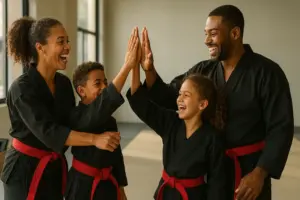
- Benefit 2: Stronger Family Bonds
- Benefit 3: Practical Life Skills
- Benefit 4: Self-Defense & Anti-Bullying
- Benefit 5: Why It’s Fun
- What to Look for in a School
- How to Get Started
- Common Martial Arts Styles in the USA
- Finding Classes in North Royalton, Ohio
- Conclusion
- Frequently Asked Questions
The task of finding constructive activities which keep children engaged while promoting their health has become more difficult than in previous times. Many parents seek a single solution which fulfills multiple needs because their children face the combined demands of schoolwork and the ongoing distraction of tablets and phones and gaming activities. The solution needs to provide enjoyment while maintaining order and physical movement and self-assurance development and practical skill acquisition. Moreover fun, Best Physical Activity, Confidence building classes
That’s where martial arts stands out.
The Modern Parent’s Dilemma: Trading Tablets for Targeted Movement
Family martial arts classes give you a weekly routine that feels exciting (not “forced”), works for different ages, and teaches skills children can use at home and in school. Whether your goal is to reduce screen time, build discipline, improve fitness, or help your child feel more confident, martial arts can be one of the most rewarding family activities you try.
This guide will break down the biggest benefits of martial arts for families, what kids actually learn (beyond kicks and punches), what to look for in a great school, and how to get started whether you’re in Ohio or anywhere in the USA.
READ MORE
Easy Ways to Help Kids Handle Anger and Frustration
Is Martial Arts an Appropriate Activity for Families to Do Together?
Yes. Martial arts is one of the best family activities because it combines structured exercise, confidence-building, and life skills in a supportive environment. Children develop their ability to concentrate and self-control and respectful conduct through physical activities which also boost their coordination and physical health. Parents achieve positive effects through physical activity which reduces their stress levels and creates daily routines that help their entire family maintain consistency.
Key Takeaways: Why Martial Arts is the Ultimate Family Life Hack
- Children find martial arts to be an enjoyable screen-free activity which makes it simpler to establish healthy routines.
- The program functions as a family-friendly solution because it provides structured content that progresses logically and suits different age groups.
- Kids develop useful life abilities through activities which include focus and self-control and respect and perseverance and confidence building.
- Quality programs focus on teaching self-defense through safety awareness and de-escalation techniques and situational awareness.
- The appropriate planning of schedules and objectives leads to positive family outcomes during the initial 30 to 60 days of implementation..
Why Families Choose Martial Arts as a Weekly Activity
Many “family activities” sound good on paper, but fall apart in real life. One kid gets bored. Another kid gets overwhelmed. Parents feel like referees instead of participants. Martial arts tends to work better because the environment is designed to be organized and goal-based.
It works for any age like kids, teens and adult
The system applies to various age groups which include children and teenagers as well as their parents. Most educational institutions keep children and adults apart during training sessions because they provide age-appropriate instruction in separate classrooms.
- building healthy habits together
- working toward milestones (stripes, belts, skills)
- celebrating progress as a family
Furthermore, if you not in the same class, you will be a part of the team
It’s Properly Organized, not chaotic
A strong martial arts program typically includes:
- a warm-up that prepares the body safely
- technique instruction broken into simple steps
- drills that reinforce skills
- cool-down or recap
That structure is one reason kids who struggle with focus often do well in martial arts. They know what to expect and they learn how to follow a process.
READ MORE
Benefit 1 – Make Exercise a Family Habit (Without the “Gym” Feel)
In many households, fitness becomes something parents try to squeeze in when life allows. Children choose screens as their preference because these devices provide immediate entertainment without requiring any effort from them.
How martial arts improves fitness for kids and adults
Martial arts builds what many parents want for their children:
- better coordination and balance
- stronger posture and core stability
- improved mobility and flexibility
- greater stamina
- body awareness and control
Parents benefit too. Even beginner-friendly classes create consistent movement and stress relief without needing a gym routine you might not enjoy.
Why it helps reduce screen time naturally
Instead of “taking screens away,” martial arts gives kids a positive alternative:
- They make friends.
- They learn skills they can show off.
- They feel proud of progress.
- They gain a routine that becomes part of their identity.
That’s why parents often say martial arts is one of the few activities that replaces screen time without constant battles.
READ MORE
25 Things You Can Do Right Now To Build a Child’s Confidence
Benefit 2 – Build Stronger Family Bonds Through Shared Progress
Martial arts doesn’t just fill an hour. It creates connection because everyone is growing and learning at the same time.
Shared goals and routines
Even if your child trains in a kids program while you train separately (or just support them), martial arts creates shared routines like:
- “We go to class on Tuesdays and Thursdays.”
- “We practice 5 minutes before dinner.”
- “We celebrate belt tests together.”
This kind of routine builds family stability. Kids often thrive when they have consistent “anchor points” in the week.
Confidence grows faster with family support
When kids see parents encouraging them or training too they learn a powerful lesson: progress comes from effort. Children develop alternative methods to handle their academic work and physical activities and social obstacles because of this change. The children develop persistence through the process of attempting challenging tasks repeatedly instead of giving up at the first sign of difficulty.
READ MORE
How Inspire Martial Arts Can Help Your Kids Have a Great 2023 School Year!
Benefit 3 – Home and School Practical Life Skills Tips
Practical Life Skills Kids Use at Home and School Parents select martial arts classes for their children because these programs teach essential life skills. The practice of martial arts centers on various core values which include:
- self-control
- courtesy
- integrity
- perseverance
- having an unconquerable, strong, and determined nature that refuses to be defeated or discouraged
Different educational institutions employ various terminology yet they achieve the same goal of teaching students respectful and confident behavior.
Discipline and focus
In a good class, kids practice:
- listening quickly
- following instructions
- controlling their bodies
- staying engaged even when something is challenging
These skills often transfer into:
- better classroom behavior
- improved attention and patience
- more responsibility at home
Emotional control and resilience
Kids don’t just learn techniques. They learn how to handle frustration:
- “I didn’t get successful but I will try my best again in next class.”
- “Mistakes can be helpful to get improve.”
- “I keep myself calm and always finish what I started.”
Children who lose motivation quickly or become worried when facing difficulties will experience a complete transformation through this way of thinking.
The “Relatable & Soft” Approach
Confidence reaches its highest level of health when it exists together with humility:
- respect for instructors
- respect for classmates
- safe and controlled behavior
The goal is not to create “tough kids.” The goal is to create capable, respectful, self-controlled kids.
Benefit 4 – Self-Defense Skills and Anti-Bullying Confidence
Parents often search for martial arts because they want their child to develop safety skills and better handle upcoming challenges. The situation makes sense but self-defense requires an exact definition.
The concept of “self-defense” teaches children essential skills which they learn during.
What is the concept of “self-defense” teaches children essential skills which they learn during
Most reputable programs teach self-defense as:
- awareness and avoidance
- boundary-setting and a strong voice
- getting help from a trusted adult
- physical techniques only as a last resort (age-appropriate)
The best programs don’t teach kids to “fight.” They teach kids to stay safe.
How martial arts helps with bullying
Martial arts can help in several ways:
- improved posture and confidence (kids look less like easy targets)
- stronger social confidence
- better emotional control under pressure
- practice speaking clearly and assertively
If your child is dealing with bullying, it’s also wise to ask a school how they approach:
- de-escalation
- confidence coaching
- safety boundaries
Benefit 5 – It’s Actually Fun (and that matters)
A major reason martial arts works: kids enjoy it.
Unlike some activities where kids feel “forced,” martial arts feels exciting because:
- progress is visible (belts, stripes, skills)
- classes are active and varied
- kids learn cool techniques
- they feel part of a team
Many children who resist “family activities” will happily attend martial arts because it feels like an adventure not a chore.
What to Look for in Family Martial Arts Classes
Not all martial arts schools are the same. Choosing the right program makes a huge difference for safety, confidence, and long-term progress.
1) Safety and class structure
Look for:
- warm-ups that prepare joints and muscles
- controlled drills (not chaotic sparring for beginners)
- clear rules about respect and behavior
- age-based grouping
- instructors who correct technique kindly and clearly
2) A beginner-friendly teaching style
The best schools are welcoming to families who are brand new. You should see:
- step-by-step instruction
- positive encouragement
- patient coaching
- realistic expectations
3) Curriculum and progress milestones
Ask:
- How do students progress?
- What skills do beginners learn first?
- How is improvement measured?
Clear structure helps kids stay motivated.
4) A trial class or intro program
If a school offers a trial class, it’s a big plus. It allows you to see:
- whether your child feels comfortable
- how instructors manage the room
- whether kids are respectful
- how disciplined the environment is
How to Get Started as a Family (Simple Plan)
Starting doesn’t need to be complicated.
Pick a schedule you can maintain
Consistency matters more than intensity. For most families:
- 2 classes per week is a great starting point.
- 3+ classes can be great later, but don’t overload your calendar too early.
Set 30-day goals
Simple goals keep kids motivated. Examples:
- Attend 8 classes.
- Learn the basic stance and 3 beginner techniques.
- Practice 5 minutes at home twice per week.
- Earn the first stripe or milestone (if the program uses them).
Keep home practice short and positive
Kids don’t need long practice sessions. Even:
- 5 minutes
- 2–3 times per week
is enough to build confidence and reinforce skills.
What to bring to your first class
Usually:
- comfortable workout clothes (unless a uniform is provided)
- water bottle
- a positive mindset (mistakes are expected)
USA-Wide Note: Martial Arts Styles Families Commonly Choose
Different families prefer different styles, and the “best” one depends on your goals and what schools are available in your area.
Common options include:
- Karate (often structured and traditional, great for discipline)
- Taekwondo (kicking-focused, popular for kids programs)
- Brazilian Jiu-Jitsu (BJJ) is a grappling-based martial art which helps practitioners build confidence
- Mixed programs (fitness + self-defense tactics + traditional values of martial arts)
The good news: regardless of style, the key factors are quality instruction, safety, and consistency.
If You’re Near North Royalton, Ohio
If your family live close to North Royalton, Ohio, the Best option is to book a trial class where you will understand everything.
You should focus on the following when you visi:
- how instructors manage the class
- how kids behave and follow rules
- whether beginners are supported (not pressured)
- how the school communicates goals and progress
Next step: Click here to schedule a paid trial class, ask about the queries you have in your mind and curriculum and safety approach.
Conclusion: Why Martial Arts Always Works for Kids and Families
Family martial arts classes provide an excellent screen-free option which helps improve fitness while teaching practical life skills. Children develop discipline and focus and build confidence and learn respectful behavior through their physical activities. Physical activity helps parents handle stress while creating daily routines that promote family unity.
You should begin with a trial class and set a practical schedule to maintain consistency during your initial month. The practice of martial arts will develop into your family’s most anticipated weekly activity before you realize it.
FAQs About Family Martial Arts Classes
1) What age can kids start martial arts?
The starting age for these programs varies between 4 and 6 years old because children develop at different rates and schools follow different educational plans. A trial class serves as the most effective method to confirm your readiness for this opportunity.
2) Are kids martial arts classes safe?
However, Martial arts is safe for kids when the school actually treats them like kids. You’re looking for a place that uses drills tailored to their age, keeps a sharp eye on every move, and builds the class around a ‘safety-first’ heartbeat. If the warm-ups are solid and the practice feels controlled rather than chaotic, you’re in the right spot.
3) Will martial arts make my child aggressive?
High-quality programs function as effective tools to reduce aggressive behavior. The program teaches students to develop respect and self-control and discipline and conflict resolution skills for situations when avoidance is not.
4) How often should kids attend martial arts classes?
Most families achieve their best results when they attend two classes each week.
5) Can martial arts help with bullying?
People can enhance their self-assurance and body alignment and personal limits through martial arts training. De-escalation techniques and appropriate circumstances for adult intervention form a standard part of numerous educational.
6) Do parents need to participate too?
Not necessarily. Kids can train alone and still get major benefits. Multiple families choose to spend time training together because they find it to be a valuable bonding experience. “Training together as a shared routine serves.
7) What should we expect in the first month?
The program includes fundamental stances and entry-level techniques and confidence-building exercises and training on respect and listening skills. The main achievement comes from establishing a consistent routine.