


This article was last updated on November 10, 2026
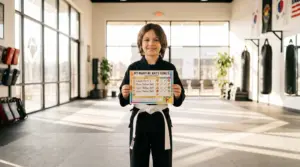
Table of Contents
- What are good new year goals for kids?
- Why do small goals work better than big resolutions for children?
- Which goals fit which age?
- Why does goal setting help your child’s focus and self-control?
- How does martial arts help kids stick to their goals?
- What do parents worry about before starting?
- Where can North Royalton kids start martial arts?
- How do I help my child set their first goal this week?
- Frequently asked questions about kids’ new year goals
Every January it plays out the same way. A child announces a huge plan, the whole family cheers, and by mid-February the chart on the fridge is buried under magnets and school flyers. Nobody lacked willpower. The goal was too big to survive an ordinary Tuesday.
Key Takeaways
- Small goals work better for kids than big resolutions. “Pack the gym bag every night” gets done, while “get straight A’s” fades by February.
- Three small goals fit most families: plan tomorrow each evening, move for 20 minutes a day, and post one family message each week.
- In a nine-month University of California, Irvine study, middle schoolers in a Taekwondo-based PE class improved more in parent-rated behavioral control than classmates in standard PE.
- Inspire Martial Arts at 10139 Royalton Rd in North Royalton runs age-specific kids’ classes, and its belt levels work as built-in goals.
What are good new year goals for kids?
A good new year goal for a child is one small, specific action that the child can repeat daily or weekly and finish without a parent doing it for them. “Put shoes by the door” qualifies. “Be more responsible” does not. The best goals take under 20 minutes and have a clear finish line. Parents set the frame, but the child picks the details, and that ownership keeps a goal alive after the novelty wears off.
Why do small goals work better than big resolutions for children?
Children think in days, not years. “Get straight A’s” gives a nine-year-old nothing to do on Monday, while “finish homework before dinner” does. A small goal also produces a win within a day or two, and a win makes the next attempt easier. When you choose goals that fit their age, a first grader and a sixth grader each get a target they can hit.
Why do small goals work better than big resolutions for children?
Martial arts educator Dave Kovar wrote the original version of these goals for instructors. They adapt easily to families, because the idea underneath is the same: small daily actions beat big yearly promises. Each goal takes 20 minutes or less. None needs special equipment or a perfect schedule.
- Take 10 to 20 minutes each evening to plan tomorrow.
- Give your child 20 active minutes a day.
- Post a weekly “Message of the Day” at home.
Curious what structured movement looks like for a child? You can browse the kids’ martial arts programs at Inspire and check the class schedule.
Goal 1: Take 10 to 20 minutes each evening to plan tomorrow
After dinner, sit with your child and walk through the next day. What is on the schedule, what goes in the backpack, which clothes come out of the drawer? On a dark January evening in North Royalton, that might include finding the uniform before class. A calm preview means fewer surprises in the morning. This short routine also helps your child build a healthy practice habit that carries over to homework and sports.
How do I get my child to actually do it?
Four habits make the routine easier to keep:
- Pick the same time every night, ideally right after dinner.
- Let your child choose the first item to plan.
- Start with a few minutes and add time slowly.
- Ask one question the next morning: “Did the plan work?”
Goal 2: Give your child 20 active minutes a day
Ohio winters make this harder than it sounds. Snow and early dark push kids toward screens, and the backyard is off limits for weeks. A living-room obstacle course counts, and so does a martial arts class. Structured training asks for attention as well as effort. In the UC Irvine study below, students practiced forms, which are sequences of movements performed in a set order, and had to remember each step while executing it with precision.
Goal 3: Post a weekly “Message of the Day” at home
Pick one short theme each Sunday and write it where everyone sees it, such as the fridge or the bathroom mirror. “Try again” and “finish what you start” both work. Add one family event for the week underneath, like a game night or a belt test. Kids see the message every day, and the theme starts showing up in conversation. If you run out of ideas, our list of ways to build perseverance in kids has plenty.
Which goals fit which age?
A goal that suits a ten-year-old can overwhelm a five-year-old. Younger children need a parent doing most of the work, and older children need room to run the routine themselves. Inspire’s kids’ classes split at the same point, with one group for ages 4 to 6 and another for ages 7 to 12. Use the table as a starting point and adjust to your child. If a goal keeps slipping, shrink it before you drop it.
| Ages 4 to 6 | Ages 7 to 9 | Ages 10 to 12 | |
|---|---|---|---|
| Sample goal | Put shoes and backpack by the door every night | Finish homework before dinner | Plan tomorrow alone, then tell a parent |
| Parent role | Does it alongside the child | Reminds once, then steps back | Checks in once a week |
| Check-in | Sticker or checkmark each day | Quick chat after dinner | Sunday review |
For a fuller breakdown from preschool through the teen years, see our guide to helping children set age-appropriate goals. For how stripes and belts work as short- and long-term goals, see goal setting for kids.
Why does goal setting help your child’s focus and self-control?
Researchers call focus and self-control executive function: holding information in mind and controlling impulses. Children build these skills through repetition, and a daily goal is repetition with a purpose. Each time a child picks homework over a game or follows a plan for tomorrow, the skill gets a small workout. Research on structured physical training points the same direction.
What does research say about structured training and executive function?
Researchers at the University of California, Irvine tested this in a public middle school. Over a nine-month school year, one class swapped two of its five weekly PE sessions for Taekwondo while another class kept standard PE. Parents of the Taekwondo students rated their children’s behavioral control much higher by the end, and 87 percent of the Taekwondo students said the classes improved their self-control. Sixty students took part in the evaluation, and you can read the full UC Irvine Taekwondo study. A separate study from the University of Palermo in Italy compared 102 children and found that those who trained in martial arts had stronger executive function and higher school marks than children who played team sports or did no sport. It appeared in the International Journal of Environmental Research and Public Health.
How do small wins build self-discipline in kids?
Self-discipline grows from finishing small things over and over. Each completed goal teaches a child that a promise to yourself can be kept, which builds the habit of keeping promises to themselves. Inspire parents see the result. One wrote:
“The staff does an excellent job of working with my son. My sons confidence and self discipline have sky rocketed through the roof. I could not have asked for a better experience for my child.”
How does martial arts help kids stick to their goals?
Martial arts gives goals a shape. A white belt cannot see a black belt from where they stand, so the path is cut into belt levels and tests a child can reach in weeks. Respect, perseverance, and focus get practiced every class. Kids hear the same expectations from the same instructors week after week, and that consistency turns a January plan into an April habit.
How do belt levels work as built-in goals?
Each belt is a goal with a deadline, a method, and an audience. A child learns a set of techniques, practices them at home, shows them to an instructor, and earns the next belt in front of classmates and family. In the UC Irvine study, students moved from white to orange belt and then from orange to yellow in nine months, and each promotion came with a ceremony and a certificate. Kids who earn one belt tend to want the next. The goal-setting lesson sticks because the child has already lived it.
Will it improve focus and behavior at school?
School is where some parents see it first. One Inspire parent, writing about Master Chris and the team, described the shift this way:
“Master Chris and the entire team are wonderful to work with. They really took the time to get to know our little guy. His concentration and focus have really improved over the last few months and his behavior at school has improved as well. Definetly worth the investment.”
The Palermo research fits that story, since the martial arts students in that study also earned higher school marks than their peers.
Can it build confidence and leadership?
Confidence builds when a child masters something hard in front of other people. A parent of a daughter in the program wrote:
“Couldn’t be happier with the training my daughter has received. She has learned so much! Most don’t realize that besides the physical part there are so many mental aspects and life lessons that she has learned. The leadership abilities and confidence she has learned is something she could have never learned at this age. I am beyond thankful to Master Chris for everything we have and will continue to learn from the program!”
To see how this works in person, book a trial class at Inspire Martial Arts.
What do parents worry about before starting?
Parents usually bring a few worries to the first call, and every one is fair. Safety comes up first. Next comes the child who is shy, easily distracted, or both. Last is the fear of quitting by February. Each gets a direct answer below.
Is martial arts safe for kids?
Classes at Inspire are grouped by age: 4 to 6, 7 to 12, and teens. Traditional training builds up slowly. In the UC Irvine study, students did not spar at all during the nine months, and researchers reported no adverse events over the year. Watch a class before you enroll and ask how the instructors handle each age group.
What if my child is shy or has trouble focusing?
A trial class lets your child see how a class runs before you commit to anything. The parent quoted earlier said the team “took the time to get to know our little guy,” which is the kind of attention a nervous or distractible beginner needs. Tell the instructor what you have noticed at home on day one.
What if my child wants to quit in February?
Expect it, because motivation drops once the novelty fades. Stay calm, ask what changed, and set a finish line: “We finish this belt, then we decide.” Skipping class after one bad day teaches the wrong lesson. For more ideas on how to keep them motivated to show up, our attendance post goes deeper.
Where can North Royalton kids start martial arts?
Inspire Martial Arts is at 10139 Royalton Rd, Suite B, North Royalton, OH 44133, and the phone number is 440-877-9112. Master Chris Gehring runs the school. It sits within a short drive of Strongsville, Brecksville, and Broadview Heights. You can find it on Google Maps through the school’s Google Business Profile.
What class fits my child’s age?
Inspired Kids runs two groups, ages 4 to 6 and ages 7 to 12. Teens have their own program, and adults train there too. Choose by age first, then let a trial class tell you whether the pace fits your child.
How do I help my child set their first goal this week?
Do not start with all three goals. Choose one, whichever feels easiest, and run it for two weeks before adding another. Then follow these steps:
- Let your child pick the goal from the three above.
- Write it in one sentence on paper.
- Post it where the family sees it every day.
- Check in every Sunday and celebrate what worked.
How do I book a trial class at Inspire Martial Arts?
Use the trial and class schedule form on the Inspire website, or call 440-877-9112. Tell them your child’s age and what you hope to see change, and they will point you to the right group.
Big resolutions fade because nobody can live up to them on an ordinary Tuesday. Small goals survive because a child can finish them in minutes and feel the win. Add a class with belt levels and an instructor who knows your child, and the habit has somewhere to grow. Pick one goal this week and let it run.
Book your child’s trial class at Inspire Martial Arts in North Royalton today.
FAQ section
Frequently asked questions about kids’ new year goals
These answers cover questions that come up after the first week, once the goal is posted and real life starts.
How many goals should my child set at once?
One is enough to start. Two or three work for older kids who already have a routine. More than that, and none of them gets enough attention to become a habit.
What age can kids start setting goals?
Most children can start around ages 4 or 5 with a parent doing the heavy lifting. A five-year-old can follow “shoes by the door” if you do it together. By age 9 or 10, many kids can write and track their own.
What are good goals for a child?
Pick one from each area of life: finish homework before dinner, move for 20 minutes a day, say thank you to one person every day. Keep each one specific enough that your child can tell whether it got done.
How do I know if a goal is too big?
If your child has missed it three days in a row, it is too big. Cut it in half and try again. “Read for 20 minutes” becomes “read for 10.”
Is it okay if my child misses a goal?
Yes. Ask what got in the way, shrink the goal if needed, and start again the next day. A missed day teaches more when you treat it as information.
Should I reward my child for hitting a goal?
A small celebration works well: a family walk, a favorite dinner, or extra time on a game they like. Praise the effort you saw, such as sticking with it after a hard day. Save bigger rewards for milestones like a new belt.