


This article was last updated on October 05, 2026
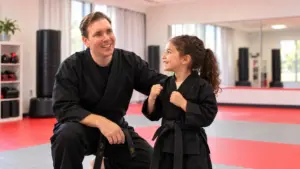
Table of Contents
- Why Kids Experience Anticipatory Fear and Anxiety
- How Structured Physical Training May Help Reduce Tension and Anger
- The Role of Instructors in Building Childhood Confidence
- Supporting Neurodivergent Kids as They Learn to Persevere
- Frequently Asked Questions
Your child hangs back at the edge of the room while the other kids jump in. Birthday parties, new classes, even raising a hand at school can feel like standing at the top of a high dive. You can see the capable kid underneath the worry, and you want to help them find a way forward.
Key Takeaways
- Structured martial arts may help some anxious or shy children build confidence by offering a predictable routine, achievable challenges, and steady instructor feedback. Outcomes vary from child to child.
- The research is encouraging but early. One small pilot study found lower tension and anger scores in children who trained in Taekwondo, and a 2025 review links youth martial arts to psychosocial benefits alongside real injury risks.
- Instructor quality matters more than the martial art itself. Look for patient teaching, gradual progression, clear safety rules, and open communication with parents.
- Martial arts supports development but does not replace professional care. If worry disrupts school, sleep, or friendships, talk with a qualified professional.
Yes, martial arts may help many anxious or shy children. A well-run class gives kids a predictable routine, small challenges they can actually meet, and an instructor who notices effort, which can build confidence over time. At Inspire Martial Arts in North Royalton, that is the goal. Martial arts is not a substitute for professional anxiety treatment, though.
This guide covers why kids worry, what the research actually shows, what good instruction looks like, and how to judge a program before you sign up.
Why Kids Experience Anticipatory Fear and Anxiety
Much of a child’s worry points forward. They fret about getting the answer wrong, being corrected in front of friends, or walking into a room full of strangers. Adults call this anticipatory worry, and it often shows up as stalling, stomachaches before activities, clinging, or flat refusal to try. The American Academy of Child and Adolescent Psychiatry (AACAP) lists excessive worry about future events, fear of mistakes, embarrassment, and social avoidance among the common signs of anxiety in children. Here is the encouraging part. Worry about the unknown tends to shrink once the unknown becomes familiar, and repetition in a safe setting is one way to make that happen.
What is anticipatory anxiety in children?
Anticipatory anxiety in children is persistent worry about a future event, such as a test, a new class, or meeting new people, before anything has actually happened. It often shows up as stalling, stomachaches, or avoidance, and it tends to ease when the child feels prepared and the situation feels familiar.
Small, specific targets help a worried child here, which is why we wrote about learning effective goal setting and how kids build it one step at a time.
How Structured Physical Training May Help Reduce Tension and Anger
So what does the research say? Some of it is promising, and it is worth being precise about how far it goes. A small pilot study led by Yang and colleagues followed 24 children overall, with only eight in the Taekwondo group. In that small group, tension-anxiety and anger-hostility mood scores dropped while vigor rose. That is a hopeful signal, not proof. A 2025 clinical review of youth martial arts points in a similar direction on psychosocial benefits, while also stressing injury prevention and proper supervision. The fair reading is that structured training may help some kids, and that the quality of supervision matters.
How structured martial arts may support emotional regulation
- Predictable routine. Kids know what comes next, which leaves less room for “what if” thinking.
- Physical movement. Active drills give restless energy and tension somewhere useful to go.
- Achievable challenges. Each skill is small enough to attempt and big enough to feel earned.
- Instructor feedback. Specific, calm coaching shows a child exactly what to adjust.
- Repeated recovery after mistakes. Kids practice missing, resetting, and trying again in a low-stakes setting.
Good programs pair all of this with close supervision, age-appropriate drills, and gradual progression, because a class that rushes a nervous child can backfire.
The Role of Instructors in Building Childhood Confidence
The style on the door matters less than the adult at the front of the room. Confidence builds when a child attempts something hard, gets specific feedback, makes a mistake without a penalty, and then watches the next try go a little better. Belt progression makes that growth visible. Being known by name matters too, because a child who feels noticed is more willing to try again. At Inspire, Master Instructor Chris Gehring leads a kids curriculum built around confidence, discipline, character, focus, and respect.
One local parent, Joanne Asmis Sitaras, shared her family’s experience in a Facebook recommendation: “[INSERT QUOTE A VERBATIM].” That is one family’s reported experience, not a guarantee that every child will change in the same way.
Notice → Adjust → Reinforce
- Notice hesitation, freezing, or frustration early.
- Adjust the pacing, the instruction, or the size of the task.
- Reinforce effort and progress, not just the result.
The same approach carries into peer situations. Kids practice standing tall, speaking clearly, and saying no respectfully instead of just hearing about it, a theme we explore in empowering kids to overcome challenges. If you want to see how this looks in practice, explore our kids martial arts classes in North Royalton.
Supporting Neurodivergent Kids as They Learn to Persevere
Martial arts is not a treatment for autism or ADHD, but a clear, patient class structure can suit many neurodivergent kids well. Clear expectations, a predictable routine, visual demonstration, adjusted pacing, and positive feedback all reduce guesswork, and repetition gives skills time to settle. Open communication between parent and instructor matters just as much. Tell the instructor what helps your child, and ask how they adapt a class when a child feels overwhelmed. Families exploring martial arts for autistic children will find more detail in our dedicated guide.
Yhesly Anaya, in a Google review that mentions ASD and ADHD, wrote: “[INSERT QUOTE B VERBATIM].” Treat that as one family’s story. Every child is different, and fit depends on the individual child and the instructor.
Supporting Neurodivergent Kids as They Learn to Persevere
Inspire Martial Arts teaches at 10139 Royalton Rd, Suite B, in North Royalton, with kids programs split by age: Inspired Kids for ages 4–6 and Inspired Kids for ages 7–12. Parents come for the confidence and focus side of training and stay for life skills like respect and self-control. You can meet Master Instructor Chris Gehring and see the program at our North Royalton martial arts school. Whatever school you visit, weigh the full picture. The 2025 youth martial arts review documents psychosocial benefits and injury risks together, and that balance is the honest way to judge any program. Ask direct questions, and watch a class if you can.
What should parents look for in a kids martial arts school?
- Patient, encouraging instructor interaction
- An age-appropriate class structure
- Gradual progression from basic skills
- Clear safety policies
- Supportive, specific feedback
- Open communication with parents
- A low-pressure trial option
Ready to see a class in person? View the trial and class schedule and choose the age group that fits your child.
The Long-Term Benefits of Starting Martial Arts Early
The lasting value of martial arts lives in skills that travel: persistence, following routines, tolerating mistakes, working toward goals, self-control, asking for help, and bouncing back from setbacks. Kids who practice these in class get repeated chances to use them at school, on teams, and at home. No program can promise lifelong outcomes, but early practice gives those habits more time to settle. Some families make it a shared activity, and the key benefits of physical activity add up when parents train alongside their kids.
What age should kids start martial arts?
There is no single ideal age. Readiness matters more than the birthday: can your child follow simple directions, take turns, and stay engaged with a coach for a short stretch? Inspire’s kids programs begin at ages 4–6, with a separate group for ages 7–12, and martial arts classes for younger kids offer an age-appropriate starting point.
Taking the First Step Toward Mental Resilience
Resilience is not the absence of worry. It is the ability to recover from a setback, stay with frustration, and try again after a mistake. A child can feel nervous and still walk onto the mat, and that is the skill. A supportive program gives kids repeated chances to try, struggle safely, receive feedback, recover, and try again. To go deeper on this idea, read how kids develop mental resilience over time.
Anxious kids need low-pressure practice at being brave. Structured martial arts can offer that through routine, small wins, and instructors who notice effort, though results vary and it never replaces professional care when worry takes over daily life. The best way to know whether a program fits your child is to see it in person. Watch a class, ask questions, and let your child set the pace.
Explore the right age group and view the North Royalton trial and class schedule for Inspire Martial Arts at 10139 Royalton Rd, Suite B, or call 440-877-9112 to talk with the instructors about your child.
Frequently Asked Questions
Will martial arts make my child more aggressive?
Well-run programs teach the opposite. Kids practice self-control, respect for training partners, and knowing when to walk away, all within a structured setting with clear rules. If aggression is a concern, ask the instructor how they handle conflict and contact before you enroll.
Is martial arts safe for kids?
Any physical activity carries some injury risk. That risk drops with close supervision, age-appropriate drills, gradual progression, and clear contact rules. Ask about class supervision, how new students are introduced to partner work, and what happens when a child feels uncomfortable.
Does my child have to spar?
Sparring policies vary by school and by age group. Ask any school you are considering how and when contact is introduced and whether it is optional for beginners. Inspire’s instructors can walk you through their approach during a trial visit.
How long does it take to see more confidence?
There is no guaranteed timeline. Some children warm up within a few classes, while others need longer, and consistent attendance with a low-pressure start tends to help. Watch for small signs first, such as less hesitation at drop-off or more willingness to try a hard skill.
What if my child is too shy to join in on the first day?
That is common, and a good instructor expects it. Arrive a few minutes early, let your child watch, and talk through what class will look like beforehand. Tell the instructor about your child’s worries so they can adjust the pace.
Is martial arts a replacement for therapy for childhood anxiety?
No. Martial arts can be a supportive activity, but it does not replace professional care. If anxiety significantly interferes with school, sleep, friendships, or everyday activities, AACAP recommends seeking an evaluation from a qualified professional.