


This article was last updated on September 28, 2026
Your child comes home quiet, drops the backpack by the door, and tells you school was “fine.” You know better, but you can’t fix what nobody will describe. Bullying lives in the gap between what kids feel and what they say out loud.
Key Takeaways
- Bullying is repeated, unwanted aggressive behavior in which one child holds more power than another. A single unkind comment or an argument between equals usually isn’t bullying.
- Children shouldn’t fight back physically. The safest response is a calm, firm voice, walking away, and telling a trusted adult, with physical self-defense saved for immediate danger.
- Structured martial arts can build focus, confidence, and self-control that support what parents and schools already do, but it never replaces them.
- North Royalton families can find age-specific children’s classes at Inspire Martial Arts, with programs for ages 4–6, ages 7–12, and teens.
Recognizing the Signs: What Parents Need to Know About Childhood Bullying
According to StopBullying.gov, bullying is unwanted aggressive behavior between kids that involves a power imbalance and happens repeatedly, or is likely to. That definition matters because plenty of playground friction doesn’t qualify. Two friends who argue over a game are in conflict, while one child who targets another again and again is bullying. Getting clear on the difference early helps, and understanding what bullying looks like keeps you calm enough to respond well. It usually takes one of four forms:
- Physical: hitting, shoving, tripping, or taking belongings.
- Verbal: name-calling, mocking, or threats.
- Social: exclusion, rumors, or turning friends against someone.
- Cyberbullying: hurtful messages, posts, or group-chat pile-ons.
Way 1: Learn the difference between bullying and conflict. A joke between friends who laugh together is play; the same words aimed at a child who flinches are something else.
Common Behavioral Changes at Home or School
The most common signs of bullying are avoiding school, pulling away from friends or favorite activities, sudden mood or sleep changes, unexplained injuries or missing belongings, and slipping grades. None of these proves bullying on its own, since other stressors cause them too, but a change that lasts more than a couple of weeks deserves a gentle conversation.
Way 2: Watch for behavioral changes. The shifts can run in the other direction as well. Joanne Asmis Sitaras, an Inspire parent, saw her son’s concentration and focus improve over a few months, and she says “his behavior at school has improved as well.” Her story is one family’s experience rather than proof of cause, but it shows how closely school behavior tracks how a child feels about himself.
How Anti-Bullying Martial Arts Classes in North Royalton, Ohio Help Children Stand Up
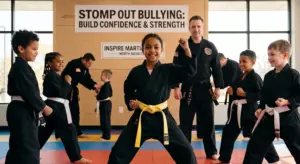
Good children’s martial arts doesn’t teach kids to fight. It teaches them to notice trouble early, speak clearly, stay calm, and use physical skills only when walking away isn’t possible. That’s a different skill set from what most parents picture, and it’s the one that helps. Inspire Martial Arts builds its kids martial arts program around respect, self-discipline, and conflict avoidance, with physical techniques treated as a last resort. Inspire groups classes by age, so a five-year-old and an eleven-year-old each get instruction that fits. Master Chris Gehring, a 7th-degree black belt, leads the school in North Royalton.
Building Focus and Concentration Through Structured Training
Structured martial arts trains attention because every class asks a child to listen, remember a sequence, repeat it, take correction, and try again. A 2023 functional near-infrared spectroscopy study of school-aged children found higher attention in the martial arts group than in free-play and rest groups, along with differences in N-back working-memory performance and brain activity. One study can’t promise results for every child. Still, the finding matches the mechanism parents see on the mat. Focus also underpins building resilient children, because a child who can stay with a hard task learns that frustration passes.
Developing Unshakable Confidence and Self-Discipline
Confidence built on praise alone cracks under pressure, while confidence built on earned progress holds. Belt by belt, kids practice a skill, get corrected, and earn the next step, which teaches them to stay calm when something feels hard. Tony Virovec credits the Inspire staff for his son’s confidence and self-discipline, which he says have “sky rocketed.” At home, strategies to empower your child work best alongside that kind of training.
Parents often worry that martial arts will make a child more aggressive. In a well-run program, the opposite tends to happen, because the training centers on respect, self-control, and de-escalation. Inspire’s children’s program treats physical skills as a last resort, and that philosophy is exactly what you should ask any school about.
The Science Behind Martial Arts for Bullying Prevention
Research on martial arts looks promising but young, and saying so makes the evidence more useful. No study shows that martial arts alone stops bullying. What the studies do suggest is that the training builds skills that keep children steadier under social pressure. Think of it as one strong beam in a larger structure that also includes you, your child’s school, and other trusted adults.
- Attention and working memory practiced under structure
- Self-regulation built through repetition
- Goal-setting and mastery
- Resilience and self-efficacy
- A supportive peer environment
- Calm responses rehearsed under pressure
Martial arts can be one part of a child’s support system. It shouldn’t replace parents, trusted adults, schools, or professional help when bullying is serious.
Why Clinical Studies Support Martial Arts Alongside Traditional Methods
A randomized controlled trial with 283 secondary-school students tested a 10-week martial-arts-based psychosocial program. Students in the intervention group improved on measures of resilience and self-efficacy, while the control group declined. The authors described the approach as potentially effective and strengths-based, not as proof that it beats conventional anti-bullying work. Keep the evidence types separate: one trial on resilience, one imaging study on attention, parent experiences like the ones above, and Inspire’s own curriculum goals. Each says something different, and none is a guarantee.
Actionable Strategies to Help Your Child Stand Up to Bullies
Twenty ways sounds like a lot, but most take a few minutes and fit into ordinary family life. Some help you spot trouble, some build resilience, some cover the moment itself, and a few come from structured training. If bullying is already happening, listen calmly, tell your child it isn’t their fault, and bring in the school. Ways 1 and 2 appear above, so here are the other eighteen.
Recognize
- Ask specific, non-leading questions, such as “Who sat with you at lunch?”
- Check in regularly with teachers and school staff.
- Notice changes in phone, gaming, and social media habits.
Build resilience
- Give age-appropriate responsibilities.
- Celebrate effort, not only results.
- Practice emotional regulation together, with slow breathing and naming feelings.
- Encourage healthy activities where your child can succeed.
- Help your child build supportive friendships.
Respond safely
- Use a calm, firm voice.
- Set verbal boundaries.
- Walk away when possible.
- Move toward trusted adults or friendly peers.
- Avoid physical escalation.
- Report repeated incidents to the school.
- Document patterns with dates and details.
Prepare through structured training
- Role-play tough moments at home.
- Build confidence through progressive martial arts training.
- Teach age-appropriate self-protection, and when not to use it.
For a full parent action plan, the ultimate anti-bullying guide covers the steps in more depth.
Empowering Your Child with Verbal Boundaries
The best verbal boundary is short, calm, and hard to argue with. StopBullying.gov advises kids not to fight back physically and to get help from a trusted adult, so the goal here is safety, not confrontation. Teach statements like these:
- “Stop. I don’t like that.”
- “Don’t touch me.”
- “I’m leaving now.”
- “I’m going to tell an adult.”
Liz Rusnak Seggie visited about four other schools before choosing Inspire for her daughter Lila, who has trained there for over two years. She recommends it “for confidence, focus, and achieving anti-bullying tactics.” Practice the phrases at the dinner table, and use how to talk to kids about tough situations to keep the conversation open afterward.
Role-Playing Scenarios for School
Run each scene twice, once with you playing the other child and once with roles reversed. Every script shows the same four moves: confident posture, clear words, leaving, and getting help.
Scenario 1: Name-calling in the hallway
- Parent (as the other child): “Nice shoes, loser.”
- Child (standing tall, eyes up): “Stop. I don’t like that.”
- Parent: keeps going.
- Child: “I’m leaving now.” (walks toward a group of classmates) “I’m going to tell my teacher.”
Scenario 2: A blocked exit
- Parent (as the other child): stands in the doorway. “You’re not going anywhere.”
- Child (steps back to make space, steady voice): “Move, please. I need to go.”
- Parent: doesn’t move.
- Child: “I’m getting a teacher.” (turns toward the hallway and the nearest adult)
Next Steps: Equipping Your Child with Lifelong Resilience
If your child would benefit from a structured place to build focus, discipline, and self-defense skills, Inspire Martial Arts in North Royalton is worth a visit. Instructors guide each class, and the peer environment is supportive. Choosing the right school matters as much as choosing to start, so read the 7 must-ask questions when choosing karate classes before you visit anywhere. Look for experienced instructors, age-appropriate teaching, close supervision, an emphasis on self-control, and a philosophy that treats physical confrontation as a last resort. You’ll find hours and directions on the North Royalton location page, at 10139 Royalton Rd, Suite B, North Royalton, OH 44133.
Bullying rarely ends with one clever comeback or one brave decision. It eases when a child has calm words, steady confidence, and adults who take the problem seriously. Martial arts can strengthen the first two, and you supply the third. Start with what you can do tonight: ask one open question, and listen to the answer.
Ready to see it in person? Request an introductory class for your child at Inspire Martial Arts in North Royalton by calling 440-877-9112, or visit the kids martial arts program page to compare class options by age.
Frequently Asked Questions
What age can my child start martial arts in North Royalton?
Inspire Martial Arts offers children’s classes beginning at ages 4–6, with separate groups for ages 7–12 and teens. Grouping by age keeps expectations realistic for short attention spans and different skill levels. If your child is right on the edge between groups, ask the instructors which fits better.
Is martial arts safe for shy or inexperienced kids?
Beginner classes assume no experience, and good instructors coach each child at their own pace. Shy kids often settle in because the expectations are clear and progress comes in small, visible steps. Watch a class first and notice how instructors correct children, since that tells you a lot about the culture.
How long before I notice a change in my child’s confidence?
Some parents report changes in focus or confidence within a month or two, while others see them more gradually. Every child moves at a different speed, and regular attendance plus practice at home makes a difference. Judge progress by small signs, like your child speaking up more at dinner or shrugging off a bad day faster.
What should I do if my child’s verbal boundaries don’t stop the bullying?
Bring in adults right away. Write down dates, names, and what happened, then ask for a meeting with the teacher or school counselor and follow up in writing. Your child’s words are a first step, not the whole plan, and repeated bullying needs the school involved.
How can I help if the bullying is happening online?
Save screenshots before anything gets deleted, then block the accounts and report them on the platform. If classmates are involved, share the evidence with the school. Avoid taking away your child’s device as a first reaction, because kids who fear losing their phone often stop telling you what’s happening.
Does my child need to be athletic to start martial arts?
No. Beginner classes teach basic movement, balance, and listening skills from scratch, so your child doesn’t need prior sports experience. Many parents choose martial arts precisely because their child hasn’t clicked with team sports.
Can teenagers start martial arts as beginners?
Yes. Inspire runs a separate teen program, and parents of teens who joined recently describe a quick lift in confidence. Starting later doesn’t put a teen behind, since new students begin at the same level.