


This article was last updated on March 17, 2026
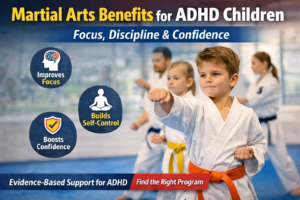
Table of Contents
- Key Takeaways
- Why Parents Look for Sports That Help Children With ADHD
- What the Evidence Says About Martial Arts for ADHD Children
- Why Martial Arts Can Be a Strong Fit for Some Kids With ADHD
- Key Benefits of Martial Arts for Children With ADHD
- Martial Arts vs Team Sports for ADHD: Which Is Better?
- How to Choose the Right Martial Arts Program for an ADHD Child
- How Parents Can Help a Child Succeed in Martial Arts
- When Martial Arts May Not Be Enough on Its Own
- Final Thoughts: Is Martial Arts Good for Kids With ADHD?
- FAQs About Martial Arts for ADHD Children
If your child is suffering from ADHD, you may be searching for a program that is more than just creating energy. You’re looking for something to help with focusing, self-control, as well as confidence and behavior in daily life. Martial arts stands out as it integrates movement, structure, routine, as well as personal guidance in a way that children can easily respond to.
Key Takeaways
Martial arts could help children suffering from ADHD improve their focus, self-discipline, confidence, as well as emotional control.
Physical activity that is structured appears to help in managing ADHD symptoms, but martial arts shouldn’t be viewed as a treatment or substitute for medical treatment.
The individualization of coaching, repetition, and clear expectations are what make martial arts beneficial for children who struggle with less structured sports.
The correct instructor, classroom environment, and parental support are just as important as the actual activity itself.
Why Parents Look for Sports That Help Children With ADHD
Children suffering from ADHD frequently have issues with impulsivity, attention, frustration tolerance, emotional control, as well as following directions. These difficulties can be seen at home, at school, as well as during interactions with other children. This is the reason why parents seek out sports that help both physical and mental development.
Movement is crucial. According to the CDC, healthy lifestyles like exercise can help children suffering from ADHD cope with stress and daily problems, in addition to prescribed treatment (CDC).
But not every activity supports attention in the same manner.
For a lot of children, playing without structure is enjoyable but isn’t always calming. Children can become overstimulated instead of being more controlled. This is why structured classes are better. Martial arts classes typically include:
- clear rules
- repeated drills
- predictable routines
- direct feedback from instructors
- step-by-step skill progression
The combination could be particularly useful for a child who requires boundaries and a sense of consistency.
This is the reason why subjects like how Martial Arts Helps Children with ADD and ADHD and the positive impact on Martial Arts for a Child at school are a natural fit in this discussion. Parents aren’t just looking for an activity after school. They want something that will positively impact behaviour throughout life.
What the Evidence Says About Martial Arts for ADHD Children
The strongest evidence currently suggests the idea of physical activity as a beneficial component of ADHD assistance. A systematic review and meta-analysis revealed that regular, moderate-to-vigorous physical activity helps improve ADHD-related outcomes for children and teens. A second meta-analysis revealed that physical activity-related interventions can assist with symptoms of inattention (PMC).
Martial arts are a possible method of that disciplined movement.
Some martial-arts-specific research is encouraging. For instance, one study on taekwondo found enhanced selective attention in teenagers who suffer from ADHD. (PMC) However, it is not the case that all studies provide similar results. A study of judo in 2022 discovered that the benefits of judo were not clearly demonstrated for children suffering from ADHD in that trial, showing that outcomes depend on the child, the type of program, and the study’s methodology.
So, the most precise conclusion is: Martial arts could be a great alternative for children suffering from ADHD; however, it must be thought of as a promising, well-structured sport, and not a general “best” solution (PMC).
Why Martial Arts Can Be a Strong Fit for Some Kids With ADHD
Martial arts are often a good choice for children who suffer from ADHD because it’s highly organized without being boring. It offers children physical exercise while encouraging them to stop, listen, observe, and react with control.
Repetition and Routine
A lot of children with ADHD have a better experience in environments that have consistent expectations. Martial arts classes typically follow a predictable pattern: warming up, instruction, drills, exercises, and then review. The routine can help reduce anxiety and aid in settling children more quickly.
One-on-one instructor feedback
Within many martial arts environments, instructors instruct students immediately and often. This can be more convenient for a child suffering from ADHD as opposed to trying to follow large group directions in a loud atmosphere.
Controlling impulses and self-control
Martial arts isn’t just about punching and kicking. The best programs teach the right time to move or stop, how to stay present while listening, and how to remain composed under stress. These are essential self-regulation abilities.
Emotional regulation and confidence
In martial arts, progress can be seen. Children can earn belts, stripes, admiration, and mastery through constant effort. This can be a powerful thing for children who are used to getting corrected more frequently instead of being encouraged.
You may like to read more in details please read 25 Things You Can Do Right Now to Help Build Confidence in a Child, How to Talk to Children About Their Feelings, Stress and Calming Down, and Resilience: Helping Teens and Children Develop Coping Skills.
Key Benefits of Martial Arts for Children With ADHD
Focus and better listening
A rigorous martial arts program requires the child to pay close attention, listen, and follow instructions. Over time, this constant exercise can help improve sustained focus and follow-through on tasks.
Better behavior and self-control
Self-control is the goal of martial arts rather than chaos. Children learn that success is a result of listening, practice, and observing boundaries.
Greater confidence and resilience
Children suffering from ADHD might be frustrated by school or social difficulties. Martial arts can provide them with an opportunity to achieve success through effort and perseverance.
Social development with no overwhelming pressure on the team
Some children are more successful in environments where they can participate in a group without having to navigate the complexities of team-based competition. Martial arts can provide an atmosphere of belonging while allowing individual growth.
A healthy outlet for energy
A lot of children suffering from ADHD require physical activity. Martial arts provides them with an opportunity to release that energy in a controlled and disciplined way.
This is one of the key reasons many parents choose martial arts, as it offers both physical and mental benefits that support a child’s overall development and 6 Amazing Benefits of Martial Arts for Children
Martial Arts vs Team Sports for ADHD: Which Is Better?
There isn’t a single solution for every child. Certain children who suffer from ADHD thrive in sports such as soccer or basketball. Others do better in a controlled environment.
Martial arts might be a better choice for children who:
- Find it difficult to follow many moving parts at the same time
- Are easily distracted in busy, noisy environments
- Benefit from direct adult supervision
- Need a stronger routine and clear expectations for behavior
- Respond well to progress and short-term goals
Team sports can still be an option when children enjoy peer interaction, can adapt to fast-paced games, and receive enough guidance from coaches who understand attention differences.
Instead of asking “Which sport is best for ADHD?” it is generally better to ask, “Which environment helps my child stay engaged, regulated, and successful?”
Understanding what your child will experience in class and how training is structured by age can make a big difference, especially when aligning expectations with their development stage.
How to Choose the Right Martial Arts Program for an ADHD Child
There are many martial arts schools, but not all are equally supportive. The right training program can make a huge difference.
Find instructors who:
- Provide clear, calm, and easy instructions
- Manage behaviour positively
- Keep classes organized
- Understand child development
- Welcome parent communication
Be sure to ask these questions prior to signing up:
- How do you assist children who have difficulty with attention or impulse control?
- What is the size of your classes?
- Do you divide classes based on age or ability?
- How do you deal with redirection and discipline?
- Is it possible for my child to try a class prior to enrolling?
Red flags to stay clear of
- Classes that are chaotic or overly loud
- Unclear behavior expectations
- Instructors who rely heavily on intimidation or shame
- Classes that have too little supervision
- Programs that promise unrealistic results
What will happen in North Royalton read these specific article 7 Questions You Should Ask to Find the Best Karate Classes in North Royalton, Ohio, and Not All Ninjas Are the Same.
How Parents Can Help a Child Succeed in Martial Arts
A class on its own is not the only solution. Parental participation is important.
Make realistic assumptions
Do not expect immediate transformation. Growth usually comes from repetition, routine, and consistent involvement over time.
Make attendance a routine
Children usually benefit from consistency rather than intensity. A regular schedule helps it become part of their routine instead of an occasional event.
Praise effort, not only performance
Encourage listening, trying again, showing respect, and finishing the class strong. These wins are important.
Work with instructors
Inform the instructor about what helps your child concentrate. Discuss goals and ask for feedback. Small collaboration can lead to better results.
Building consistency is just as important as skill development, which is why many parents focus on practical approaches like motivating children to attend classes regularly, developing strong practice habits at home, and understanding how to be a supportive and effective karate parent throughout the journey.
When Martial Arts May Not Be Enough on Its Own
Martial arts may provide beneficial support; however, it is not meant to replace medical or psychological care when needed. CDC guidelines make it clear that healthy lifestyles can help, but they are meant to be used alongside ADHD treatments, not as a substitute.
Parents should look into broader support when a child is experiencing:
- Difficult academic challenges
- Intense emotional outbursts
- Safety concerns
- Sleep problems
- Anxiety, depression, or other significant social issues
In such situations, a pediatrician, mental health specialist, school support team, or ADHD specialist may need to be involved.
In some cases, children may need additional support beyond physical activities, especially when behavioral challenges or emotional regulation difficulties are present. Exploring topics such as oppositional defiant behavior, building behavior from within, and strengthening a child’s mental health through daily habits can provide parents with a more complete support system.
Final Thoughts: Is Martial Arts Good for Kids With ADHD?
For many kids, martial arts can be a positive experience. It combines physical activity with discipline, structure, motivation, and personal growth. This combination makes it particularly appealing to children who require more than just an outlet to burn off energy.
The most important thing is to keep expectations realistic. Martial arts is not a cure for ADHD. However, with the right program and proper support, it can become an important part of developing confidence, focus, self-control, and resilience.
It’s simple—visit a local class, observe how they teach, and see how the instructor interacts with children. The best programs don’t just teach techniques; they build life skills.
FAQs About Martial Arts for ADHD Children
Do martial arts work for children suffering from ADHD?
Yes, they can. Martial arts provide structured movement, direct instruction, and opportunities to improve confidence and self-control.
What is the best martial art for ADHD?
There is no single best option. The instructor and class structure matter more than the style itself.
Can martial arts replace ADHD medication?
No. Martial arts can support focus and behavior but should not replace medical treatment unless advised by a professional.
Are group classes suitable for ADHD children?
Yes. Many children benefit from structured group classes, especially when led by experienced instructors.
How long does it take to see benefits?
Some children show improvements within a few weeks, while long-term benefits require consistent practice over time.
What age should a child with ADHD start martial arts?
Most programs begin around ages 4–6, but readiness depends on the child’s maturity and attention span.
What should parents look for in a martial arts school?
Look for structure, positive discipline, experienced instructors, and strong communication with parents.